
Bayshore Safety & Industrial Supplies Guide
What is a twin-leg SRL-P, and what is a replacement leg? 100 percent tie-off with a personal SRL, as FallTech describes it
An SRL-P is the personal self-retracting lifeline of ANSI/ASSP Z359.14-2021: a small device that mounts on the harness dorsal D-ring and travels with the worker, 6 to 11 ft long. A twin-leg SRL-P is two of those drums on one dorsal connector, so the worker can keep one leg connected while moving the other to the next anchor, 100 percent tie-off, the same job a Y-lanyard does with two fixed legs. FallTech’s manual states the rule for the leg not in use: it clips to the harness lanyard keeper, never to the harness or the other leg. A replacement leg is one of those drums sold on its own: FallTech’s FT-X models with SpeedLink let the user disconnect a damaged retractable leg and fit a new one without sending the device in, which is what FallTech means by “field-repairable” on an SRL-P. Both legs carry the class on the label, Class 1 for anchorage at or above the D-ring, Class 2 for anchorage up to 5 ft below it with a leading-edge-tested lifeline, and the 2021 standard added tests for twin-leg devices specifically.
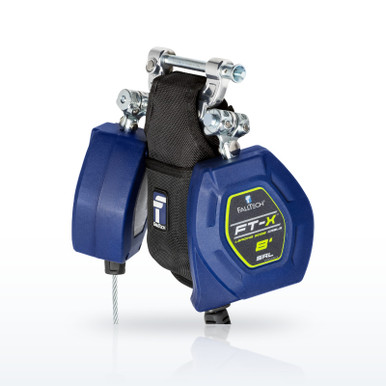 FallTech 82808TP0 SRLs, 8 ft FT-X Cable Leading Edge, Twin-legTwin-leg Class 2 SRL-P on an aluminum dorsal slide connector, for 100 percent tie-off at a leading edge (FallTech data)
Why a twin-leg device exists. A worker with one connector has to unhook to move past an obstruction or to the next anchor, and for that moment there is no fall protection. Two legs remove the moment: the second leg goes on before the first comes off. The old answer was a twin-leg energy-absorbing lanyard; the SRL-P version adds what any SRL adds, a line that stays short and taut as the worker moves, so free fall and the clearance it needs are smaller. The cost is weight on the back, which FallTech names as the reason a Class 2 twin-leg, with its larger cable, is heavier than a Class 1 web twin-leg, and the reason the 2021 standard added a test for how twin-leg energy absorbers deploy when the forces on two legs could exceed 1,800 lb.
The terms, as the standard and the manufacturer use them
From Z359.14-2021 as FallTech summarizes it and from the FT-X manual.
What FallTech states about personal SRLs beside lanyards and anchor-mounted SRLs
From the SRL-P comparison and the product pages:
- A personal SRL is dorsally mounted and moves with the worker; it is typically shorter, which limits swing fall, and twin-leg versions are available where 100 percent tie-off is needed.
- A standard SRL connects to a fixed point with a line as long as 100 ft; it covers a larger area and carries more swing-fall potential.
- Because weight is kept low in an SRL-P, FallTech states it can wear faster than an anchor-mounted SRL.
- Its personal SRLs page lists 6 ft single and twin-leg and 9 ft lengths with steel cable, Dyneema web or Kevlar lifelines; the FT-X lines run 8 and 11 ft.
- The device’s own label and clearance chart govern the clearance; the Maximum Arrest Distance field on each FallTech SRL page carries the figure (42 in on the 2021-class devices).
Twin-leg SRL-Ps FallTech lists, by class and lifeline
| Line | Class | Lifeline | Length | Anchor-end connector options |
|---|---|---|---|---|
| DuraTech Mini twin | Class 1 | Dyneema web | 6 ft | snap hook, rebar hook, carabiner |
| Arc Flash DuraTech Mini twin | Class 1 | Kevlar web | 6 ft | dielectric and steel hooks |
| FT-X Web twin | Class 1 | Dyneema web | 8 ft and 11 ft | snap hook, rebar hook, carabiner |
| FT-X Cable twin | Class 2, leading edge | galvanized steel cable | 8 ft | snap hook, rebar hook, carabiner |
| CTX Cable twin | Class 2, leading edge | galvanized steel cable | 8 ft | snap hook, rebar hook |
| FT-X EdgeCore twin | Class 2, leading edge | EdgeCore aramid web | 6 ft and 8 ft | snap hook, rebar hook, carabiner |
| FT-X EdgeCore Arc Flash twin | Class 2, leading edge | EdgeCore arc flash web | 8 ft | dielectric and steel hooks |
The band below shows the parts we carry; the anchor-end hook is in the part number suffix.
Source: The SRL Class, Lifeline Material, Length and Anchor Connector fields on the FallTech SRL product pages on this site.
Questions people ask
What is a twin-leg SRL?
A personal self-retracting lifeline with two retractable legs on one dorsal connector, so one leg stays connected while the other moves to the next anchor: 100 percent tie-off. ANSI/ASSP Z359.14-2021 calls the device an SRL-P; FallTech lists twin-leg SRL-Ps in Class 1 (web) and Class 2 (cable or EdgeCore web).
Why use a double lanyard with a full body harness?
For 100 percent tie-off: with two legs the worker connects the second before unhooking the first, so there is no moment without fall protection while moving between anchors or past an obstruction. A twin-leg SRL-P does the same job with two retractable legs that stay short and taut, which FallTech states gives lower free fall and clearance than a fixed-length Y-lanyard.
At what height is 100 percent tie-off mandatory?
OSHA does not use the phrase. The duty is continuous protection wherever the trigger applies, 6 feet in construction and 4 feet in general industry, so a worker who unhooks to move at height is unprotected for that moment; twin-leg devices are how crews meet the duty while moving. Steel erection names the heights for connectors (15 to 30 feet) and requires them to be provided with fall protection even where they may choose not to tie off.
What is the difference between a twin-leg SRL-P and a Y-lanyard?
Both give two legs for 100 percent tie-off. The Y-lanyard’s legs are fixed length with an energy absorber; the SRL-P’s legs pay out and retract so the line stays short, and the device locks on a fall. FallTech states the SRL-P gives similar mobility to a lanyard with shorter deceleration distance and lower force on the body.
Where does the unused leg go?
To the harness lanyard keeper, per the FallTech manual; never to the harness D-rings or to the other leg.
What is SpeedLink?
FallTech’s connector on some FT-X SRL-Ps that lets the user disconnect a retractable leg and fit a replacement leg on site, which FallTech describes as the field-repairable feature of those models.
Can a twin-leg SRL-P be anchored at foot level?
Only a Class 2 device is rated for anchorage below the dorsal D-ring, up to 5 ft below, and its lifeline is tested for an edge; a Class 1 device is rated at or above the D-ring. FallTech states its own position allows a Class 1 below the D-ring only where there is no leading-edge exposure, outside the scope of the standard.
How much clearance does a twin-leg SRL-P need?
The device’s label and clearance chart give it. FallTech’s examples run 10 ft for an SRL anchored overhead and 19 ft (as printed) for an SRL anchored at foot level, with harness stretch, a safety factor and swing fall included.
The ratings, test results and standards shown here are the manufacturers' published values, reproduced as published. Nothing on this page is a recommendation by Bayshore Safety that any product is suitable for a particular task, hazard or workplace. Selecting safety products and protective equipment is the responsibility of the end user and the employer, based on their own hazard assessment and the regulations that apply to their work. Confirm every value on the manufacturer's own documentation before use.
© 2026 Bayshore Safety & Industrial Supplies, Inc. All rights reserved. This guide may not be copied or republished without written permission.