
What are hard hats designed to protect you from? Top impact, penetration and electrical contact under ANSI/ISEA Z89.1, what a hard hat does not stop, how heavy one is, and OSHA’s 2023 guidance on safety helmets
A hard hat is designed and tested for three things: a blow to the top of the head from a falling or swinging object (the force-transmission test drops an 8 pound mass onto the crown), a pointed object penetrating the shell (a 2.2 pound penetrator dropped onto the crown must not reach the headform), and, for Class G and Class E shells, an accidental brush against an energized conductor (a wet proof test at 2,200 volts for G and 20,000 volts for E). A Type II hat or safety helmet adds blows to the front, sides and back and an off-center penetration test, which is what OSHA’s 2024 bulletin and its August 2026 letter are about. What a hard hat is not designed for: a bullet, a vehicle, a fall onto the head from height without a chin strap to keep it on, or working on energized lines (the class is for incidental contact). Most cap-style HDPE hats weigh under a pound; a Type II helmet with a foam liner weighs more.
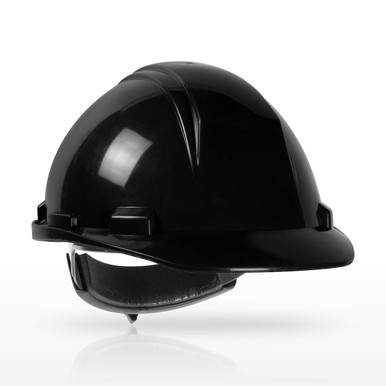 PIP Mont-Blanc 280-HP542R Type II, Cap Style Hard Hat, HDPE ShellPIP lists the Mont-Blanc 280-HP542R as ANSI/ISEA Z89.1 Type II Class E: tested for impact to the top and sides of the head
The rule, then the standard. 29 CFR 1910.135(a)(1) requires a protective helmet “when working in areas where there is a potential for injury to the head from falling objects”, and (a)(2) a helmet “designed to reduce electrical shock hazard” near exposed electrical conductors that could contact the head; 1926.100(a) for construction says “impact, or from falling or flying objects, or from electrical shock and burns”. Both rules then point to ANSI/ISEA Z89.1 for what “protective” means, and Z89.1 is a set of tests: the Type says where on the head the hat is tested to take a blow, the Class says what voltage the shell was proof-tested at. Everything on this page about what a hard hat protects against comes from those tests and from what the manufacturers print; everything about what it does not protect against is the gap between the tests and the question people ask.
What a hard hat is and is not built for
Test descriptions are Z89.1 as the manufacturers state it and the live type and class guides quote it; OSHA statements are from the 2024 bulletin and the August 2026 letter.
The words on a hard hat label
The vocabulary of head protection, from the label to the bulletin.
- Type I: tested for impact and penetration on the top of the head. Type II: tested on the top and also the front, sides and back, with an off-center penetration test and (for helmets) a chin strap retention test; has a foam liner.
- Class G: proof-tested at 2,200 volts, for incidental contact with low-voltage conductors. Class E: proof-tested at 20,000 volts, for high-voltage conductors. Class C: no electrical test; every vented hat.
- Force transmission test: 8 lb mass onto the crown at 18 ft/s; the force reaching the headform is limited. Apex penetration: 2.2 lb pointed penetrator at 23 ft/s must not touch the headform.
- HT and LT: optional Z89.1 marks for a hat conditioned at high temperature or low temperature before testing. HV: high-visibility shell that meets the standard’s color and luminance test.
- Reverse-donning arrow: the mark that allows a hat to be worn backwards; the bulletin says only hats with it can be.
- Chin strap: keeps the hat on through a slip, trip or fall; required for the Type II helmet retention test; “should be considered for use with all head protection” (OSHA bulletin).
- Safety helmet: the climbing-style, close-fitting Type II hat with liner and chin strap; a trade name, not a rating. Hard hat: the cap or full brim on a suspension. The label decides.
- SHIB: OSHA’s Safety and Health Information Bulletin of March 6 2024 on safety helmets; advisory, “creates no new legal obligations”.
What each hazard asks of a hard hat, and which label answers it
| Hazard people ask about | Tested in Z89.1? | Label that covers it | What OSHA says |
|---|---|---|---|
| Falling or dropped object on the crown | Yes: force transmission and apex penetration | Type I or Type II, any class | 1910.135(a)(1), 1926.100(a): helmet required where the potential exists |
| Swinging load, equipment contact, side blow | Type II only: lateral impact and off-center penetration | Type II | Aug 2026 letter: Type I “may not be adequate” where the assessment finds side-impact hazards |
| Brush against a low-voltage conductor | Yes: 2,200 V wet proof test | Class G or E, non-vented | 1910.135(a)(2); bulletin: vented hats cannot be used for electrical work |
| Brush against a high-voltage conductor | Yes: 20,000 V wet proof test | Class E, non-vented | Same; 1926.100(b) electrical insulation for high voltage |
| Slip, trip or fall from height (hat staying on) | Chin strap retention test, Type II helmets | Type II helmet with chin strap | Bulletin: chin straps for heights and construction |
| Molten metal, high heat | Optional HT conditioning | HT mark | Bulletin: “HT” for high temperatures |
| Bullet, vehicle, crush | No | None; not industrial head protection | — |
| Minor bumps on fixed objects, no falling-object hazard | Not Z89.1 (bump caps are outside it) | Bump cap only where 1910.135 does not apply | Live bump cap guide |
The employer’s hazard assessment under 1910.132(d) decides the type and class; the table lists what each label was tested for.
Source: ANSI/ISEA Z89.1 tests as PIP, JSP and Portwest state them on the product pages on this site and as the live type and class guides quote them; 29 CFR 1910.135 and 1926.100; OSHA SHIB March 6 2024; OSHA letter Aug 17 2026.
Questions people ask
What are hard hats designed to protect you from?
A blow to the top of the head (8 lb mass at 18 ft/s), a pointed object penetrating the shell (2.2 lb penetrator), and for Class G and E shells, incidental contact with an energized conductor (2,200 V and 20,000 V proof tests). Type II adds blows to the front, sides and back.
Why do construction workers wear hard hats?
Because 29 CFR 1926.100(a) requires protective helmets where there is a possible danger of head injury from impact, falling or flying objects, or electrical shock and burns, and because the Z89.1 tests behind the label are the dropped tool and the swinging load.
Will a hard hat stop a bullet?
No. Z89.1 has no projectile test and no manufacturer claims one. Ballistic helmets are a different product to a different specification.
What voltage are Class E hard hats designed to?
Proof-tested at 20,000 volts phase to ground, for incidental contact with high-voltage conductors. Class G is 2,200 volts; Class C has no electrical rating.
What do Class E hard hats protect against?
The shock from a momentary brush of the head against an energized conductor, by keeping the current from passing through the shell. Not a rating for working on energized lines; vents or metal accessories defeat it.
What hard hat protects the top and sides?
A Type II hard hat or safety helmet (PIP Mont-Blanc and Kilimanjaro Type II, PIP Stromboli Type II, JSP Evolution Deluxe 6252, Portwest Peak View PV60), tested on the front, sides and back as well as the crown.
What are the new OSHA hard hat requirements for construction?
There is no new rule. OSHA’s March 6 2024 bulletin lists Type II helmets with chin straps as a consideration for construction and work at heights and says it is advisory; OSHA’s Aug 17 2026 letter says 1910.135 does not require a particular type, but a hazard assessment that finds side-impact hazards may make Type I inadequate.
Is OSHA requiring safety helmets instead of hard hats?
No. OSHA switched its own staff to Type II Class G helmets and published a bulletin; the bulletin “creates no new legal obligations”. The employer’s hazard assessment decides.
Is 3 pounds heavy for a helmet?
For an industrial hat, far too heavy: Portwest lists its cap-style hard hats at 0.74 to 0.93 lb and its Type II helmets at 0.91 to 1.43 lb. Three pounds is a motorcycle or ballistic helmet.
How much does a hard hat weigh?
Under a pound for a cap or full-brim hat (Portwest PW67 0.74 lb, PH55 0.93 lb), about a pound to a pound and a half for Type II helmets with liners and chin straps (Portwest PS53 0.91 lb, PS71 1.43 lb); the product page lists the weight where the manufacturer publishes it.
What is the 222 rule for helmets?
Not a Z89.1 or OSHA rule. The service-life guidance is the manufacturer’s, plus OSHA’s bulletin: retire a hat after any impact, inspect shell and suspension, keep it out of the sun and the car.
Does a hard hat protect you in a fall?
Only if it stays on. A chin strap is what keeps it there; the Type II helmet retention test and OSHA’s bulletin both point to chin straps for work at heights.
Can I wear a beanie or ball cap under a hard hat?
Only what the manufacturer allows; a cap bill or a thick hat changes how the suspension sits and the hat performs. The live liner and how-to-wear guides cover winter liners made for the purpose.
Which class of hard hat should never be used around electrical hazards?
Class C, which includes every vented hat and any metal hat. OSHA’s bulletin: vented hard hats or safety helmets cannot be used for electrical work.
What is the difference between a Type 1 and a Type 2 Class C helmet?
Both have no electrical rating (Class C, usually vented). Type 1 is tested for top impact only; Type 2 adds front, side and back impact and off-center penetration, with a foam liner.
How do helmets protect your head?
The shell spreads the blow and sheds a penetrator; the suspension gap on a Type I hat or the crushable liner on a Type II helmet absorbs the energy so what reaches the head stays under the Z89.1 limit.
What is the normal weight of a helmet?
Under a pound for a cap-style HDPE hard hat and about 1 to 1.3 lb for a Type II safety helmet; Studson states 495 to 567 g for the SHK-1 versions.
What is the 2 2 2 rule for helmets?
A sports-helmet phrase with no definition in Z89.1 or OSHA’s rules; the industrial rules are replace after impact, suspension yearly, shell within about five years. The 2 2 2 rule guide covers it.
What does MSA say about the space between the shell and the suspension?
Nothing may be stored there: MSA’s FAQ states gloves, cigarettes or earplugs in that space can transmit significant force to the head and neck in an impact, because the gap is what absorbs the energy.
Related guides
Type I vs Type II hard hatsWhat the types meanClass G, Class E and Class C hard hatsThe electrical ratingsSafety helmet vs hard hatWhat the chin strap and Type II changeOSHA hard hat requirementsWhat 1910.135 and 1926.100 sayDo hard hats expire?Service life, the date stamp, and when to replace oneWhat are hard hats made of?HDPE, polycarbonate, fiberglass and ABSThe ratings, test results and standards shown here are the manufacturers' published values, reproduced as published. Nothing on this page is a recommendation by Bayshore Safety that any product is suitable for a particular task, hazard or workplace. Selecting safety products and protective equipment is the responsibility of the end user and the employer, based on their own hazard assessment and the regulations that apply to their work. Confirm every value on the manufacturer's own documentation before use.