
Bayshore Safety & Industrial Supplies Guide
What are high-visibility jackets called? Bombers, parkas, soft shells, 2-in-1 and 3-in-1 jackets, rain jackets, hoodies and sweatshirts under ANSI/ISEA 107 Class 3, why you would wear a vest instead, what a hi-vis jacket costs, and how to pick one
They are called by their cut, the way any jacket is, with the class on the label: bomber jackets (a waist-length insulated jacket with a hood that "fits into collar"), parkas (longer, heavier, "quilted liner with thermal insulation", a detachable hood), soft shell jackets ("durable water-resistant soft shell material"), 2-in-1 and 3-in-1 jackets (a shell with a "removable black quilted liner" or a "removable zip up hoodie sweatshirt" that is worn alone in milder weather), rain jackets and long rain coats ("waterproof material with durable seam-sealed construction"), and hoodies and sweatshirts. ML Kishigo labels every one of them ANSI/ISEA 107 Type R Class 3, because a jacket has sleeves and the sleeves carry the bands that lift the garment to Class 3; the one Class 2 jacket in the line (the JS156 bomber) is the exception. People also call them safety jackets, reflective jackets and hi-viz coats; the standard calls all of them HVSA. The guide below sets out what each cut is for, what it costs ($47.49 to $184.00 for the jackets, $67.99 to $155.00 for the rain jackets at our prices today), and the question that comes up every winter: whether to buy jackets or put a vest over the coats the crew already owns.
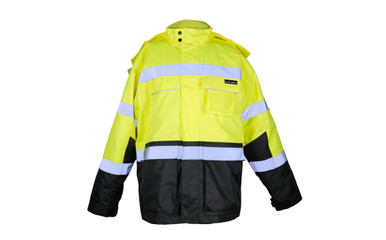 ML Kishigo JS140 Hi Vis Parka, Class 3 Type R, Lime, 7 Pockets, Zipper FrontML Kishigo labels it ANSI/ISEA 107 Type R Class 3: ripstop parka, waterproof seam-sealed, quilted liner, detachable hood, 7 pockets
Vest or jacket. A Class 2 vest over any coat meets a daytime roadway, costs from $6.49, comes off at the truck and goes in the wash by itself; it is the right answer for a crew that already owns coats, for mild winters and for a site where the vest is the PPE and the coat is the worker’s. A Class 3 jacket is the right answer where Class 3 is required (the MUTCD says a flagger at night should wear it), where the arms must be seen (signaling, equipment work), where the crew is in rain or cold all day, and where the employer wants one garment that is both the coat and the hi-vis, because a vest over a dark coat hides the arms and a coat over a vest hides the vest. On the payment side, 1910.132(h)(4)(iii) lets an employer off paying for "winter coats, jackets, gloves, parkas ... raincoats" worn solely for weather, but a Class 3 jacket issued to meet a hi-vis requirement is hi-vis PPE, and the free-vests guide linked below works through it.
The cuts, in ML Kishigo’s words
Each description is from the product page; the class is what the label says.
The questions, one by one
Answers from the ML Kishigo product pages, the FAQ and the rules named in the byline.
What are high-visibility jackets called?
By cut: bomber, parka, soft shell, 2-in-1 or 3-in-1, rain jacket or rain coat, hoodie, sweatshirt; by label, ANSI/ISEA 107 Type R Class 3 (or Class 2 for the one bomber cut that way). "Safety jacket", "reflective jacket", "hi-viz coat" and "Class 3 jacket" all mean the same garment; ML Kishigo’s FAQ groups them under HVSA, "garments such as vests, jackets, pants, shirts, rainwear and coveralls".
What is a Class 3 high-visibility jacket?
A jacket with enough fluorescent background and retroreflective material, including bands on the sleeves, to carry the Class 3 label, the class ML Kishigo’s FAQ describes as "greater visibility to the wearer in both complex backgrounds and through a full range of body motions". Every Kishigo jacket, parka, soft shell, hoodie and rain jacket in the bands is Class 3; it is the jacket the MUTCD says a night flagger should wear.
Why would I wear a vest instead of a jacket?
Because the vest is cheaper, cooler, washes alone, fits over whatever the crew wears and is enough where Class 2 is the requirement; a dozen vests cost less than one parka. The jacket wins where Class 3 is required, where the arms must be seen, and where the employer wants the coat and the hi-vis to be one garment that cannot be left in the truck. Many crews own both: a vest for most days, a Class 3 jacket for night and weather.
Are hi-vis jackets warm?
The insulated ones are: ML Kishigo prints "thermal insulation" on the bombers, "quilted liner with thermal insulation" on the parkas, and "storm cuff (powder barrier) waist liner keeps wind and snow out" on the JS152. A soft shell and a rain jacket are not insulated and are worn over a hoodie; the 3-in-1 JS135 puts the hoodie inside the shell. The cold-weather layering guide linked below sets the layers out.
How much does a reflective jacket cost?
In the ML Kishigo line at our prices today, Class 3 jackets, bombers, parkas and soft shells run $47.49 to $184.00 (the JS121 economy bomber is $47.49, the JS135 3-in-1 $184.00), Class 3 rain jackets $67.99 to $155.00, and Class 3 hoodies from $48.99. The where-to-buy guide linked below lays the whole line out by garment.
What is a 3-in-1 jacket?
A waterproof shell plus a liner that zips out, giving three garments: shell alone (rain, mild), liner alone (dry, cool), both together (cold and wet). ML Kishigo’s JS135 pairs a ripstop seam-sealed shell with a "removable zip up hoodie sweatshirt"; the JS119 bomber has a "removable black quilted liner" (2-in-1). The class belongs to the shell; check the liner’s own label before wearing it alone on the roadway.
Is a hi-vis rain jacket a Class 3 jacket?
Yes when it is labeled so, and every Kishigo rain jacket in the bands is Type R Class 3: the bands run on the sleeves. The rain jacket adds "waterproof material with durable seam-sealed construction" and loses the insulation; the hi-vis rain gear guide linked below covers the Class E pants and bibs that go with it.
What is a safety jacket called, and what is a thick hoodie called?
A hi-vis jacket, a Class 3 jacket or, in a catalog, outerwear; the heavy fleece hoodies are hooded sweatshirts, and ML Kishigo sells its Class 3 versions as "hoodie sweatshirts" (JS102, JS142, JS154) with the bands sewn in. A hoodie with reflective tape and no label is Non-ANSI.
What should a crew lead buy for winter?
Count the nights and the rain. Day work in mild weather: Class 2 vests over the crew’s own coats. Night roadway work: Class 3, either a jacket (bomber or parka) or a Class 3 shirt and a vest with Class E pants. Wet work: a Class 3 rain jacket with Class E rain pants or bibs. Cold and wet: a parka or a 3-in-1. Two sizes up from the shirt size is the usual jacket size over a hoodie; the sizing guide linked below has the chart.
In plain words
- Hi-vis jackets are named by cut: bomber, parka, soft shell, 2-in-1 or 3-in-1, rain jacket, hoodie. The label says Class 3 because the sleeves carry bands.
- A Class 2 vest over any coat is the cheap answer for day work; a Class 3 jacket is the answer for night, rain, cold and work where the arms must be seen.
- ML Kishigo jackets run $47.49 to $184.00, rain jackets $67.99 to $155.00, hoodies from $48.99.
- The class belongs to the shell of a 3-in-1; check the liner’s label before wearing it alone on a roadway.
Questions people ask
What is a hi-vis bomber jacket?
A waist-length insulated jacket with a waterproof seam-sealed shell and a hood in the collar, labeled Class 3 by ML Kishigo; the JS121 is the economy version.
What is the difference between a hi-vis parka and a bomber?
Length and warmth: the parka is longer with a quilted liner and a detachable hood, the bomber waist-length with thermal insulation.
Are hi-vis jackets Class 2 or Class 3?
Class 3 on every ML Kishigo jacket, parka, soft shell, hoodie and rain jacket in the line, because the sleeves carry bands; the JS156 bomber is the one Class 2.
Is a soft shell jacket waterproof?
Water-resistant, as ML Kishigo prints it on the JS144; the rain jackets and parkas are the waterproof seam-sealed garments.
Can I wear a vest over my own coat instead of buying a jacket?
Yes where Class 2 is the requirement by day; at night on a roadway the MUTCD says a flagger should wear Class 3, which a vest over a dark coat is not.
What does a hi-vis jacket cost?
$47.49 to $184.00 for ML Kishigo jackets, bombers, parkas and soft shells at our prices today; rain jackets $67.99 to $155.00.
Does the employer have to pay for a hi-vis jacket?
For a jacket issued to meet a hi-vis requirement, yes under 1910.132(h); for a coat worn solely for weather, no. The free-vests guide explains.
What is a hi-vis hoodie called in the catalog?
A hoodie sweatshirt; ML Kishigo labels its JS102, JS142 and JS154 Class 3 and its B310 Type O Class 1.
Related guides
What is a Class 2 safety shirt, and what is a high-visibility jacket?Vest vs shirt vs jacketHi-vis rain gear and cold-weather gearKeeping the class ratingHow do you dress for cold-weather work?Base, mid and shell layers, insulated coveralls and bibsHow long does a heated jacket battery last?Run time and what it is notWhere can you buy a safety vest, and how much does one cost?Prices by garment, and what moves themWhere can you get free hi-vis vests?What 1910.132(h) says about who paysWhat size hi-vis vest should you get?The ML Kishigo chest and length chartWhat are the levels of safety vests?Class 1, 2, 3 and E, Type R, O and PThe ratings, test results and standards shown here are the manufacturers' published values, reproduced as published. Nothing on this page is a recommendation by Bayshore Safety that any product is suitable for a particular task, hazard or workplace. Selecting safety products and protective equipment is the responsibility of the end user and the employer, based on their own hazard assessment and the regulations that apply to their work. Confirm every value on the manufacturer's own documentation before use.
© 2026 Bayshore Safety & Industrial Supplies, Inc. All rights reserved. This guide may not be copied or republished without written permission.