
Bayshore Safety & Industrial Supplies Guide
Where can you get free hi-vis vests? What OSHA 1910.132(h) says about who pays for high-visibility apparel, what counts as PPE and what counts as clothing, replacement vests, employee-owned vests, Cal/OSHA 3380, and what a vest program costs
From your employer, if the vest is PPE. OSHA’s payment rule, 29 CFR 1910.132(h)(1), says that "the protective equipment, including personal protective equipment (PPE), used to comply with this part, shall be provided by the employer at no cost to employees", and a hi-vis vest issued because the hazard assessment under 1910.132(d) found a struck-by hazard, or because the MUTCD requires it in a work zone, is exactly that. The employer also pays for replacements under (h)(5) "except when the employee has lost or intentionally damaged the PPE". The rule has exceptions, and they are the reason the question gets asked: (h)(4)(iii) lets the employer off the hook for "ordinary clothing, skin creams, or other items, used solely for protection from weather, such as winter coats, jackets, gloves, parkas, rubber boots, hats, raincoats", so a hi-vis parka issued for the cold is a gray area the employer settles in its own policy, while a Class 2 vest for the roadway is not. Nobody hands out free vests to the public; a Class 2 vest in the ML Kishigo line starts at $6.49, which is why a crew lead buying a dozen is the usual path, and why the employer and not the worker is the one who buys.
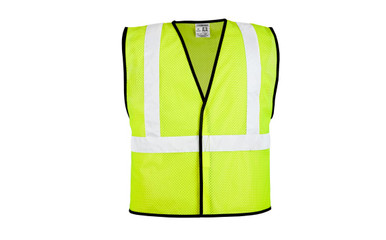 ML Kishigo 1571 Safety Vest, Class 2 Type R, Lime, Hook and Loop FrontML Kishigo labels it ANSI/ISEA 107 Type R Class 2; the lowest-priced Class 2 vest in the line at $6.49
Why the employer pays. 1910.132(d)(1) requires the employer to "assess the workplace to determine if hazards are present, or are likely to be present, which necessitate the use of personal protective equipment", then to "select, and have each affected employee use, the types of PPE that will protect the affected employee from the hazards identified". Once the assessment names a struck-by hazard from vehicles or equipment and selects hi-vis, the vest is PPE "used to comply with this part", and (h)(1) puts the cost on the employer. On a roadway the selection is made for the employer: 1926.201(a) sends flaggers to Part 6 of the MUTCD, whose section 6C.05 says all workers within the right-of-way in a temporary traffic control zone "shall wear high-visibility safety apparel that meets the Performance Class 2 or 3 requirements" of ANSI/ISEA 107, and that "a person designated by the employer to be responsible for worker safety shall make the selection of the appropriate class of garment". California says the same through Cal/OSHA 1598(c) and 1599(d), and 3380(d) makes the employer "assure that all required safety devices and safeguards, whether employer or employee provided" are maintained.
The payment rule, piece by piece
Each line is 29 CFR 1910.132(h) as the eCFR prints it.
The questions, one by one
Answers from the regulations and the ML Kishigo pages named in the byline.
Where can I get free hi-vis vests?
From the employer who requires you to wear one: that is what 1910.132(h)(1) means by "at no cost to employees". There is no public program that hands out ANSI-labeled vests, and the "free vest" offers people find online are promotional vests with no class label, which do not satisfy a site that asks for Class 2. If you are self-employed or a volunteer, the vest is yours to buy, and a Type R Class 2 mesh vest with a 2 in. reflective band and a hook-and-loop front costs $6.49 in the ML Kishigo line; we sell nationwide by the piece and by the case.
Does OSHA require the employer to provide a safety vest?
Yes, once the vest is PPE. The chain is 1910.132(d) (assess, select) or 1926.201 and the MUTCD (roadway work zones), then 1910.132(h)(1) (provide at no cost). An employer that tells a flagger to buy her own Class 2 vest is on the wrong side of (h)(1); an employer that lets a warehouse worker keep wearing his own labeled vest under (h)(6) is within the rule.
Is a hi-vis vest PPE or clothing?
PPE when it is selected to protect against a hazard the assessment found, clothing when it is not. 1910.132(a) covers "protective clothing" among the equipment the rule applies to, and ML Kishigo’s FAQ calls its labeled garments "high visibility PPE". The same vest worn to walk the dog is clothing; nothing in the garment changes, only the reason it is worn.
Does the employer have to pay for a hi-vis jacket or rain jacket?
The weather exception in (h)(4)(iii) is written for "ordinary clothing ... used solely for protection from weather", and a jacket issued solely for warmth is in it. A Class 3 hi-vis jacket issued because the crew works at night in traffic is not solely for weather; it is the hi-vis PPE the MUTCD requires, worn in a form that also keeps the worker warm. Most employers who require Class 3 in winter pay for the jacket; the ones who issue a vest and let workers choose their own coat under it are within the rule too, because the vest is the PPE.
How often does the employer have to replace a vest?
When it no longer does its job, at the employer’s cost under (h)(5). ML Kishigo gives two measures: the rated washes on each spec sheet (25X or 50X, the count the fluorescent and retroreflective performance is tested to) and its garment inspection card, which grades a vest "acceptable", "marginal" ("some soiling and light fading") or "unacceptable" ("little visibility and safety for the user"). A lost vest or one a worker cut up is the one exception.
What does a vest program cost an employer?
Less than most other PPE. In the ML Kishigo line at our prices, Type R Class 2 vests run $6.49 to $87.49 by the piece, Class 3 vests $15.99 to $75.99, Class 2 and 3 shirts $18.49 to $68.99, Class 3 jackets $47.49 to $184.00 and FR hi-vis vests $14.49 to $119.00; a crew of twelve in the lowest-priced Class 2 vest is under $80. The where-to-buy guide linked below has the whole range.
Can an employer deduct the vest from my pay or charge a deposit?
Not for required PPE: (h)(1) says "at no cost to employees", and a deduction or a deposit is a cost. An employer may ask for the vest back when you leave, because it owns it, and may charge for a vest you lost or intentionally damaged under (h)(5).
Can I wear my own vest?
If the employer allows it under (h)(6) and it is "adequate", which for hi-vis means it carries the ANSI/ISEA 107 label with the type and class the site requires (Type R Class 2 for a roadway by day, Class 3 for a night flagger under MUTCD 6C.05). A promotional vest with no label is not adequate for a work zone, and the employer has to issue one that is.
In plain words
- A hi-vis vest you are required to wear at work is PPE, and 1910.132(h)(1) makes the employer buy it "at no cost to employees".
- The employer also pays for replacements, except for a vest you lost or deliberately damaged.
- The exceptions are everyday clothing and gear worn solely for weather; a Class 2 vest for the roadway is neither.
- There is no public source of free ANSI-labeled vests; the vest starts at $6.49 in the ML Kishigo line, by the piece.
- In California, Cal/OSHA 1598, 1599 and 3380 say the same thing in state words.
Questions people ask
Who pays for a safety vest at work?
The employer, under 29 CFR 1910.132(h)(1), whenever the vest is PPE the employer selected or the MUTCD requires; replacements too, except for a lost or deliberately damaged vest.
Can an employer make me buy my own hi-vis vest?
Not for a vest that is required PPE; (h)(1) says "at no cost to employees". The employer may allow you to wear an adequate vest you already own under (h)(6).
Does OSHA require employers to pay for hi-vis rain jackets?
Weather-only gear is an exception under (h)(4)(iii); a Class 3 rain jacket issued because the site requires hi-vis in the rain is hi-vis PPE, and most employers pay for it.
Are there free safety vests anywhere?
No public program issues ANSI/ISEA 107-labeled vests; promotional giveaway vests carry no class and do not satisfy a work zone. The lowest-priced Class 2 vest we sell is $6.49.
What does a Class 2 vest cost?
In the ML Kishigo line at our prices, Type R Class 2 vests run $6.49 to $87.49 by the piece, depending on pockets, closure and series.
Who decides which class of vest the employer buys?
On a roadway, "a person designated by the employer to be responsible for worker safety", per MUTCD 6C.05; elsewhere the hazard assessment under 1910.132(d).
Does the rule apply in California?
Yes; Cal/OSHA 1598 and 1599 require the warning garments and 3380(d) makes the employer responsible for required safety devices "whether employer or employee provided".
How many vests should an employer issue per worker?
The rule does not say; two per worker is common so one can be washed, since ML Kishigo rates its vests for 25 or 50 washes and grades a faded vest unacceptable.
Related guides
Who pays for PPE?The OSHA employer payment ruleDoes OSHA require high-visibility clothing?The rules that call for itWhat are the levels of safety vests?Class 1, 2, 3 and E, Type R, O and PWhere can you buy a safety vest, and how much does one cost?Prices by garment, and what moves themWhat is a PPE hazard assessment?What 1910.132(d) requiresHi-vis for flaggers and roadway workWhat the MUTCD requiresIs it a legal requirement to wear hi-vis in California?Cal/OSHA 1598 and 1599OSHA 1910.132 PPE General RequirementsThe rule pageThe ratings, test results and standards shown here are the manufacturers' published values, reproduced as published. Nothing on this page is a recommendation by Bayshore Safety that any product is suitable for a particular task, hazard or workplace. Selecting safety products and protective equipment is the responsibility of the end user and the employer, based on their own hazard assessment and the regulations that apply to their work. Confirm every value on the manufacturer's own documentation before use.
© 2026 Bayshore Safety & Industrial Supplies, Inc. All rights reserved. This guide may not be copied or republished without written permission.