
What is a controlled access zone? The control line rules in 1926.502(g), who may enter, and where a CAZ is allowed
A controlled access zone (CAZ) is an area where certain work, overhand bricklaying and leading edge work under a fall protection plan, may take place without guardrails, personal fall arrest or safety nets, because access to the zone is controlled (29 CFR 1926.500(b)). It is not a fall protection system in the equipment sense; it is a line on the floor that keeps everyone but the named workers away from the edge. The line is a rope, wire or tape with a 200-pound breaking strength, flagged with high-visibility material every 6 feet, rigged between 39 and 45 inches above the surface (50 inches for bricklaying), set 6 to 25 feet back from a leading edge (6 to 60 feet, or half the member length, for precast erection) or 10 to 15 feet from a bricklaying working edge, running the full length of the edge and tied at each end to a guardrail or wall (1926.502(g)). Only the employees doing the work may be inside; everyone else is protected by the line. A CAZ is allowed in three places: overhand bricklaying (1926.501(b)(9)), the locations a written fall protection plan identifies where conventional protection is infeasible (1926.502(k)(7)), and, along the edge parallel to a leading edge, in place of a guardrail for workers not doing the leading edge work (1926.501(b)(2)(ii)).
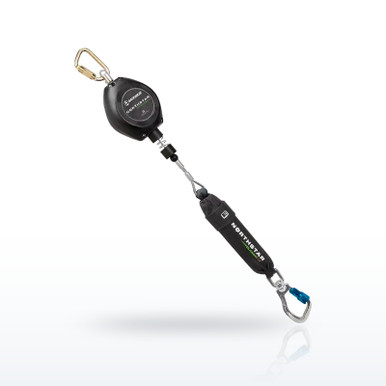 Safewaze Northstar Classic FS-FSP9020 Self-Retracting Lifelines, Leading Edge 20Class 2 leading-edge SRL for the workers who stay connected at the edge (Safewaze data)
Why a line instead of equipment. A bricklayer laying the outside wythe of a wall has to lean over the edge to strike the joints; a harness and lanyard on every mason, tied to an anchor that moves every few feet, was judged in the 1994 rule to be more hazard than help, and a guardrail on a wall that is being built is in the way of the work. The rule’s answer was to keep the hazard to the people doing the job and move everyone else back: a control line far enough from the edge that a worker who is not laying brick cannot fall off it, and a rule that only the named workers cross it. The same logic reaches leading edge work and precast erection through the fall protection plan, where the employer first has to show that guardrails, nets and arrest are infeasible, and residential construction, where the plan is the exception to 1926.501(b)(13). Where the CAZ stands alone, the workers inside it have no system catching them, which is why 1926.502(k)(8) adds a safety monitor when nothing else has been implemented and why the training rule lists the CAZ among the systems every exposed worker has to understand.
The control line, figure by figure
From 1926.502(g)(1) through (g)(5).
Where a controlled access zone is allowed
The rule names the situations; the zone is not a general substitute for guardrails.
- Overhand bricklaying and related work: each employee reaching more than 10 inches below the walking surface to lay block or brick is protected by a guardrail, safety net or personal fall arrest system, or works in a controlled access zone; the related work (mortar mixing, scaffold work beside the mason) is included (1926.501(b)(9)).
- Leading edge work under a fall protection plan: where the employer can demonstrate that guardrails, nets and arrest are infeasible or a greater hazard for workers constructing a leading edge, the plan identifies each such location and classifies it as a controlled access zone (1926.501(b)(2)(i); 1926.502(k)(7)).
- Beside a leading edge, for the other workers: an employee on the same surface who is not doing the leading edge work must have a guardrail, net or arrest system, and if a guardrail is chosen and a CAZ has already been set up for the leading edge work, the control line may serve in place of the guardrail along the edge that parallels the leading edge (1926.501(b)(2)(ii)).
- Precast concrete erection and residential construction, through the fall protection plan on the same terms (1926.501(b)(12) and (b)(13); 1926.502(k)).
- Nowhere else. A control line around a roof edge or a floor hole in ordinary construction is not a controlled access zone and does not take the place of the systems 1926.501(b) requires; a warning line on a low-slope roof is a different system with its own figures (1926.502(f)).
Control line vs warning line: the two lines Subpart M describes
| Control line (controlled access zone) | Warning line (low-slope roofs) | |
|---|---|---|
| Paragraph | 1926.502(g) | 1926.502(f) |
| Where it is allowed | Overhand bricklaying; leading edge, precast and residential work under a fall protection plan | Low-slope roofs, paired with a guardrail, net, arrest system or safety monitor |
| Distance from the edge | 6 to 25 ft from a leading edge (6 to 60 ft or half the member for precast); 10 to 15 ft from a bricklaying edge | Not less than 6 ft from the roof edge; where mechanical equipment is used, 6 ft parallel to and 10 ft perpendicular to its direction of travel |
| Height | 39 to 45 in (50 in for bricklaying), including sag | 34 to 39 in, including sag |
| Strength | 200 lb minimum breaking strength | 500 lb minimum tensile strength; stanchions resist a 16 lb horizontal force without tipping |
| Marking | Flagged every 6 ft with high-visibility material | Flagged every 6 ft with high-visibility material |
| Who crosses it | Only the employees named for the work | Only workers doing the roofing work, and then with the paired system |
Source: 29 CFR, e-CFR text current as of November 5, 2026, 1926.502(f) and (g).
What the workers inside the zone have
A control line protects the people outside it. The masons or leading edge workers inside have whatever the paragraph that allowed the zone provides: in bricklaying, nothing further is required by (b)(9) once the zone is set; under a fall protection plan, the measures the plan documents, which must include a safety monitoring system under 1926.502(h) where no other alternative has been implemented (1926.502(k)(8)). A safety monitor is a competent person on the same surface, close enough to communicate, with no other duties, who warns workers when they are unaware of the hazard or working unsafely (1926.502(h)(1)). Where the plan allows equipment at the edge, the devices on this page are the ones built for a line running over an edge: Class 2 leading-edge SRLs, twin-leg devices for staying connected while moving, and cross arm straps and chokers as the anchorage connectors, each with the figures its manufacturer states.
29 CFR 1926.502(h)(1) and (k)(8); Safewaze product data (SRL Class, Leading Edge Rated, ANSI Standards fields).Training
Every employee who might be exposed to a fall hazard is trained by a competent person in the use and operation of controlled access zones among the other systems, in the role of each employee in a safety monitoring system when one is used, and in the role of employees in fall protection plans, with a written certification kept (1926.503(a)(2)(iii), (iv) and (vii); (b)).
29 CFR 1926.503.Questions people ask
What is a controlled access zone?
An area in which certain work (overhand bricklaying, and leading edge, precast or residential work under a fall protection plan) may take place without guardrails, personal fall arrest or safety nets, and to which access is controlled by a control line or another means that restricts access (1926.500(b); 1926.502(g)(1)).
How far from the edge does a control line go?
6 to 25 feet from a leading edge; 6 to 60 feet or half the member length, whichever is less, when erecting precast concrete; 10 to 15 feet from an overhand bricklaying working edge (1926.502(g)(1)(i), (ii) and (g)(2)(i)).
How high is a control line, and how strong?
Between 39 and 45 inches above the surface including sag (50 inches for bricklaying), with a minimum breaking strength of 200 pounds, flagged every 6 feet with high-visibility material (1926.502(g)(3)).
Who is allowed inside a controlled access zone?
Only employees engaged in overhand bricklaying or related work (1926.502(g)(2)(iv)), or, under a fall protection plan, the employees the plan names; no other employees may enter (1926.502(k)(9)).
Is a controlled access zone the same as a warning line?
No. A warning line is the roofing system in 1926.502(f): 6 feet from the roof edge, 34 to 39 inches high, 500 lb tensile strength, used on low-slope roofs with a guardrail, net, arrest system or safety monitor. A control line is 1926.502(g): 6 to 25 feet from a leading edge or 10 to 15 feet from a bricklaying edge, 39 to 45 inches high, 200 lb.
Can a controlled access zone be used instead of a harness?
Only in the situations the rule names: overhand bricklaying, and leading edge, precast or residential work where a written fall protection plan shows guardrails, nets and arrest are infeasible or a greater hazard. On an ordinary floor edge or roof the systems in 1926.501(b) are required (1926.501(b)(9); 1926.502(k)).
Does a controlled access zone need a safety monitor?
Under a fall protection plan, yes where no other alternative measure has been implemented (1926.502(k)(8)); the monitor is a competent person on the same surface with no other duties (1926.502(h)(1)). For overhand bricklaying under 1926.501(b)(9) the paragraph does not require one.
What can the control line be made of?
Ropes, wires, tapes or equivalent materials on supporting stanchions, provided the line has a 200 lb minimum breaking strength and is flagged every 6 feet (1926.502(g)(3)). Barricade tape by itself meets the marking requirement; whether it meets the 200 lb strength is what the tape’s own data sheet has to state.
Who sets up a controlled access zone?
The employer, under the competent person supervising the fall protection plan where one applies (1926.502(k)(4)); the plan itself is prepared by a qualified person (k)(1). Workers are trained in the zone’s use under 1926.503(a)(2)(iii).
Related guides
OSHA fall protection requirements, section by sectionSubpart M from 1926.500 to 1926.503Does OSHA require a written fall protection plan?What 1926.502(k) requiresOSHA roof fall protection rulesWarning lines and safety monitorsWhat is a leading edge?Why foot-level anchorage needs a Class 2 SRLCompetent person vs qualified personThe OSHA definitions and the jobs each doesThe ratings, test results and standards shown here are the manufacturers' published values, reproduced as published. Nothing on this page is a recommendation by Bayshore Safety that any product is suitable for a particular task, hazard or workplace. Selecting safety products and protective equipment is the responsibility of the end user and the employer, based on their own hazard assessment and the regulations that apply to their work. Confirm every value on the manufacturer's own documentation before use.