
What PPE should an electrician wear? What OSHA 1910.335 and 1910.269 require, and how NFPA 70E fills in the arc flash side
OSHA states the pieces and NFPA 70E states the numbers. For general industry electrical work, 1910.335(a)(1) requires electrical protective equipment appropriate to the body parts and the work, nonconductive head protection wherever there is a danger of head injury from electric shock or burns from contact with exposed energized parts, and eye and face protection wherever there is a danger from electric arcs or flashes or from flying objects from an electrical explosion; 1910.137 sets the rubber insulating glove classes and their test voltages. For power generation, transmission and distribution, 1910.269(l)(8) requires the employer to estimate the incident heat energy and to provide clothing with an arc rating at least that high, prohibits clothing that could melt onto skin or continue to burn (acetate, nylon, polyester and polypropylene unless the employer shows otherwise), and requires an arc-rated face shield or hood above 9 cal/cm² for single-phase arcs in open air and above 5 cal/cm² for other exposures. NFPA 70E 130.7 turns those duties into a kit: arc-rated clothing by category or incident energy, a hard hat (Class E or G), safety glasses or goggles, hearing protection (ear canal inserts), leather or arc-rated gloves over rubber insulating gloves where shock is the hazard, and an arc-rated face shield with balaclava or a hood as the energy rises. The band below holds the Radians-line pieces of that kit with the figures each page prints; the rubber insulating gloves, which Radians does not make, are in the electrical gloves guides.
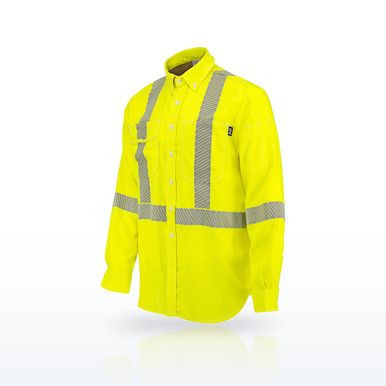 Neese VDH5VSH3 FR Hi-Vis Shirts, ATPV 8 cal/cm², CAT 2, Type R Class 3Arc-rated FR work shirt with the ATPV and category Neese prints (Neese data)
Why the list is two lists. An electrician faces two hazards that call for different gear. Shock is the first: contact with an energized part, defended with rubber insulating gloves rated by voltage class under 1910.137 and ASTM D120, leather protectors over them, insulated tools and nonconductive head protection. Arc flash is the second: a fault that releases heat measured in calories per square centimeter, defended with clothing whose arc rating meets the estimated incident energy, plus face, head and hearing protection. OSHA writes the duty (1910.335 for general industry, 1910.269 for utilities, 1926 Subpart V for construction of power lines) and leaves the method to the consensus standard; NFPA 70E supplies the method, with its categories 1 to 4 at 4, 8, 25 and 40 cal/cm² and its table of what each category wears. The gear in the band below is the arc flash side from the Radians lines: Neese and VolCore shirts, pants and coveralls with their ATPV printed, Neese arc-rated rainwear, Radians arc-rated hi-vis vests for the outer layer, Class E hard hats, Z87.1+ glasses and dielectric hearing protection. The rubber gloves and the insulated tools come from other manufacturers; the guides linked below cover them.
What the rules require, clause by clause
The OSHA paragraphs and the NFPA 70E table, as written.
What the Radians-line pages print for each piece
From the product pages on radians.com, fetched Nov 8 2026:
- Arc-rated clothing: Neese and Radians VolCore shirts, pants and coveralls with the ATPV on the page (4.6 cal/cm² CAT 1 on the Neese Nomex pieces; 8 to 11.5 cal/cm² CAT 2 on the Indura, Ultra-Soft, Westex DH and VolCore cotton pieces), and the standards each is listed to: NFPA 70E, ASTM F1506, NFPA 2112 and UL certification where printed.
- Arc-rated rainwear: Neese Flex Arc, Flex Arc II, Dura Arc I and II and Petro Arc, listed to ASTM F1891 and ASTM F2733, one or both as each page prints, with ANSI/ISEA 107 Class 3 or Class E.
- Outer layer hi-vis: Radians FR vests with the arc rating printed (5.1 to 8 cal/cm², CAT 1 and 2) for work where the roadway standard also applies.
- Head: DEWALT DPG22 Type II Class E, Radians Granite GHR6 Type I Class E and G, both non-vented; the vented DPG22V and Titanium THRXV are Class C and carry no electrical rating.
- Eyes: Radians, Crossfire and DEWALT safety glasses listed to ANSI Z87.1+; NFPA 70E places them under the face shield or hood.
- Hearing: Radians Deviator, Resistor, Deflector and Evader plugs and the DEWALT DPG65 plugs listed as dielectric with the NRR; the DEWALT DPG660-D and Radians DCMT25 cap-mount muffs listed dielectric at NRR 25.
- Not on the Radians pages: rubber insulating gloves, leather protectors and insulated tools. The electrical gloves guides cover the classes.
NFPA 70E PPE categories and the minimum arc rating of the clothing (Table 130.7(C)(15)(c))
| Category | Minimum arc rating | Clothing | Head and face | Also |
|---|---|---|---|---|
| 1 | 4 cal/cm² | arc-rated long-sleeve shirt and pants, or coverall | arc-rated face shield or arc flash suit hood; hard hat | safety glasses or goggles, hearing protection, heavy-duty leather or arc-rated gloves, leather footwear |
| 2 | 8 cal/cm² | arc-rated long-sleeve shirt and pants, or coverall | arc-rated face shield and balaclava, or hood; hard hat | as Category 1 |
| 3 | 25 cal/cm² | arc-rated shirt and pants plus arc flash suit, or coverall plus suit | arc flash suit hood; hard hat | arc-rated gloves, as above |
| 4 | 40 cal/cm² | arc flash suit over arc-rated shirt and pants or coverall | arc flash suit hood; hard hat | arc-rated gloves, as above |
Source: NFPA 70E-2024 Table 130.7(C)(15)(c), summarized; the incident energy analysis method of 130.5(G) is the alternative to the category table. The garment label governs.
More questions people ask
What are the categories of electrical PPE, who is a qualified person, and at what voltage does NFPA 70E apply?
Electrical PPE falls in two groups: shock protection (rubber insulating gloves in classes 00 to 4 by voltage under 1910.137 and ASTM D120, leather protectors, insulating sleeves, blankets and mats, insulated tools, Class E or G head protection) and arc flash protection (arc-rated clothing and suits in NFPA 70E PPE Categories 1 to 4 at 4, 8, 25 and 40 cal/cm², arc-rated face shields and hoods, hearing protection, leather footwear). A qualified person, in OSHA’s definition at 1910.399, is one who has received training in and has demonstrated skills and knowledge in the construction and operation of electric equipment and installations and the hazards involved; 1910.332 sets the training content and 1910.269 adds its own for utility work, and NFPA 70E’s definition tracks OSHA’s. NFPA 70E’s shock protection boundaries and PPE requirements apply to exposed energized conductors and circuit parts at 50 volts and above, which is also the threshold in OSHA’s 1910.333 for de-energizing or guarding before work; below 50 V the shock hazard is treated as low, though an arc hazard can still exist at high fault currents.
What is the most common OSHA electrical violation, and what does OSHA require before working on energized equipment?
In OSHA’s annual most-cited lists, the electrical standards that recur are the general-industry wiring methods rule (1910.305) and the general requirements rule (1910.303), with lockout/tagout (1910.147) near the top of every year’s list; the live most-cited guide tracks them. For energized work, 1910.333(a)(1) requires live parts to be de-energized before work unless the employer can demonstrate that de-energizing introduces additional or increased hazards or is infeasible due to equipment design or operational limitations, which are the two reasons NFPA 70E also allows (its third is work below 50 V). An unqualified person stays outside the limited approach boundary and does not touch or approach exposed energized parts; the electrical safety program’s audit interval under NFPA 70E is three years for the program and annually for field work practices, as the standard states it. 1910.335(a)(1)(i) is the PPE duty, and 1910.335(a)(2) requires insulated tools and protective shields and barriers.
Answers from the sources named above and in the byline.Questions people ask
What PPE should an electrician wear?
Per OSHA 1910.335: electrical protective equipment appropriate to the work (rubber insulating gloves under 1910.137), nonconductive head protection where shock or burn to the head is possible, and eye and face protection where an arc or flash is possible. Per NFPA 70E 130.7: arc-rated clothing by category or incident energy, hard hat, safety glasses, hearing protection, gloves and, as the energy rises, an arc-rated face shield with balaclava or a hood.
What are the OSHA requirements for arc flash clothing?
1910.269(l)(8): assess the hazard, estimate the incident energy, provide clothing with an arc rating at least that high, and do not allow clothing that could melt onto skin or keep burning (acetate, nylon, polyester, polypropylene unless shown otherwise). Head and face protection above 9 cal/cm² single-phase open-air or 5 cal/cm² otherwise.
What class of hard hat does an electrician need?
1910.335 requires nonconductive head protection where there is a shock or burn danger to the head. ANSI/ISEA Z89.1 Class E is tested at 20,000 volts and Class G at 2,200; Class C is not electrically rated. The pages on this site print the class Radians or DEWALT states.
Can I get a free copy of NFPA 70E?
NFPA offers free online read-only access to its codes and standards, including NFPA 70E, through its website after registration; the printed and downloadable editions are sold.
Does an electrician need hearing protection for arc flash?
NFPA 70E Table 130.7(C)(15)(c) lists hearing protection (ear canal inserts) for every PPE category. Radians and DEWALT list several plugs and muffs as dielectric with the NRR printed.
Where are the rubber insulating gloves?
Radians does not make them. The electrical insulating rubber gloves guide and the rubber gloves and NFPA 70E guide cover the classes, test voltages and the six-month test interval of 1910.137.
What clothing to wear under arc rated PPE?
1910.269(l)(8)(iii) prohibits clothing that could melt onto skin where the arc hazard exists, naming nylon and polyester. Radians states its heated gear is not FR rated; its arc-rated hi-vis vests are the outer layer its pages list for that work.
When is arc flash PPE worn?
Whenever an arc flash hazard exists and the worker is inside the arc flash boundary: NFPA 70E 130.5 requires the arc flash risk assessment to decide whether a hazard exists, and 130.7(C) requires arc-rated clothing and PPE for the incident energy at the working distance (or the PPE category from the tables) when it does. Equipment in an electrically safe work condition, verified, has no arc flash hazard and needs no arc-rated PPE; voltage testing to verify it does, because the parts are still assumed energized.
What are the different categories of electrical PPE?
Shock protection (rubber insulating gloves in classes 00 to 4, leather protectors, sleeves, blankets and mats, insulated tools, Class E or G hard hats) and arc flash protection (arc-rated clothing in NFPA 70E Categories 1 to 4 at 4, 8, 25 and 40 cal/cm², arc-rated face shields and hoods, hearing protection).
What is an example of PPE for working with electrical equipment?
Class 0 rubber insulating gloves with leather protectors, a Class E hard hat, Z87.1+ safety glasses, an arc-rated shirt and pants at 8 cal/cm² or above with an arc-rated face shield, and leather footwear.
Which class of hard hat should never be used around electrical hazards?
Class C, which has no electrical rating and includes every vented hat; 1910.335(a)(1)(iv) requires nonconductive head protection, which is Class E or Class G.
Is there a code for electrical safety?
NFPA 70E is the electrical safety in the workplace standard; the NEC (NFPA 70) is the installation code; OSHA’s rules are 1910.301 to 1910.335 for general industry and 1910.269 for utilities.
At what voltage does NFPA 70E apply?
Its shock protection requirements apply to exposed energized conductors and circuit parts at 50 volts and above, the same threshold OSHA uses in 1910.333.
Who is a qualified electrical worker under OSHA and NFPA 70E?
One trained in and demonstrating skills and knowledge in the construction and operation of the equipment and the hazards involved (1910.399 and 1910.332), with the training 1910.269 adds for utility work; NFPA 70E’s definition tracks OSHA’s.
What is the most common OSHA electrical violation?
Wiring methods (1910.305) and general requirements (1910.303) recur in OSHA’s most-cited lists, with lockout/tagout (1910.147) near the top every year; the live most-cited guide tracks the current list.
How often must an electrical safety program be audited?
NFPA 70E calls for the program to be audited at intervals not exceeding three years and field work practices annually, as the standard states it.
When does NFPA 70E allow work on energized equipment?
When de-energizing introduces additional or increased hazards, when it is infeasible due to equipment design or operational limitations, or when the parts are below 50 V; OSHA’s 1910.333(a)(1) gives the first two.
What should an unqualified person do near electrical hazards?
Stay outside the limited approach boundary, never touch or approach exposed energized parts, and leave the work to a qualified person; 1910.332 limits unqualified persons to the training for their exposure.
Is an explosion an electrical hazard?
An arc blast is: the pressure wave from an arcing fault that can throw a worker, rupture eardrums and drive molten metal; NFPA 70E treats arc flash and arc blast together with shock as the electrical hazards.
What is the standard for electrical equipment maintenance?
NFPA 70B, Standard for Electrical Equipment Maintenance; NFPA 70E requires equipment to be maintained per the manufacturer’s instructions or industry consensus standards because the arc flash label assumes the protective devices work as designed.
Related guides
What is NFPA 70E?The electrical safety standardNFPA 70E PPE categories1 to 4 and the cal/cm² thresholdsArc rating, ATPV and EBTHow a cal/cm² figure is setElectrical insulating rubber glovesClasses 00 to 4Rubber insulating gloves and NFPA 70EWhen they are requiredHard hat electrical classesClass G, E and CThe ratings, test results and standards shown here are the manufacturers' published values, reproduced as published. Nothing on this page is a recommendation by Bayshore Safety that any product is suitable for a particular task, hazard or workplace. Selecting safety products and protective equipment is the responsibility of the end user and the employer, based on their own hazard assessment and the regulations that apply to their work. Confirm every value on the manufacturer's own documentation before use.