
ASTM F2413 Performance Requirements for Protective (Safety) Toe Cap Footwear: what it requires and the equipment it names
ASTM F2413 is the protective footwear performance standard that 29 CFR 1910.136 incorporates by reference (with its test method companion, ASTM F2412). It is the source of the four-line label sewn into a safety boot: the edition, the I/75 C/75 toe rating, and the letters for metatarsal, conductive, electrical hazard, static dissipative and puncture-resistant performance. We sell nationwide; ships in 1–2 business days; most orders arrive in 3–7 business days.
The plain answer
ASTM F2413 is the Standard Specification for Performance Requirements for Protective (Safety) Toe Cap Footwear, and ASTM F2412 is the test method it uses. 29 CFR 1910.136(b)(1) requires protective footwear to meet ASTM F2412-05 and F2413-05 (or ANSI Z41-1999 or 1991), and later editions (F2413-11, -17, -18, -24) are accepted under the equivalence clause of (b)(2); Cal/OSHA §3385(c) names the same ASTM editions for footwear bought after January 26, 2007.
As OSHA's PPE booklet and the manufacturers' labels state it, every F2413 shoe has a protective toe cap rated I/75 for impact (75 foot-pounds, from a 50 pound weight dropped 18 inches, leaving a minimum clearance inside the cap) and C/75 for compression (2,500 pounds), whatever the cap material (steel, composite or alloy). Optional designations follow: Mt/75 metatarsal protection, Cd conductive (to drain static where explosives or flammables are handled), EH electrical hazard (the sole and heel withstand 18,000 volts at 60 Hz for one minute with no more than 1 milliampere of leakage, as secondary protection against incidental contact), SD 10, SD 35 or SD 100 static dissipative (resistance between 1 and 100 megohms, in three ranges), and PR puncture resistant (a plate in the sole that resists 270 pounds of force). The label, sewn on the tongue or quarter, reads the edition on line one, the gender and the I/75 C/75 ratings on line two, and the optional letters on lines three and four.
The equipment it names is safety-toe shoes and boots (steel, composite and alloy toe), metatarsal boots, electrical hazard boots, static dissipative shoes, puncture-resistant boots, and overshoes with a protective toe that manufacturers test to the standard; slip resistance, waterproofing and insulation are not F2413 ratings and are stated separately by the manufacturer.
What the rule says
Each entry is condensed from the paragraph cited; the paragraph itself is the rule and the link opens it.
29 CFR 1910.136(a): Protective footwear where there is a danger of foot injury from falling or rolling objects or objects piercing the sole, or where footwear protects against an electrical hazard that remains after other measures.
29 CFR 1910.136(b)(1): Protective footwear complies with ASTM F-2412-2005 (test methods) and ASTM F-2413-2005 (performance requirements), or ANSI Z41-1999 or Z41-1991, incorporated by reference in 1910.6.
29 CFR 1910.136(b)(2): Footwear the employer demonstrates is at least as effective is deemed in compliance, which is how the 2011, 2017, 2018 and 2024 editions on current labels are accepted.
29 CFR 1926.96: Construction safety-toe footwear meets ANSI Z41.1-1967, the predecessor to Z41 and F2413.
29 CFR 1910.132(h)(2): The employer need not pay for non-specialty safety-toe footwear that may be worn off the job site.
Source: 29 CFR, Occupational Safety and Health Standards, as published by OSHA (ecfr.gov), read Nov 9 2026.
What the standard sets out, as OSHA 3151 and the manufacturers publish it
Toe protection (required on every F2413 shoe): impact I/75, a 50 pound weight dropped 18 inches to deliver 75 foot-pounds onto the toe cap with a minimum interior clearance remaining (0.5 inch for men, 0.468 for women); compression C/75, a 2,500 pound load on the cap with the same clearance. Earlier editions also listed I/50 and C/50 (50 foot-pounds, 1,750 pounds), which F2413-11 and later dropped, so a current label always reads I/75 C/75. The cap material is not specified; steel, composite (non-metallic) and alloy caps all pass the same tests, and OSHA 3151 states that all ANSI or ASTM footwear has a protective toe with impact and compression protection.
Metatarsal (Mt/75): a guard over the instep, built in or strap-on, that withstands 75 foot-pounds of impact with a minimum clearance over the metatarsal bones. Conductive (Cd): footwear that drains static electricity through the sole (resistance 0 to 500,000 ohms) for workers handling explosives or in flammable atmospheres, never where electrical hazards exist. Electrical hazard (EH): sole and heel withstand 18,000 volts at 60 Hz for one minute with no current flow or leakage over 1 milliampere under dry conditions, as a secondary source of protection against incidental contact with live circuits; OSHA 3151 notes EH footwear is compromised when wet or worn through.
Static dissipative (SD): footwear that reduces static accumulation while keeping enough resistance to protect against electrical hazards, in three ranges, SD 100 (1 to 100 megohms), SD 35 (1 to 35) and SD 10 (1 to 10). Puncture resistant (PR): a plate in the sole construction that withstands 270 pounds of force from a test pin without penetration, and resists corrosion and flexing. Chainsaw cut resistant (CS) and dielectric insulation (DI) appear on some labels under their own ASTM methods.
Label: a four-line rectangular label sewn into the footwear, line one the standard and edition (for example ASTM F2413-18), line two the gender (M or F) and the toe ratings (I/75 C/75), lines three and four the optional designations (Mt/75, Cd, EH, SD, PR); the manufacturer's product page repeats the line. Slip resistance (ASTM F2913 or F3445), waterproofing and insulation are separate manufacturer claims and not part of F2413.
Source: OSHA 3151-02R 2023, Personal Protective Equipment (osha.gov) (Foot and Leg Protection); manufacturers' F2413 label statements on each product page (Portwest, Boss Footwear, Dunlop Protective Footwear, Rocky, Blundstone, Tingley); Portwest footwear data sheets and the EN ISO 20345 codes printed beside the ASTM label; our guides Does OSHA require safety-toe shoes (F2413) and the EN ISO 20345 boot codes.
California (Cal/OSHA)
Each entry is condensed from the paragraph cited; the paragraph itself is the rule and the link opens it.
Title 8 §3385(c): Protective footwear purchased after January 26, 2007 meets ASTM F2412-05 and F2413-05; earlier purchases may meet ANSI Z41-1999.
Source: California Code of Regulations, Title 8, as published by Cal/OSHA (dir.ca.gov), read Nov 9 2026.
Equipment the rule names
| Equipment or condition | What the rule requires | Paragraph |
|---|---|---|
| Protective toe cap | I/75 impact (75 ft-lb) and C/75 compression (2,500 lb); steel, composite or alloy | F2413 as labeled; OSHA 3151 |
| Metatarsal guard (Mt/75) | Instep protection to 75 ft-lb | F2413 as labeled |
| Electrical hazard (EH) | 18,000 V at 60 Hz for 1 minute, leakage 1 mA or less, dry; secondary protection only | F2413 as labeled; OSHA 3151 |
| Static dissipative (SD 10, 35, 100) | 1 to 10, 35 or 100 megohms resistance | F2413 as labeled |
| Conductive (Cd) | 0 to 500,000 ohms; explosives and flammables; never with electrical hazards | F2413 as labeled; OSHA 3151 |
| Puncture resistant (PR) | Sole plate resists 270 lb pin force | F2413 as labeled |
| Label | Four lines: edition; gender and I/75 C/75; optional codes | F2413 as labeled |
| Not rated by F2413 | Slip resistance, waterproofing, insulation: separate manufacturer statements | Manufacturers' statements |
Source: 29 CFR, Occupational Safety and Health Standards, as published by OSHA (ecfr.gov), read Nov 9 2026.
What we carry for it
Each table lists products whose manufacturer data states the rating or the standard the rule names, every brand we carry that does, with the current price. Sizes and versions are chosen on the product page. The selector linked under each table holds every item of that type.
Safety-toe boots and shoes stating a steel, composite or alloy toe
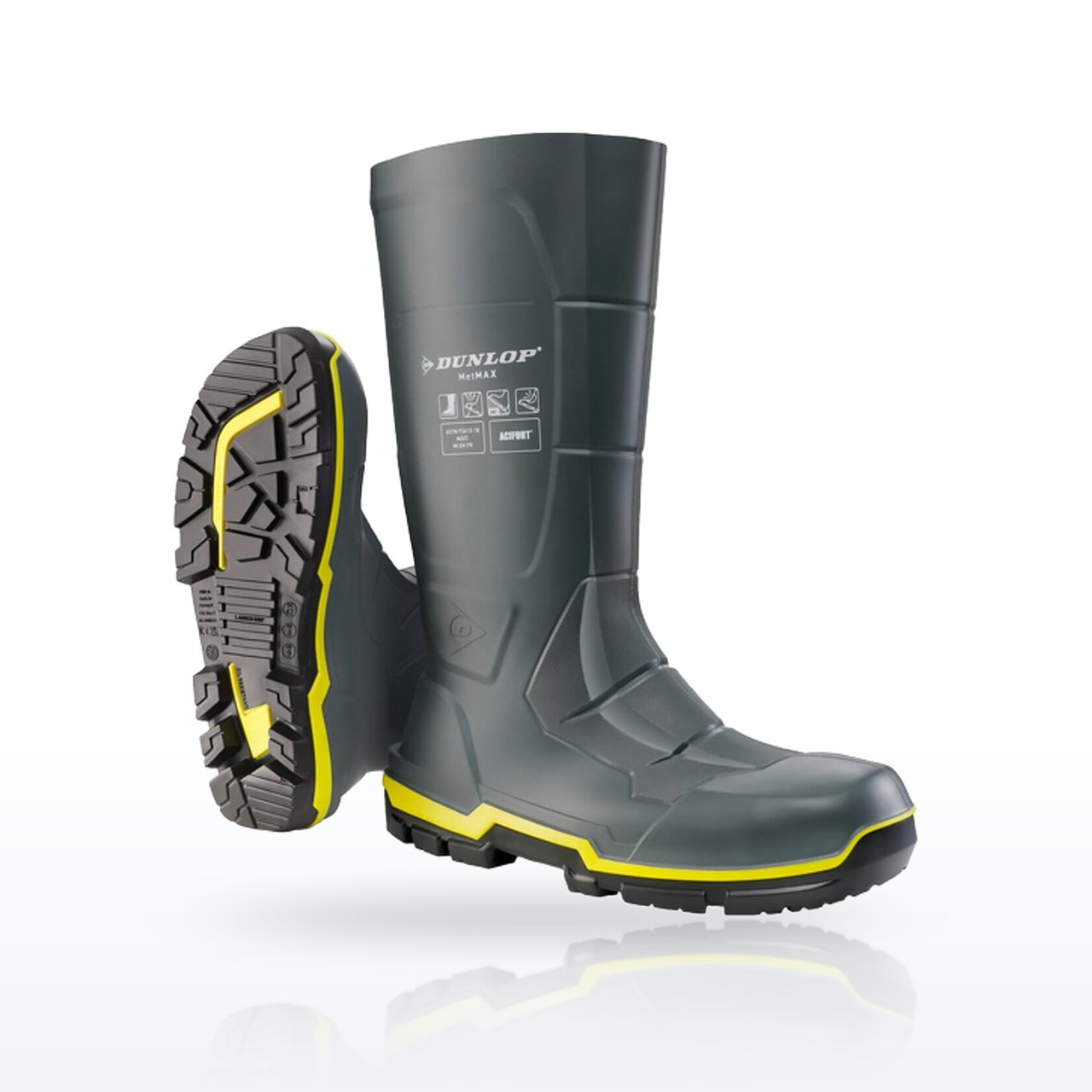

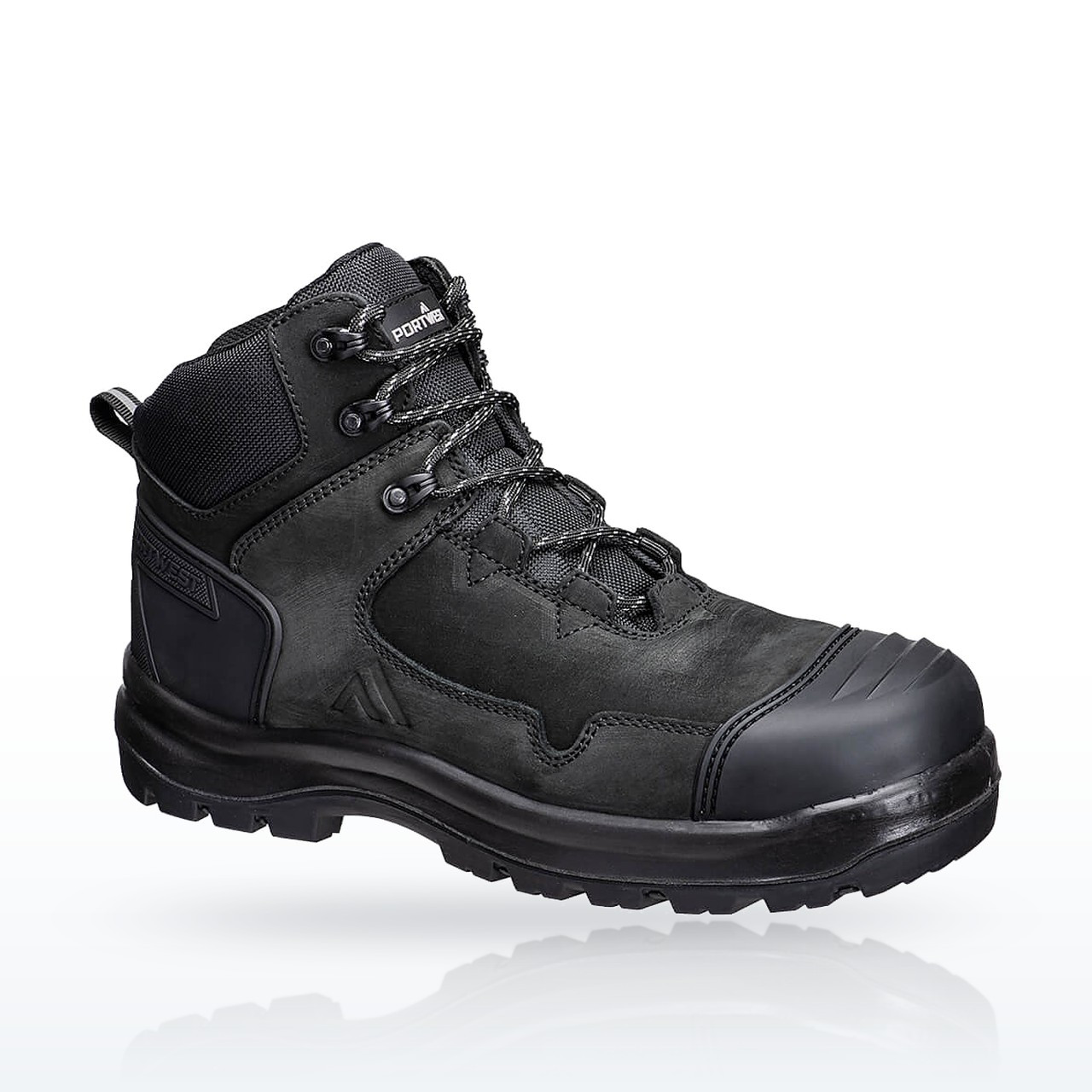
More: every boot and shoe we carry.
Source: the manufacturers' product pages, specification sheets and catalogs as reproduced on each product page; the ratings and standards shown are the manufacturers' own statements, and the products listed are those whose published data names the rating or the standard, not a selection by Bayshore Safety.
Metatarsal boots and strap-on metatarsal guards
| Part number | Item | Rating stated | Price | ||
|---|---|---|---|---|---|
| 028-090 | Blundstone Boots & Shoes, 028 Waterproof Steel Toe Metatarsal Gumboots | Metatarsal | $190.50 | Choose on the page | |
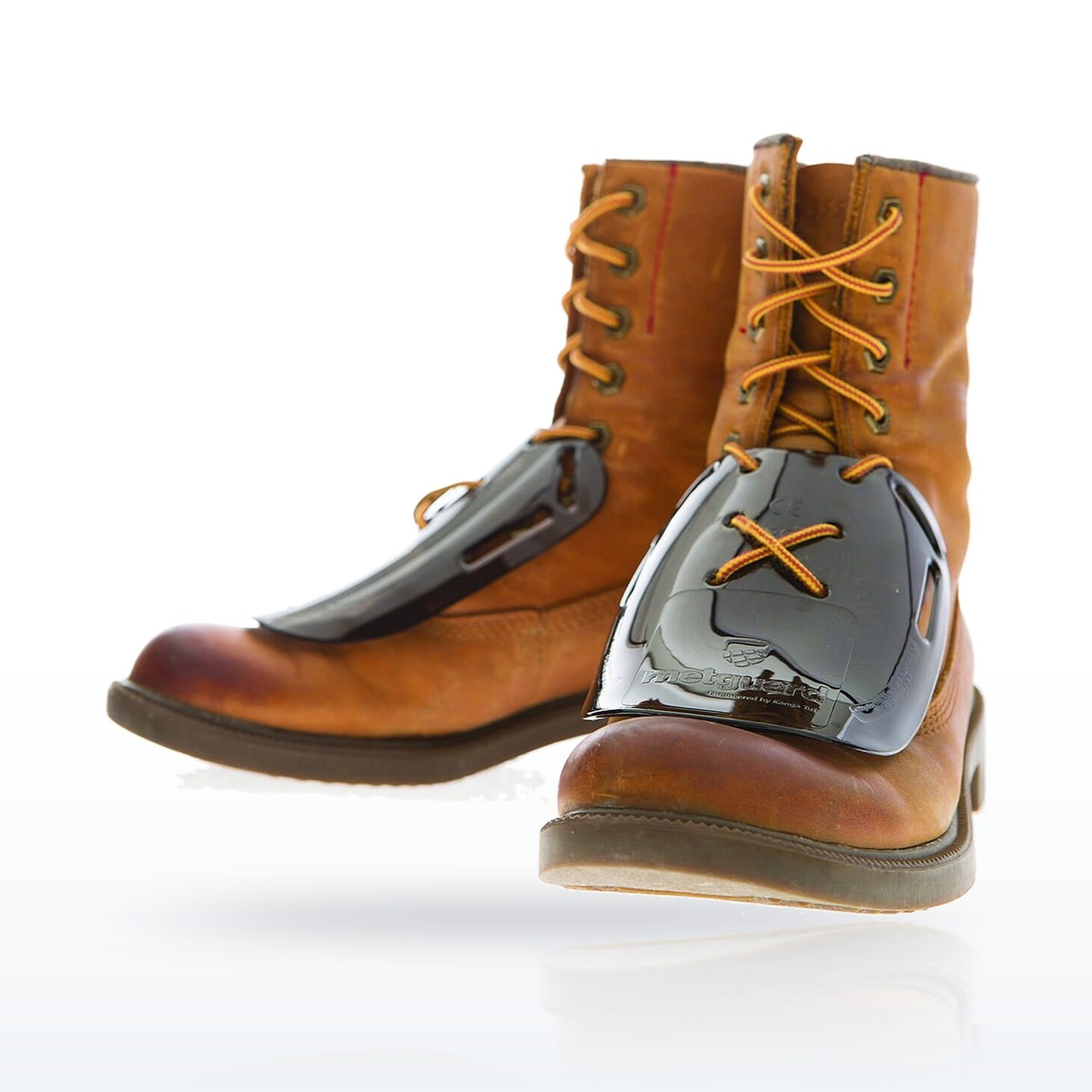 | METGUARD | Impacto METGUARD Footwear Accessories, Metatarsal Protector | METGUARD | $33.80 | |
| 65493S-BRN-100 | PIP 65396 Safety Footwear, Oliver Men's 10 in Rigger Boot, Metatarsal Protection | Metatarsal | $171.00 | ||
| MB816B | Tingley MB816B Boots & Shoes, Sigma 16 in Steel Toe Metatarsal Rubber Knee Boots | Metatarsal | $161.58 | Choose on the page |
More: every metatarsal guard.
Source: the manufacturers' product pages, specification sheets and catalogs as reproduced on each product page; the ratings and standards shown are the manufacturers' own statements, and the products listed are those whose published data names the rating or the standard, not a selection by Bayshore Safety.
Steel-toe PVC and rubber boots for wet work
More: every rubber and PVC boot.
Source: the manufacturers' product pages, specification sheets and catalogs as reproduced on each product page; the ratings and standards shown are the manufacturers' own statements, and the products listed are those whose published data names the rating or the standard, not a selection by Bayshore Safety.
Steel-toe overshoes worn over work shoes
| Part number | Item | Rating stated | Price | ||
|---|---|---|---|---|---|
| 2HS6231 | Boss 2HS6231 Safety Boots, 34 in, Rubber, Steel Toe | Steel Toe | $118.00 | Choose on the page | |
| 382-810 | Boss 382-810 Safety Boots, 16 in, PVC, Steel Toe | Steel Toe | $27.49 | Choose on the page | |
| 382-910 | Boss 382-910 Safety Boots, 16 in, PVC, Steel Toe | Steel Toe | $28.49 | Choose on the page | |
| 383-820 | Boss 383-820 Safety Boots, Black PVC Full Steel Toe Midsole | Steel Toe | $35.49 | Choose on the page | |
| 383-890 | Boss 383-890 Safety Boots, 16 in, Polyblend, Steel Toe | Steel Toe | $38.99 | Choose on the page | |
| T2GU | Impacto T2GU Overboots, TOES2GO Steel Toe Cap Overshoes | Steel Toe | $49.61 | Choose on the page | |
| 1531 | Liberty Safety DuraWear 1531 Overboots, 32.5" Black steel toe hip | steel toe | $102.00 | Choose on the page | |
 | 22205-GRY-100 | PIP 22205 Safety Boots, Oliver 22 Series 16 Inch PVC Steel Toe | Steel Toe | $106.00 |
More: every overboot and overshoe.
Source: the manufacturers' product pages, specification sheets and catalogs as reproduced on each product page; the ratings and standards shown are the manufacturers' own statements, and the products listed are those whose published data names the rating or the standard, not a selection by Bayshore Safety.
Guides that go further
Does OSHA require safety-toe shoes · What do S1, S1P, S3, S3S and S7 mean on safety boots · Who pays for PPE · What PPE does OSHA require on a construction site · OSHA 1910.136, the rule that incorporates F2413.
ASTM F2413 Performance Requirements for Protective (Safety) Toe Cap Footwear questions
What are the ASTM standards for work boots? ASTM F2413, the performance specification, and ASTM F2412, the test methods, which 29 CFR 1910.136(b) incorporates (2005 editions, with later editions accepted). F2413 covers the toe cap (I/75 C/75) and the optional metatarsal, conductive, electrical hazard, static dissipative and puncture-resistant ratings; slip resistance is tested under ASTM F2913 and is not an F2413 rating.
Does ASTM F2413-18 exceed ASTM F2413-11? The core requirements are the same: both require I/75 and C/75 toe protection, EH at 18,000 volts, Mt/75 and PR at 270 pounds. The 2011 edition dropped the I/50 and C/50 class; the 2017 and 2018 editions revised labeling and test details (puncture plate testing and the SD ranges) without raising the toe figures, so a boot labeled F2413-11 and one labeled F2413-18 have the same toe protection, and OSHA accepts both under 1910.136(b)(2).
What is stronger, steel toe or composite toe? Under F2413 they pass the same I/75 and C/75 tests, so a labeled composite cap protects to the same tested level as a labeled steel cap. Manufacturers describe composite as lighter, non-conductive and non-magnetic (and it does not conduct cold), and steel as thinner for the same rating; the rating on the label, not the material, is what 1910.136 looks at.
Does OSHA accept composite toe shoes? Yes. 1910.136(b)(1) names the standard, not the material, and F2413 rates the toe cap by test performance; a composite-toe shoe labeled ASTM F2413 I/75 C/75 meets the paragraph the same as steel.
What does ASTM stand for on boots? ASTM International, formerly the American Society for Testing and Materials, the standards body that publishes F2413 and F2412. The label line "ASTM F2413-18 M I/75 C/75 EH" means the 2018 edition, men's, impact and compression rated toe, electrical hazard sole.
What does EH mean on a boot? Electrical hazard: under F2413 the sole and heel withstood 18,000 volts at 60 Hz for one minute with no more than 1 milliampere of leakage in dry conditions. OSHA's PPE booklet describes EH footwear as a secondary source of protection against incidental contact with live circuits, compromised when wet or worn, never a substitute for the rubber insulating equipment 1910.137 requires.
The ratings, test results and standards shown here are the manufacturers' published values, reproduced as published. Nothing on this page is a recommendation by Bayshore Safety that any product is suitable for a particular task, hazard or workplace. Selecting safety products and protective equipment is the responsibility of the end user and the employer, based on their own hazard assessment and the regulations that apply to their work. Confirm every value on the manufacturer's own documentation before use.