
Horizontal Lifelines
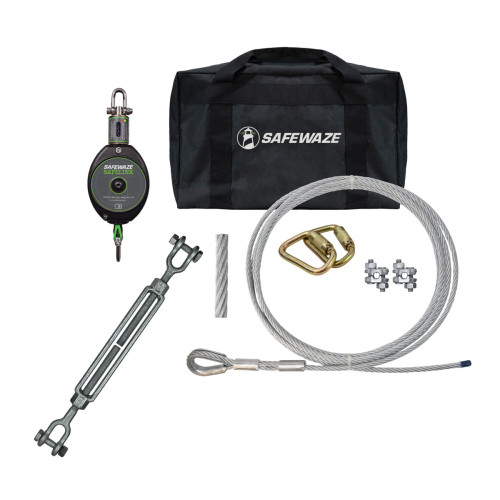
Safewaze SafeLink horizontal lifeline systems, including the 65 foot kit, for temporary tie-off across a roof, deck or steel. Span and worker capacity are in the name.
In this category
1 product from Safewaze.
Brands in this category: Safewaze (1)
How to read a fall protection rating
ANSI/ISEA Z359 covers harnesses, lanyards, self-retracting devices and anchorage connectors. A Z359.11 harness is rated for a user weight (clothing and tools included) of 130 to 310 lb; OSHA 1926.502 sets maximum arresting force at 1,800 lb with a full-body harness and a free fall of no more than 6 ft. Energy-absorbing lanyards and SRLs list the maximum arrest force and arrest distance from the standard's test; the product label carries the standard, capacity and date of manufacture.
Guides for horizontal lifelines
Horizontal Lifelines questions
Can lifelines be vertical and horizontal? Yes, and the rules differ. A vertical lifeline hangs from one anchorage and serves one worker (1926.502(d)(10)), with a rope grab as the connector; a horizontal lifeline stretches between two anchorages for one or more workers and must be designed, installed and used under a qualified person as part of a complete system with a safety factor of at least two (1926.502(d)(8)). Both have a 5,000 lb minimum breaking strength (d)(9). More in the guide: What is a horizontal lifeline, and what does 1926.502(d)(8) require? Temporary cable, rope and retractable systems, by users and span
How should you inspect a self-retracting lifeline SRL before use? Pull the line out sharply to confirm the brake locks, then let it retract fully and evenly; run the whole line through your hands looking for cuts, burns, kinks, broken wires or swelling; check the hook gate, lock and swivel, the housing for cracks and loose fasteners, the impact indicator, and that the label is readable. The user does this before each use and a competent person inspects on the schedule in the manual (1926.502(d)(21); 1910.140(c)(18)). Anything that fails comes out of service. More in the guide: SRL vs PFL: what a personal fall limiter is, and what Class 1 and Class 2 mean under ANSI Z359.14-2021
How do you calculate fall distance? Add the pieces below the anchor: the lanyard length (or the SRL’s arrest distance), the energy absorber’s deceleration distance (up to 3.5 ft under OSHA; the label gives the real figure), the height of the worker from D-ring to feet (about 5 ft), harness stretch (about 1 ft) and a safety margin (the manufacturers use 2 to 3 ft), then subtract the distance the anchor sits above the D-ring. The total is the clearance that must exist below the working surface. The worked example above runs the 6-foot lanyard case to about 18 feet. More in the guide: How to calculate fall clearance
What are the OSHA inspection requirements for personal fall protection harnesses? Inspect prior to each use for wear, damage and other deterioration, and remove defective components from service (1926.502(d)(21)); in general industry, before initial use during each workshift (1910.140(c)(18)); and after any fall arrest, remove the system from service until a competent person inspects it and determines it is undamaged and suitable (1926.502(d)(19)). OSHA sets no written-record requirement for the pre-use check; the annual competent-person inspection and its record come from ANSI Z359.11 as the manufacturers reproduce it. More in the guide: How long is a safety harness good for? Service life and retirement
What are the OSHA fall protection requirements? Construction: personal fall arrest systems inspected prior to each use for wear, damage and other deterioration, defective components removed from service (1926.502(d)(21)). General industry: inspected before initial use during each workshift for mildew, wear, damage and other deterioration (1910.140(c)(18)). Anything that has arrested a fall comes out of service until a competent person clears it ((d)(19); (c)(17)). OSHA sets no written-record or annual requirement; ANSI Z359.2 and the manufacturers do. More in the guide: How often must a harness be inspected, and what to look for
What is the difference between lifeline and lanyard? A lanyard connects the harness to the anchorage or to a lifeline and has a connector at each end. A lifeline hangs from an anchorage (vertical) or stretches between two (horizontal) and is what the lanyard or rope grab connects to (1926.500(b)). More in the guide: What is a personal fall arrest system, and what are its parts?
Ratings and specifications on this page are shown as published by the manufacturer or the named standard and describe performance in that standard's test. They are not a recommendation for any task. The employer's hazard assessment decides what protective equipment a job needs. Verify details against the manufacturer's current documentation before you buy.
