
What is the 25 percent rule in roofing? A building-code replacement rule, and the OSHA fall protection rules that do apply on a roof
The “25 percent rule” people search for is not a fall protection rule. It comes from the Florida Building Code’s existing-building provisions: when more than 25 percent of the total roof area, or a roof section, is repaired, replaced or recovered within a 12-month period, the entire roofing system or section has to be brought up to the current code (section 706.1.1 of the Existing Building volume); Florida narrowed it in 2022 (Senate Bill 4-D) so a roof built to the 2007 code or later can be repaired without the full replacement. Other states have no such rule. What does apply on every roof in the country is OSHA’s Subpart M: fall protection at 6 feet, a low-slope roof (4 in 12 or less) allowing warning lines and safety monitors in combinations, a steep roof requiring guardrails with toeboards, nets or a personal fall arrest system, and a residential roof covered by 1926.501(b)(13). The rest of this page is those rules, and the anchors and kits the manufacturer lists for them.
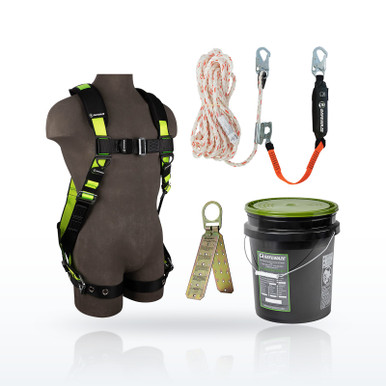 Safewaze PRO FS120 Fall Protection Kits, Bucket Roof Kit, FS280 HarnessRoof kit: harness, rope lifeline with rope grab, lanyard and reusable roof anchor in one bucket (Safewaze data)
Why the two rules get mixed up. Both are “roofing rules” and both turn on a number, so the search engines merge them. The 25 percent rule governs what a roofing contractor has to replace when the owner pays for a partial repair; it is a code and insurance question, not a safety one, and it exists in one state’s code. OSHA’s roofing rules govern how the crew is protected while the work is done, apply in every state (federal OSHA or a state plan such as Cal/OSHA), and turn on three numbers of their own: 6 feet to the lower level, 4 in 12 for the slope, and 50 feet for the roof width that allows a safety monitor alone. A crew that knows which rule is which spends its planning on the one that carries a citation.
The OSHA roofing rules, by roof
From 1926.500(b), 1926.501(b) and 1926.502.
What the roof anchor manufacturer adds
The manufacturer’s installation rules sit under OSHA’s system rules:
- The FS871 knock-down anchor is installed a minimum of 5 feet from any edge, over secured sheathing with the fastener holes over a truss, with fasteners that penetrate both the sheathing and the truss (a minimum of 1-1/2 inches into the truss); it must not be installed into the truss or the sheathing alone.
- The substrate is inspected before installation for rot, cracks, severe weathering, soft or deteriorated areas in the sheathing and storm damage.
- The reusable (FS870) and knock-down (FS871) anchors ship as anchor only, fasteners only, or anchor with plated steel 16D roofing nails or 2-1/2 inch plated steel sheet metal screws.
- For restraint on a roof the manufacturer allows its anchors only on slopes up to 4/12, with a structure that holds 1,000 pounds and no free fall possible; above 4/12 the system is arrest, and the clearance below the eave has to be there.
- Every Safewaze roof anchor lists ANSI 130–310 lb and OSHA up to 420 lb and its own minimum breaking strength (5,000 lb on the reusable, permanent, peak, ridge, chain, ring and post anchors; 3,600 lb on the knock-down, standing seam, membrane and TileLink anchors; 1,800 lb on the wood truss/attic anchor), is inspected before each use and annually by a competent person, and is removed from service after a fall.
The California rule FallTech reports for residential roofs
FallTech’s California note: from July 1, 2025 Cal/OSHA’s residential rules call for fall protection at 6 feet, down from 15, for roofing and framing work (guardrails, nets, scaffolds or a personal fall arrest system, or a fall protection plan with monitors and controlled access zones where those cannot be used), with interior framing between 6 and 15 ft allowed on a plan only when members are braced or laid flat, gaps are 24 inches or less or covered, and workers stay 6 ft from an unprotected edge; starter boards, sheathing and fascia, work outside the gable truss, and low-slope roofs from 0:12 to 7:12 are named. FallTech states the agency has announced a lower trigger height for all construction in 2026. Its roof anchor pages list each anchor’s application (reusable, single-use or permanent), the substrate (wood, or steel deck and metal roofing for the 7410M) and the minimum breaking strength, and its roofer’s kits (8595A, 8595RA, 8596A, 9103JK) bundle the 7016 Contractor harness, the 8150 vertical lifeline, a trailing rope adjuster or anti-panic fall arrester (8368 or 8388) and a hinged reusable wood roof anchor (7410) or a 6 ft pass-through anchor (7372).
FallTech, “Cal/OSHA Lowers Fall Protection Height for Residential Work” (falltech.com, fetched Nov 8 2026); Cal/OSHA Title 8 sections 1716.2 and 1730 (residential framing and roofing); FallTech Wood Frame Structure Anchors manual MANC04 and MANC28; the Application and Minimum Breaking Strength fields on each FallTech roof anchor page.Questions people ask
What is the 25 percent rule for roofing?
A Florida Building Code rule: when more than 25 percent of a roof area or section is repaired, replaced or recovered in a 12-month period, the whole roof or section is brought to current code (Existing Building 706.1.1), narrowed by SB 4-D in 2022 for roofs built to the 2007 code or later. It is not an OSHA rule and does not exist in most states.
Are roof anchors required by code?
OSHA requires the fall protection, not the anchor: at 6 feet on a roof the worker must have a guardrail, net, personal fall arrest system or, on a low-slope roof, a warning line with one of those or with a safety monitor (1926.501(b)(10) and (11)). Where a personal fall arrest system is the choice, an anchorage that meets 1926.502(d)(15) is required. Permanent roof anchors on a building are a matter of the building code and the owner’s window-washing and maintenance obligations (IBC and ANSI/IWCA I-14.1 as the authority having jurisdiction applies them), not of Subpart M.
Can you work on a roof without a harness?
Yes, where the protection is something else: a guardrail, a safety net, or on a low-slope roof a warning line paired with a guardrail, net, arrest system or safety monitor, or a safety monitor alone on a roof 50 feet or less wide (1926.501(b)(10)). On a steep roof the only choices are guardrails with toeboards, nets or a personal fall arrest system (1926.501(b)(11)). Below 6 feet to the lower level no fall protection is required.
What do roofers use to not slip?
Footwear and work practice, not fall protection equipment: soft rubber soles, roof brackets and toe boards on steep roofs (toe boards are part of a guardrail system under 1926.502(b)(10)), and dry decking. None of it substitutes for the fall protection 1926.501(b)(10) and (11) require at 6 feet; a slide guard is not fall protection on its own since the 2011 directive ended that policy.
What is the OSHA 6-foot rule for roofs?
Fall protection is required at 6 feet above a lower level on every roof in construction (1926.501(b)); the slope decides which systems are allowed.
What is a low-slope roof?
A roof with a slope of 4 in 12 or less (1926.500(b)). Low-slope roofs allow warning lines combined with another system and, on roofs 50 feet or less wide, a safety monitor alone.
How far from the edge does a warning line go?
Not less than 6 feet, or 10 feet where mechanical equipment is being used, on all sides of the work area (1926.502(f)(1)).
How far from the edge does a roof anchor go?
The manufacturer sets it: Safewaze installs the FS871 knock-down anchor a minimum of 5 feet from any edge and the permanent roof anchors at a minimum of 6 feet, both over a truss.
The ratings, test results and standards shown here are the manufacturers' published values, reproduced as published. Nothing on this page is a recommendation by Bayshore Safety that any product is suitable for a particular task, hazard or workplace. Selecting safety products and protective equipment is the responsibility of the end user and the employer, based on their own hazard assessment and the regulations that apply to their work. Confirm every value on the manufacturer's own documentation before use.