
Roof anchors by roof type: wood, standing seam, corrugated, tile and membrane, and whether an anchor can stay on the roof
A roof anchor is matched to the roof structure, not to the worker: a wood-framed roof takes a nailed or screwed anchor over a truss, a standing seam roof takes a clamp that grips the seams without piercing the panel, a corrugated roof takes a drop-through anchor whose fasteners reinstall to keep the roof watertight, a tile roof takes an anchor fastened to the truss under the tile, and a membrane roof takes an anchor with an elevated eye to keep the connector off the membrane. Safewaze lists its anchors that way in its roofing brochure, with one capacity across the line (ANSI 130–310 lb, OSHA up to 420 lb) and a minimum breaking strength it publishes per anchor (5,000 lb on the reusable, permanent, peak, ridge, chain, ring and post anchors, 3,600 lb on the knock-down, standing seam, membrane and TileLink anchors). Whether an anchor stays on the roof is also the manufacturer’s call: the permanent roof anchors are designed to stay and be inspected every six months; the FS871 knock-down anchor can be removed, or hammered flat and shingled over, or have its connection point snapped off; the FS870 reusable anchor is removed and reused; and any anchor that has arrested a fall is removed and destroyed.
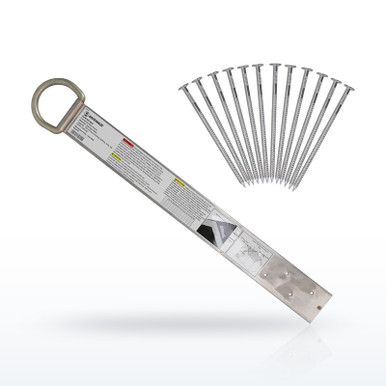 Safewaze 020-4026 Roof Anchors, PermanentPermanent roof anchor, stainless and zinc-plated steel, installed under the ridge cap (Safewaze data)
Why the roof decides. The OSHA rule is about the anchorage, not the anchor: 1926.502(d)(15) requires the anchorage to hold 5,000 pounds per worker or be part of a complete system with a safety factor of two designed by a qualified person. The anchor is the hardware that transfers that load into the roof, and it only does so if it is fastened the way the manufacturer tested it: through the sheathing into a truss, clamped on a seam of the right profile, bolted through a purlin. An anchor on the wrong roof, or on the right roof with the wrong fasteners, has a breaking strength on its label that the roof will never see. That is why the manufacturer’s manuals read like carpentry instructions, and why Safewaze issues bulletins on lag bolt lengths, seam clamp profiles and corrugated panel installation.
Anchors by roof type, as the manufacturer lists them
Safewaze’s roofing brochure and manuals; the part numbers are in the band below.
Can a roof anchor stay on the roof? What each manual says
From the manuals, by anchor:
- Permanent roof anchors (020-4025, 4026, 4027): designed to be installed underneath the ridge cap or shingles and left in place; inspected before each use and at least every 6 months by a competent person other than the user, with the inspection documented; installed a minimum of 6 feet from the edge, never on unsupported areas such as eaves and never directly onto a truss with no sheathing.
- Knock-down anchor (FS871): a temporary anchor. When no longer needed it can be removed in its entirety, or the connection point can be hammered flat and shingled over, or the connection point can be snapped off and removed; installation damages the substrate and the user is responsible for the repair.
- Reusable ring anchor (FS870): installed with nails or screws for the job and removed and reused; inspected before each use and annually.
- Every Safewaze roof anchor: the minimum breaking strength on its page (5,000 lb or 3,600 lb by anchor, 1,800 lb on the wood truss/attic anchor); capacity ANSI 130–310 lb and OSHA up to 420 lb including tools and clothing; a structure that supports 5,000 lb or a 2:1 factor set by a qualified person; removed from service immediately and destroyed after it has been subjected to fall arrest forces.
- For restraint (keeping the worker off the edge) the manufacturer allows its anchors on slopes up to 4/12 only, with the structure holding 1,000 lb and no free fall possible.
Fasteners and placement by anchor, from the manufacturer
| Anchor | Fasteners | Placement |
|---|---|---|
| FS870 Reusable Roof Anchor | Plated steel 16D roofing nails or 2-1/2 in plated steel sheet metal screws (FS870N, FS870S) | Peak or flat wood roof, over a truss; removed and reused |
| FS871 Knock-Down Roof Anchor | 16D nails (FS871N) through sheathing and truss, 1-1/2 in minimum into the truss | Minimum 5 ft from any edge; hammered flat and shingled over, or removed |
| 020-4025 to 4027 Permanent, Peak and Ridge | Ten 16D nails under the ridge cap or shingles | Minimum 6 ft from the edge, over a truss; stays in place, 6-month competent-person inspection |
| 023-4095 / 023-4096 / FS-EX311 Standing seam | Seam clamps, no roof penetration; crossarm 24–40 in | Seam profiles per Technical Bulletin 00320 |
| 024-4112 / 024-4113 Corrugated | Drop-through, fasteners reinstalled to keep the roof watertight | Ridge height up to 1-3/4 in, width up to 3-3/4 in; see bulletins 00277 and 00316 |
| 022-4092 / 022-4094 TileLink | Screws into a wooden truss or rivets into a metal truss | Directly under the tile |
| 022-4090 Membrane | Per the manual; elevated eye bolt | Membrane roofs; eye keeps the connector off the membrane |
Fastener counts and edge distances are the manufacturer’s; the roof’s structure is confirmed by a competent person before installation.
Source: Safewaze roof anchor manuals, Roof Anchors with Fasteners flyer, Fall Protection in Roofing brochure, Technical Bulletins 00277, 00316, 00320, 00324.
What FallTech adds for its roof anchors
FallTech’s California note: from July 1, 2025 Cal/OSHA’s residential rules call for fall protection at 6 feet, down from 15, for roofing and framing work (guardrails, nets, scaffolds or a personal fall arrest system, or a fall protection plan with monitors and controlled access zones where those cannot be used), with interior framing between 6 and 15 ft allowed on a plan only when members are braced or laid flat, gaps are 24 inches or less or covered, and workers stay 6 ft from an unprotected edge; starter boards, sheathing and fascia, work outside the gable truss, and low-slope roofs from 0:12 to 7:12 are named. FallTech states the agency has announced a lower trigger height for all construction in 2026. Its roof anchor pages list each anchor’s application (reusable, single-use or permanent), the substrate (wood, or steel deck and metal roofing for the 7410M) and the minimum breaking strength, and its roofer’s kits (8595A, 8595RA, 8596A, 9103JK) bundle the 7016 Contractor harness, the 8150 vertical lifeline, a trailing rope adjuster or anti-panic fall arrester (8368 or 8388) and a hinged reusable wood roof anchor (7410) or a 6 ft pass-through anchor (7372).
FallTech, “Cal/OSHA Lowers Fall Protection Height for Residential Work” (falltech.com, fetched Nov 8 2026); Cal/OSHA Title 8 sections 1716.2 and 1730 (residential framing and roofing); FallTech Wood Frame Structure Anchors manual MANC04 and MANC28; the Application and Minimum Breaking Strength fields on each FallTech roof anchor page.Questions people ask
Can you leave a roof anchor on the roof?
A permanent roof anchor is designed to stay, under the ridge cap or shingles, with a competent-person inspection every 6 months in Safewaze’s manual. A knock-down anchor can be hammered flat and shingled over or removed; a reusable anchor is removed and reused. An anchor that has arrested a fall is removed and destroyed.
Are roof anchors required by code?
OSHA requires the fall protection, not the anchor: at 6 feet on a roof the worker must have a guardrail, net, personal fall arrest system or, on a low-slope roof, a warning line with one of those or with a safety monitor (1926.501(b)(10) and (11)). Where a personal fall arrest system is the choice, an anchorage that meets 1926.502(d)(15) is required. Permanent roof anchors on a building are a matter of the building code and the owner’s window-washing and maintenance obligations (IBC and ANSI/IWCA I-14.1 as the authority having jurisdiction applies them), not of Subpart M.
Can you work on a roof without a harness?
Yes, where the protection is something else: a guardrail, a safety net, or on a low-slope roof a warning line paired with a guardrail, net, arrest system or safety monitor, or a safety monitor alone on a roof 50 feet or less wide (1926.501(b)(10)). On a steep roof the only choices are guardrails with toeboards, nets or a personal fall arrest system (1926.501(b)(11)). Below 6 feet to the lower level no fall protection is required.
What are the OSHA requirements for roof tie-offs?
The same as anywhere else: the anchorage holds 5,000 lb per attached worker or is engineered at a safety factor of two, is independent of any anchorage used to support platforms, and is not a guardrail or hoist (1926.502(d)(15) and (23)); the system keeps free fall to 6 feet and the worker off the lower level (d)(16); a vertical lifeline serves one worker (d)(10). Safewaze’s roof anchor manuals add the fastener count and placement for each anchor.
How much weight does a roof anchor hold?
Safewaze lists a minimum breaking strength per anchor (5,000 lb on the reusable, permanent and chain anchors, 3,600 lb on the knock-down and standing seam anchors) and a user capacity of ANSI 130–310 lb and OSHA up to 420 lb; OSHA 1926.502(d)(15) requires the anchorage to hold 5,000 lb per worker or be part of a 2:1 engineered system.
Where do you install a roof anchor?
Over a truss, through secured sheathing, a minimum of 5 feet (knock-down) or 6 feet (permanent) from the edge in Safewaze’s manuals, never on eaves or other unsupported areas, after the sheathing has been checked for rot and damage.
What anchor goes on a standing seam roof?
A seam clamp anchor that grips the seams without piercing the panel; Safewaze lists the 023-4095 SRL swivel anchor, the 023-4096 swivel anchor and the FS-EX311 crossarm anchor, with the seam profiles in its Technical Bulletin 00320.
What anchor goes on a metal corrugated roof?
A drop-through anchor whose fasteners reinstall to keep the roof watertight; Safewaze’s 024-4112 (steel) and 024-4113 (stainless) fit ridge heights up to 1-3/4 inches and widths up to 3-3/4 inches.
How often are roof anchors inspected?
Before each use by the user, and by a competent person annually on the temporary anchors and every 6 months on the permanent roof anchors, documented, in Safewaze’s manuals.
The ratings, test results and standards shown here are the manufacturers' published values, reproduced as published. Nothing on this page is a recommendation by Bayshore Safety that any product is suitable for a particular task, hazard or workplace. Selecting safety products and protective equipment is the responsibility of the end user and the employer, based on their own hazard assessment and the regulations that apply to their work. Confirm every value on the manufacturer's own documentation before use.