
Benzene exposure limits: the OSHA 1910.1028 PEL, STEL and action level, what counts as benzene exposure, what the employer must do above the PEL, and how benzene is measured with a PID or a detector tube
OSHA regulates benzene in its own standard, 29 CFR 1910.1028, not just in Table Z-1. The permissible exposure limits are 1 ppm as an 8-hour time-weighted average and 5 ppm as a 15-minute short-term exposure limit; the action level is 0.5 ppm as an 8-hour TWA, and crossing it starts periodic monitoring and medical surveillance. The standard applies to all occupational exposures to benzene (CAS 71-43-2) except the fuel-handling, bulk-loading, sealed-container and low-benzene exceptions in paragraph (a)(2), so a refinery, a chemical plant, a coke oven or a laboratory is in, while a gas station dispensing fuel less than four hours a day indoors is out. Exposure is determined from breathing-zone air samples representative of each job (e)(1); where the initial monitoring shows exposure at or above the action level the employer monitors at least yearly, and above the TWA at least every six months (e)(3). Above the PEL the employer establishes a regulated area limited to authorized persons (d), institutes engineering controls and work practices first (f), supplements them with respirators under 1910.134 where they cannot hold the limit (g), posts the DANGER BENZENE MAY CAUSE CANCER sign (j)(2), and makes medical surveillance available (i). NIOSH lists benzene as a potential occupational carcinogen with a REL of 0.1 ppm and an IDLH of 500 ppm. Direct-reading measurement is by a photoionization detector; RKI Instruments’ FAQ describes its 10.0 eV lamp and benzene filter tube for a benzene-specific reading, and Draeger’s benzene detector tubes give a spot reading with a hand pump.
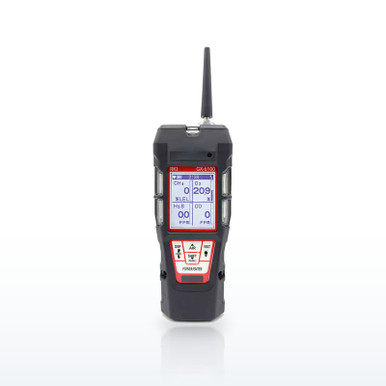 RKI Instruments 72-61XZBX-C GX-6100 2-Gas Monitor, Benzene/VOC, Li-ionGX-6100 with a benzene channel: RKI’s 10.0 eV lamp and benzene filter tube in Benzene Specific Mode, as RKI states
Why benzene has its own standard. Benzene causes leukemia, so OSHA wrote 1910.1028 in 1987 with limits far below the old Table Z value and with the machinery of a carcinogen standard: an action level that triggers monitoring and medical surveillance before the PEL is reached, regulated areas, a hierarchy of controls, a sign that names the cancer hazard, and 30-year exposure records. The limits are low enough that a general PID reading does not answer the question: a 10.6 eV lamp reads every ionizable vapor in the air as one number, and the standard’s Appendix D accepts portable direct-reading instruments only where the method is specific and accurate enough for the compliance decision. RKI’s answer, described in its FAQ, is a 10.0 eV lamp that ignores most aliphatic solvents and reads the aromatics, with a filter tube that strips the rest, in a Benzene Specific Mode whose sampling time runs 35 to 135 seconds by temperature; the laboratory answer is a charcoal tube and gas chromatography.
The 1910.1028 numbers and duties
What counts as benzene exposure, and how it is measured
- The standard covers liquefied or gaseous benzene, benzene in liquid mixtures and the vapors they release, but not trace amounts of unreacted benzene in a process (b, definition of benzene); exposure is determined from breathing-zone samples representative of each employee’s average exposure (e)(1)(i).
- Excluded by (a)(2): storage, transport, distribution and use of gasoline and motor fuels after final discharge from bulk storage (except indoor dispensing more than 4 hours a day); bulk loading with vapor control; sealed containers and pipelines; mixtures under 0.1 percent benzene and natural gas plants processing gas under 0.1 percent; and oil and gas drilling, production and servicing, which 1910.1000 Table Z-2 covers instead.
- Appendix D: representative 8-hour exposure from one 8-hour sample or two 4-hour samples, or at least five random short-interval samples over the shift; charcoal tubes with gas chromatography are the reference method, and portable direct-reading instruments, real-time continuous monitors and passive dosimeters may be used where they meet the standard’s accuracy requirement.
- A PID in a multi-gas monitor: RKI’s GX-6100 carries 10.0, 10.6 and 11.7 eV lamps; the 10.0 eV lamp with RKI’s benzene filter tube reads benzene selectively in Benzene Specific Mode, with the sampling time through the tube set from the temperature (35 to 135 seconds). A general 10.6 eV reading is total ionizable vapor and is corrected for benzene only if benzene is the only vapor present.
- A detector tube: Draeger’s benzene tubes (0.25/a, 2/a, 5/a, 15/a ranges) give a spot reading with the accuro hand pump, with the cross-sensitivities on the tube’s data sheet; a tube reads once and does not alarm or log.
- Where benzene is found, by RKI’s FAQ: crude oil and gasoline, refinery and petrochemical streams, coke ovens, and solvents; RKI quotes the OSHA PEL of 1 ppm, the NIOSH REL of 0.1 ppm and the IDLH of 500 ppm on the same page.
- Records: every monitoring result that measures an employee’s exposure is an exposure record kept 30 years under 1910.1020, and the standard’s own recordkeeping in (k) applies.
Questions people ask
What is considered benzene exposure?
Under 1910.1028, an employee being exposed to airborne benzene in a covered workplace, measured in the breathing zone as an 8-hour average and a 15-minute STEL; the standard covers benzene gas, liquid, liquid mixtures and their vapors, with the fuel-handling, sealed-container and under-0.1-percent exceptions in paragraph (a)(2).
What are the OSHA standards for benzene?
29 CFR 1910.1028 in general industry (PEL 1 ppm TWA, STEL 5 ppm, action level 0.5 ppm, regulated areas, monitoring, respirators, medical surveillance, signs and records), with Table Z-2 of 1910.1000 covering the operations 1910.1028 excludes.
What is the OSHA PEL for benzene exposure?
1 ppm as an 8-hour time-weighted average, with a 5 ppm short-term exposure limit over 15 minutes (1910.1028(c)).
What must your employer do if the concentration of benzene in the air is found to exceed the PEL?
Establish a regulated area limited to authorized persons with the benzene cancer sign, institute engineering controls and work practices to reduce exposure, supplement them with respirators under 1910.134 where the controls cannot hold the limit, repeat monitoring at least every six months, and make medical surveillance available (1910.1028(d), (f), (g), (e)(3) and (i)).
What is ACGIH TLV for benzene?
ACGIH publishes a TLV for benzene in its licensed TLVs and BEIs book; it is not reproduced here. The enforceable federal number is OSHA’s 1 ppm PEL and the NIOSH recommendation is 0.1 ppm.
What are three symptoms if you are exposed to benzene?
The NIOSH Pocket Guide lists irritation of the eyes, skin, nose and respiratory system; dizziness, headache, nausea and staggered gait; and, with longer exposure, bone marrow depression; it names leukemia as the cancer site.
Your employer is required to provide medical surveillance for all workers at risk for benzene exposure. What does this surveillance include?
Under 1910.1028(i), examinations by or under a licensed physician with laboratory tests by an accredited laboratory, for employees exposed at or above the action level 30 or more days a year or at or above the PEL 10 or more days a year; the paragraph sets the initial and periodic examinations and the blood counts.
How is benzene measured in the air?
By breathing-zone sampling on charcoal tubes with laboratory gas chromatography as the reference, or by a portable direct-reading instrument that meets the standard’s accuracy requirement (Appendix D): a PID with a 10.0 eV lamp and benzene filter tube as RKI Instruments describes, or a Draeger benzene detector tube for a spot reading.
Does a PID detect benzene?
Yes; benzene’s ionization potential is 9.24 eV, below every PID lamp. A 10.6 eV lamp reads it mixed with every other ionizable vapor; RKI’s 10.0 eV lamp with the benzene filter tube reads it selectively in Benzene Specific Mode.
Is benzene flammable?
Yes: the NIOSH Pocket Guide lists a flash point of 12 °F and a flammable range of 1.2 to 7.8 percent by volume, a Class IB flammable liquid; the toxic limits are thousands of times lower than the LEL, so the PID or tube, not the LEL channel, is the exposure measurement.
Related guides
VOC detection with a PIDWhat a photoionization detector measuresPEL vs REL vs TLVWho sets each limitTWA, STEL and ceilingWhat each limit meansToxic and flammable gases at workIDLH, PEL and LEL for 17 gasesDetector tubes vs electronic monitorsWhen each is usedGas monitors by jobWastewater, utilities, oil and gas, fire, marineThe ratings, test results and standards shown here are the manufacturers' published values, reproduced as published. Nothing on this page is a recommendation by Bayshore Safety that any product is suitable for a particular task, hazard or workplace. Selecting safety products and protective equipment is the responsibility of the end user and the employer, based on their own hazard assessment and the regulations that apply to their work. Confirm every value on the manufacturer's own documentation before use.