
At what height does Cal/OSHA require fall protection on a house? The residential rule that moved from 15 feet to 6 feet on July 1, 2025
In California the residential answer changed on July 1, 2025. Before that date Cal/OSHA’s residential framing and roofing sections allowed work to 15 feet before conventional fall protection was required; from that date the trigger is 6 feet for most residential roofing and framing, which matches federal OSHA’s construction rule. FallTech’s note on the change lists what the revised sections ask for: at 6 feet or more, guardrails, safety nets, scaffolding or a personal fall arrest system, with a fall protection plan using trained safety monitors and controlled access zones where those cannot be used; interior framing between 6 and 15 feet on a plan only when the structural members are braced or laid flat, gaps between them are 24 inches or less or covered with plywood, and workers stay at least 6 feet from an unprotected edge; fall protection for framed wall layout on floors 6 feet or higher even where walls will enclose the space; roofing tasks such as starter boards, sheathing and fascia at 6 feet; work outside the gable end truss or rafter at 6 feet; and low-slope roofs from 0:12 to 7:12 at 6 feet. The rest of Cal/OSHA’s construction fall protection, section 1669 and its 7½-foot general trigger, is unchanged, and FallTech reports the agency has announced a lower trigger height for all construction work in 2026.
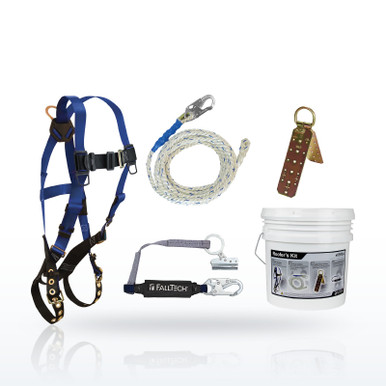 FallTech 8595A Roofer's Kits, Hinged Reusable Anchor and Trailing Rope AdjusterRoofer’s kit: Contractor harness, hinged reusable anchor, 50 ft vertical lifeline and rope adjuster (FallTech data)
Why California was different, and why it is not now. Federal OSHA set 6 feet for residential construction in 1926.501(b)(13) and ended the long-running interim alternatives in 2011 with STD 03-11-002. California runs its own plan, and its residential framing section kept a 15-foot trigger for years on the argument that framing crews moving across joists could not tie off practically below that height. The 2025 revision closes most of that gap: 6 feet is the trigger, and the 15-foot figure survives only as the ceiling of the interior-framing band in which a written plan with braced members, covered gaps and a 6-foot setback can replace conventional systems. For a Bay Area roofer or framer the practical change is that the anchors, lifelines and harnesses federal crews have carried since 2011 are now the California kit too, and FallTech’s note on the change points to the roofer’s kit, harness, lanyard or lifeline, anchor and bag in one order, as the common way crews are meeting it.
What the revised residential rule asks for, by task
As FallTech summarizes the July 1, 2025 change; the Cal/OSHA text governs.
The federal rule beside it, and what FallTech adds for the roof
For comparison and for the gear:
- Federal: 1926.501(b)(13) requires guardrail, net or personal fall arrest at 6 feet in residential construction, with a written fall protection plan under 1926.502(k) only where the employer demonstrates those are infeasible or create a greater hazard; STD 03-11-002 (2011) ended the interim alternative methods.
- California: section 1669 keeps the general construction trigger at 7½ feet for work not covered by a specific section; the residential sections now read 6 feet as above.
- FallTech: its roofer’s kits bundle a Contractor harness, a hinged reusable wood roof anchor or a pass-through anchor, a 50 ft vertical lifeline and a trailing rope adjuster; each kit page lists the component part numbers.
- FallTech’s roof anchor pages list the application for each anchor, reusable, single-use or permanent, the substrate (wood; steel deck and metal roofing for the 7410M) and the minimum breaking strength (3,600 lb on the single-use ridge anchor, 5,000 lb on the reusable and permanent anchors).
- FallTech’s FAQ: where a below-D-ring anchor must be used, setting it farther back from the edge reduces the clearance needed; its harness manual removes any anchor that has arrested a fall from service.
Questions people ask
At what height does Cal/OSHA require fall protection in residential construction?
6 feet, for most residential roofing and framing, from July 1, 2025; before that the residential sections allowed 15 feet. FallTech’s note on the change lists the tasks and the plan conditions.
Are roofers required to wear harnesses?
In California residential work, since July 1, 2025, at 6 feet unless a guardrail, net or other listed system protects them; under federal OSHA, roofers on a low-slope roof at 6 feet may be protected by guardrails, nets, personal fall arrest, or warning line combinations (and a safety monitor alone on roofs 50 feet wide or less), and on a steep roof by guardrails with toeboards, nets or personal fall arrest (1926.501(b)(10)–(11)). A harness is required when the employer chooses personal fall arrest or restraint to meet those rules; the other systems do not use one.
How do roofers keep from falling off the roof?
With the systems the rules allow for the roof type: a roof anchor (reusable hinged anchor on the ridge or a permanent post) with a rope lifeline, rope grab and lanyard in fall arrest, or a restraint line set short of the eave; guardrails at the edge; warning lines and a safety monitor on low-slope commercial roofs; and on a steep roof the roof jacks, slide guards and toeboards that stop a slide before the edge. FallTech’s roofer’s kits and roofing anchors above are the personal system side of it.
Is California stricter than federal OSHA on fall protection?
Cal/OSHA runs its own plan that must be at least as strict as federal rules and often adds requirements; on residential height the two now match at 6 feet, while Cal/OSHA’s general construction trigger in section 1669 is 7½ feet against the federal 6.
Can a framing crew still work to 15 feet without harnesses?
Only on interior framing between 6 and 15 feet under a fall protection plan, and only when the members are braced or laid flat, gaps are 24 inches or less or covered with plywood, and workers stay 6 feet from an unprotected edge, as FallTech summarizes the revised section.
Does the rule cover low-slope roofs?
Yes. FallTech lists low-slope roofs with a pitch from 0:12 to 7:12 at a 6-foot fall distance: harnesses, guardrails, nets, scaffolding, or a plan with trained monitors where those are not feasible.
What is a roofer’s kit?
One order holding the parts of a roof fall arrest system: FallTech’s kits carry a Contractor harness, a hinged reusable or pass-through roof anchor, a 50 ft vertical lifeline and a trailing rope adjuster or anti-panic fall arrester, with the component part numbers on the kit page.
Is a bigger change coming?
FallTech reports Cal/OSHA has announced plans to lower the fall protection trigger height for all construction activities in 2026; the sections in force are the ones to read.
The ratings, test results and standards shown here are the manufacturers' published values, reproduced as published. Nothing on this page is a recommendation by Bayshore Safety that any product is suitable for a particular task, hazard or workplace. Selecting safety products and protective equipment is the responsibility of the end user and the employer, based on their own hazard assessment and the regulations that apply to their work. Confirm every value on the manufacturer's own documentation before use.