
Bayshore Safety & Industrial Supplies Guide
What does Cal/OSHA require for first aid and eyewash stations in California? Title 8 sections 3400, 1512, 5162 and 3439, the monthly eyewash activation, and how they differ from federal OSHA
California runs its own OSHA program, and its first aid rules are in Title 8 of the California Code of Regulations rather than 29 CFR. Section 3400 is the general industry rule: medical personnel available for advice (a); where no infirmary, clinic or hospital is in near proximity, persons trained to render first aid with training "equal to that of the American Red Cross or the Mine Safety and Health Administration" (b); "adequate first-aid materials, approved by the consulting physician, readily available for employees on every job", kept sanitary and usable, frequently inspected and replenished (c); quick drenching or flushing facilities within the work area where eyes or body may be exposed to injurious corrosive materials (d); stretchers and blankets where the Division requires them "unless ambulance service is available within 30 minutes under normal conditions" (e); and advance provisions for prompt medical treatment of serious injury through a communication system able to direct emergency services to the location, on-site treatment facilities, or transport equipment (f). Section 1512 is the construction version with its supply table and written plan; section 5162 is the eyewash and shower rule, which requires plumbed or self-contained equipment meeting ANSI Z358.1 wherever eyes may contact a corrosive, severely irritating, permanently damaging or absorption-toxic substance, within 10 seconds, with plumbed units "activated at least monthly to flush the line and to verify proper operation"; section 3439 is the farm rule with a first aid kit at headquarters or on the crew bus and one trained employee per 20 at remote locations.
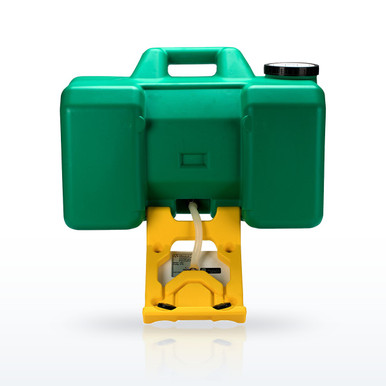 First Aid Only M7501 HAWS 15 Minute Eye Wash StationFirst Aid Only prints the HAWS 15-minute gravity-fed eyewash station, certified by CSA to ANSI Z358.1, 15 minutes at 0.4 gallons per minute
Why a California page. The question that reaches us most often from California is the eyewash one: whether the state rule is the same as the federal one. It is not quite. Federal 1910.151(c) says "suitable facilities for quick drenching or flushing" and OSHA enforces it by reference to ANSI Z358.1; Cal/OSHA section 5162 writes the standard into the rule by name, says in so many words that "water hoses, sink faucets, or showers are not acceptable eyewash facilities", says personal eyewash units "shall not be used in lieu of" a plumbed or self-contained unit, puts the unit within 10 seconds, and sets a monthly activation of plumbed units. The first aid side has its own differences: a consulting physician approves the materials, a 30-minute ambulance test decides whether stretchers and blankets are required, and the construction rule prints a supply list. This page prints the four sections and the differences; the federal rule is on the live OSHA first aid kit guide.
Cal/OSHA Title 8 vs federal OSHA on first aid and eyewash
| Subject | Cal/OSHA (Title 8) | Federal OSHA (29 CFR) | The difference |
|---|---|---|---|
| First aid materials | 3400(c): adequate materials "approved by the consulting physician", readily available on every job, sanitary, frequently inspected and replenished | 1910.151(b): adequate first aid supplies readily available; Appendix A points to ANSI Z308.1 | California wants a physician’s approval on the fill; federal points to the ANSI list |
| Trained first aider | 3400(b): where no infirmary, clinic or hospital in near proximity; training equal to the Red Cross or MSHA | 1910.151(b): same trigger; "adequately trained" | California names the training benchmark |
| Construction kit | 1512(c): at least one kit per employer in a weatherproof container, the supply table by crew size, no medications without physician approval | 1926.50(d): weatherproof container, sealed packages, weekly check; contents per Z308.1 (non-mandatory) | California prints the list and bans unapproved medications |
| Emergency plan | 1512(i): a written emergency medical services plan on construction; 3400(f): a communication system that can direct EMS to the location, on-site treatment or transport | 1926.50(b), (e), (f): provisions, transport or communication, posted numbers and location | California requires the construction plan in writing |
| Stretchers and blankets | 3400(e): may be required by the Division unless ambulance service is available within 30 minutes; 1512(h): a basket litter and two blankets per building five floors or 48 feet up or down | No federal equivalent in 1910.151 | California only |
| Eyewash and shower | 5162: plumbed or self-contained equipment meeting ANSI Z358.1 by name; hoses, faucets and showers are not eyewash; personal units only as a supplement; within 10 seconds; potable water at the ANSI flow and duration; hands-free stay-open valve; plumbed units activated at least monthly | 1910.151(c): suitable facilities for quick drenching or flushing within the work area; OSHA cites Z358.1 as guidance in its letters | California writes the standard, the 10 seconds, the bottle limit and the monthly activation into the rule |
| Agriculture | 3439: materials at headquarters or on the crew bus, a kit in the foreman’s vehicle for scattered crews, one trained employee per 20 at remote locations | 1928 and 1910.151 as applied | California sets the 1-per-20 ratio |
| Electrical workers | 3400 note: also sections 2320.10 (low voltage) and 2940.10 (high voltage) | 1910.269 and 1910.151 | California cross-references its electrical orders |
Source: Cal/OSHA Title 8 section 3400 Medical Services and First Aid (dir.ca.gov); Cal/OSHA Title 8 section 1512 Emergency Medical Services, Construction Safety Orders (dir.ca.gov); Cal/OSHA Title 8 section 5162 Emergency Eyewash and Shower Equipment (dir.ca.gov); Cal/OSHA Title 8 section 3439 First-Aid Kit, Agricultural Operations (dir.ca.gov); 29 CFR 1910.151 Medical services and first aid (eCFR)
The questions, one by one
What are the OSHA requirements for eyewash stations in California?
Section 5162(a): plumbed or self-contained eyewash or eye/face wash equipment meeting ANSI Z358.1 "at all work areas where, during routine operations or foreseeable emergencies, the eyes of an employee may come into contact with a substance which can cause corrosion, severe irritation or permanent tissue damage or which is toxic by absorption"; hoses, faucets and showers do not count; personal eyewash units and drench hoses "may support plumbed or self-contained units but shall not be used in lieu of them". (b): an emergency shower where the body may contact such a substance. (c): within 10 seconds of the injured person, eyewash and shower usable at the same time by one person, the area kept clear. (d): potable water at the ANSI flow rates and durations (0.4 gallons per minute for 15 minutes for an eyewash, as the live rule page states the standard), a valve that stays open hands-free; personal units deliver potable water or a solution approved by the consulting physician. (e): plumbed units "activated at least monthly to flush the line and to verify proper operation", other units maintained per the manufacturer. The ANSI standard itself asks for weekly activation, and most California employers do both: weekly per ANSI, logged monthly per 5162. The live eyewash requirements guide covers the federal side.
What does section 3400 require of a California employer?
The six paragraphs in the answer at the top: medical advice available; trained first aiders where no clinic is in near proximity, trained to the Red Cross or MSHA level; adequate first aid materials approved by the consulting physician, readily available on every job, inspected frequently and replenished; drenching or flushing facilities within the work area for corrosives; stretchers and blankets where the Division requires them unless an ambulance is within 30 minutes; and advance provisions for prompt treatment of serious injury by a communication system that can direct emergency services to the location (911 or equivalent), on-site treatment facilities, or transport equipment, in any combination that avoids delay.
What is the "consulting physician" in 3400(c)?
The physician the employer uses for advice under 3400(a); 3400(c) says the first aid materials are "approved by the consulting physician". In practice the employer keeps a signed note from an occupational physician approving the kit list (usually the Z308.1 Class A or B fill), and 1512(c)(3) makes the same physician the gate for any medication, antiseptic, eyewash solution or inhalant in a construction kit. The Z308.1 fill First Aid Only prints on each kit is what most physicians sign.
How does the California construction rule differ from 1926.50?
Section 1512 prints a supply table by crew size, requires a weatherproof container with sterile dressings in sealed packages, bans drugs, antiseptics, eye irrigation solutions, inhalants and medicines from the kit without a physician’s written approval, requires a written emergency medical services plan, requires posted phone numbers for a physician, hospitals, ambulance and fire, allows employers on one site to pool trained persons, and adds a two-way emergency communication system and a basket litter with two blankets for buildings five or more floors or 48 feet above or below ground. The construction guide linked below prints the table.
When does California require stretchers and blankets?
3400(e): "Stretchers and blankets, or other adequate warm covering, may be required by the Division, unless ambulance service is available within 30 minutes under normal conditions." A remote plant, a quarry or a site an ambulance cannot reach in half an hour keeps a stretcher and blankets; 1512(h) makes the basket litter and two blankets mandatory per tall building on construction. The third group in the band is First Aid Only’s stretchers and blankets.
What is section 3439?
The agricultural first aid kit rule: adequate first aid materials "immediately available at the farm headquarters and/or on worker transportation buses", kept sanitary and inspected frequently; for widely scattered small crews, a kit in the traveling foreman’s vehicle; at remote locations, advance provisions for prompt medical attention and "at least 1 employee for every 20 employees ... with training for the administering of emergency first aid". The remote and lone worker guide linked below uses that ratio.
Does Cal/OSHA accept the ANSI Z308.1 kit?
Title 8 does not name Z308.1 anywhere; 3400(c) asks for materials approved by the consulting physician and 1512(c) prints its own table or a physician’s list. A Z308.1 Class A or B kit with the physician’s approval attached is how most California employers meet both, and the Class A fill covers every line of the 1512 table except the items the table lists as "readily available but not necessarily within the first-aid kit" (applicators, forceps, emesis basin, flashlight, magnifying glass, oxygen).
Does Cal/OSHA require an emergency action plan too?
Yes: section 3220 carries the emergency action plan (the same elements as federal 1910.38, with the same oral option for 10 or fewer employees) and 3221 the fire prevention plan; the pass-1 emergency action plan guide covers both. 3400(f) is the medical piece of that plan.
What about heat, hi-vis and fall protection in California?
Each has its own Title 8 section and its own live guide: heat illness prevention (3395), hi-vis for flaggers and highway work, residential fall protection heights. This page is the first aid and eyewash set only.
In plain words
- 3400: advice available, trained first aiders where no clinic is near, physician-approved materials inspected often, flushing facilities for corrosives, stretchers unless an ambulance is within 30 minutes, a way to reach 911 that can give the location.
- 1512: construction, one kit per employer, the supply table by crew size, a written plan, no medications without a physician’s written approval.
- 5162: real eyewash stations meeting Z358.1, within 10 seconds, bottles only as a supplement, plumbed units activated at least monthly.
- 3439: farms, kit at headquarters or on the bus, one trained employee per 20 at remote locations.
- The federal rules say less in words; California writes the standard, the seconds and the ratio into the rule.
Questions people ask
What does Cal/OSHA require for eyewash stations?
Section 5162: plumbed or self-contained units meeting ANSI Z358.1 within 10 seconds of the hazard, hands-free stay-open valve, potable water at the ANSI flow for 15 minutes, bottles only as a supplement, plumbed units activated at least monthly.
Is a sink or hose an eyewash in California?
No; 5162(a) says water hoses, sink faucets and showers are not acceptable eyewash facilities.
Can a personal eyewash bottle replace a station in California?
No; it may support a station but shall not be used in lieu of one.
How often is a plumbed eyewash activated in California?
At least monthly under 5162(e); the ANSI standard asks for weekly, and most employers do both.
What does section 3400 require?
Medical advice, trained first aiders where no clinic is near, physician-approved first aid materials inspected and replenished, flushing facilities, stretchers unless an ambulance is within 30 minutes, and a communication system that can direct EMS to the location.
Who approves the first aid materials in California?
The consulting physician (3400(c)); on construction, an employer-authorized licensed physician for any medication or eyewash solution (1512(c)(3)).
When are stretchers required?
When the Division requires them, unless ambulance service is available within 30 minutes; mandatory on construction five floors or 48 feet up or down.
What is the farm rule?
Section 3439: kit at headquarters or on the bus, a kit in the foreman’s vehicle for scattered crews, one trained employee per 20 at remote locations.
Does California name ANSI Z308.1?
No; it names the consulting physician and, on construction, its own supply table.
Related guides
OSHA first aid kit requirementsWhat 1910.151 and ANSI Z308.1 requireOSHA eyewash station requirementsWhat 1910.151(c) and ANSI Z358.1 requireANSI/ISEA Z358.1 Emergency Eyewash and Shower EquipmentThe rule pageOSHA 1910.151 Medical Services and First AidThe rule pageConstruction site first aid kits by crew size1926.50 and the Cal/OSHA 1512 tableFirst aid for remote sites and lone workersNear proximity in minutes, and the remote-site kitWhat must an emergency action plan include?The six elements of OSHA 1910.38Cal/OSHA heat illness preventionWhat section 3395 requires for outdoor workThe ratings, test results and standards shown here are the manufacturers' published values, reproduced as published. Nothing on this page is a recommendation by Bayshore Safety that any product is suitable for a particular task, hazard or workplace. Selecting safety products and protective equipment is the responsibility of the end user and the employer, based on their own hazard assessment and the regulations that apply to their work. Confirm every value on the manufacturer's own documentation before use.
© 2026 Bayshore Safety & Industrial Supplies, Inc. All rights reserved. This guide may not be copied or republished without written permission.