
Bayshore Safety & Industrial Supplies Guide
Can you buy a vest that says POLICE? Public safety vests under ANSI/ISEA 207 and ANSI/ISEA 107 Type P, who wears them, what the MUTCD says about law enforcement and responders in a work zone, the lettering and the breakaway, and what we sell
The vest exists and we sell it: ML Kishigo’s 8055BZ is a public safety vest with a "Police Legend" printed across the back, labeled ANSI/ISEA 107 Type P Class 2, and the 4001BZ, 4003BV and 4007BZ are the same cut with a badge holder and a name-tag holder and no legend. Whether a given person may wear one lettered POLICE is not a question the garment standard answers; impersonating a peace officer is a crime in every state, and departments buy these vests for sworn officers, so a buyer who is not one is asking a question for the state penal code, not for us. For everyone else who directs traffic or works an incident, the standard has a type: Type P, which ML Kishigo’s FAQ explains was "developed in response to requests from the public safety sector for a standard for HVSA used by emergency and incident responders and law enforcement personnel" as ANSI/ISEA 207, with requirements that "differed somewhat from ANSI/ISEA 107 to accommodate tactical and identification needs", and which has since been "incorporated into ANSI/ISEA 107 Standard as Type P". The guide below covers who wears Type P, what the MUTCD says about police and responders in a work zone, the breakaway and the lettering, and what a security company, a fire department or an incident commander should buy.
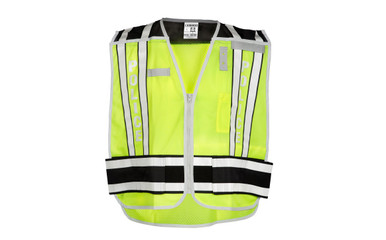 ML Kishigo 4001BZ Public Safety Vest, Class 2 Type P, Lime, 2 PocketsML Kishigo labels it ANSI/ISEA 107 Type P Class 2: solid front, mesh shoulders and back, 4-point breakaway, badge and name-tag holders
What the MUTCD says about police and responders. Section 6C.05 of the 11th Edition requires that "when uniformed law enforcement personnel are used to direct traffic, to investigate crashes, or to handle lane closures, obstructed roadways, and disasters, high-visibility safety apparel as described in this Section shall be worn by the law enforcement personnel", and gives them an option the rest of the work zone does not have: "emergency and incident responders and law enforcement personnel within the TTC zone may wear high-visibility safety apparel that meets the performance requirements of the ANSI/ISEA 207-2006 publication ... or equivalent revisions, and labeled as ANSI 207-2006, in lieu of ANSI/ISEA 107-2015 apparel". Firefighters "or other emergency responders working within the right-of-way shall wear high-visibility safety apparel as described in this Section", except that those "engaged in emergency operations that directly expose them to flame, fire, heat, and/or hazardous materials may wear retroreflective turn-out gear". The Type P vest is the 207 vest, and the badge holder, the name-tag holder, the breakaway and the smaller material area are what "tactical and identification needs" means in cloth.
The public safety vest, feature by feature
Quoted from the ML Kishigo product pages for the 4001BZ, 4003BV, 4007BZ and 8055BZ.
The questions, one by one
Answers from the ML Kishigo FAQ and product pages and the MUTCD named in the byline.
Can I buy a vest that says POLICE?
We sell the ML Kishigo 8055BZ, a Type P Class 2 vest with a POLICE legend, to law enforcement agencies and officers; a department orders it like any other uniform item. A person who is not a peace officer wearing a POLICE vest in public is a question for the state’s impersonation law, and no garment standard or supplier can answer it. The 4001BZ, 4003BV and 4007BZ are the same vest without the legend, with a badge holder and name-tag holder a department fills in.
Do police have to wear high-visibility vests?
In a work zone or at a crash scene on the road, yes: MUTCD 6C.05 says uniformed law enforcement personnel used "to direct traffic, to investigate crashes, or to handle lane closures, obstructed roadways, and disasters" shall wear high-visibility apparel, either Type R Class 2 or 3 or an ANSI/ISEA 207 (Type P) vest. Off the roadway, department policy decides.
Do police wear the vest inside or outside?
Over the uniform or the outer carrier, where it can be seen; the point of a Type P vest is to be the outermost layer at a scene, which is why it is sized "even over bulky coats", breaks away if grabbed, and carries the badge and name holders on the outside. It comes off when the officer leaves the roadway, and the 4001BZ folds into its own pocket for the door.
What is a public safety vest, and how is it different from a construction vest?
A Type P vest: a smaller minimum area of hi-vis material than Type R, a tactical cut with breakaway points so it cannot be used to hold the wearer, identification panels, and a solid front for a legend. Kishigo’s FAQ says the 207 requirements "differed somewhat from ANSI/ISEA 107 to accommodate tactical and identification needs, recognizing that these garments were not intended for general occupational use". A construction crew wears Type R; the MUTCD lets only law enforcement and responders substitute Type P.
What vest does a security guard wear?
Security is not law enforcement under the MUTCD, so a guard directing traffic in a work zone wears Type R Class 2 like any other worker; on private property the employer chooses, and a Type P vest with a SECURITY name-tag holder or a Type R breakaway vest is common. ML Kishigo’s Type P vests carry a name-tag holder for the company’s own identification.
What should a fire department or EMS crew buy?
Type P or Type R Class 2 for the roadway, Class 3 for night incidents (MUTCD 6C.05: Class 3 "should be worn" by flaggers at night), and turnout gear with its own retroreflective trim when "engaged in emergency operations that directly expose them to flame, fire, heat, and/or hazardous materials". A 5-point breakaway (the 4003BV) is the usual choice at a scene with moving vehicles.
What is an incident command vest?
A vest with a role panel (COMMAND, SAFETY, OPERATIONS) worn so the roles at an incident can be read at a distance; the Type P public safety vest with its name-tag holder and solid front is the hi-vis garment that takes the panel, and the custom-printing guide linked below covers the placement rules.
Does a Type P vest meet OSHA?
OSHA requires hi-vis through 1926.201 and the MUTCD, and the MUTCD accepts ANSI/ISEA 207 (Type P) for law enforcement and responders in the TTC zone and requires Type R Class 2 or 3 for everyone else. A Type P vest on a construction worker does not satisfy 6C.05; a Type R vest on an officer does.
What is the 5-point breakaway for?
So the vest comes off instead of holding the wearer: the five points are the two shoulders, the two sides and the front closure, each joined with hook-and-loop. For an officer it means a vest cannot be grabbed and used against him; for a tow operator or a flagger it means a passing mirror takes the vest and not the person.
In plain words
- The POLICE vest is a real product (ML Kishigo 8055BZ, Type P Class 2); who may wear it is state impersonation law, not the garment standard.
- Type P is the former ANSI/ISEA 207 public safety vest: less material, breakaway, badge and name holders. The MUTCD lets law enforcement and responders wear it in a work zone instead of Type R.
- Everyone else in the right-of-way, security included, wears Type R Class 2 by day and Class 3 at night.
- Fire crews in flame, heat or hazmat may wear turnout gear instead.
Questions people ask
What is a Type P vest?
The public safety type under ANSI/ISEA 107, the former ANSI/ISEA 207 vest: a smaller material minimum, breakaway points and identification holders, for law enforcement and responders.
Is ANSI/ISEA 207 still a standard?
Its requirements were folded into ANSI/ISEA 107 as Type P, per ML Kishigo’s FAQ; the MUTCD still accepts apparel labeled ANSI 207-2006 or equivalent revisions for responders.
Can security guards wear a police vest?
A vest lettered POLICE on someone who is not a peace officer is a question for state impersonation law; security wears Type R Class 2 in a work zone or a vest with its own identification.
Do firefighters need a hi-vis vest on the highway?
Yes, under MUTCD 6C.05, unless engaged in operations exposing them to flame, heat or hazmat, when retroreflective turnout gear may be worn instead.
Which Kishigo vest has the POLICE lettering?
The 8055BZ, Type P Class 2, with a "Police Legend" on the back and a 4-point breakaway.
What sizes do the public safety vests come in?
M/XL and 2X/4X, two steps with four-season adjustability to fit over a coat.
Can a public safety vest be printed with a department name?
Yes; the solid front takes a legend and the name-tag holder takes a card, within the ANSI/ISEA 107 placement rules the custom-printing guide explains.
What class does a night crash scene call for?
The MUTCD says Class 3 should be worn by flaggers at night; a Type P vest over a Class 3 shirt or a Class 3 jacket covers an officer working traffic after dark.
Related guides
Type R vs Type O vs Type PThe three high-visibility apparel typesHi-vis for flaggers and roadway workWhat the MUTCD requiresWhat are the levels of safety vests?Class 1, 2, 3 and E, Type R, O and PWhat is a surveyor’s safety vest?Surveyor, breakaway, X-back and black bottom vestsCan you get a safety vest custom printed with a logo?What ANSI/ISEA 107 allowsDoes OSHA require high-visibility clothing?The rules that call for itANSI/ISEA 107 High-Visibility Safety ApparelThe rule pageThe ratings, test results and standards shown here are the manufacturers' published values, reproduced as published. Nothing on this page is a recommendation by Bayshore Safety that any product is suitable for a particular task, hazard or workplace. Selecting safety products and protective equipment is the responsibility of the end user and the employer, based on their own hazard assessment and the regulations that apply to their work. Confirm every value on the manufacturer's own documentation before use.
© 2026 Bayshore Safety & Industrial Supplies, Inc. All rights reserved. This guide may not be copied or republished without written permission.