
Confined space entry procedure step by step: the 1910.146 sequence from identifying the space to canceling the permit, the safety precautions, and what the entry supervisor, attendant and entrant each do
OSHA does not print a numbered checklist, but 29 CFR 1910.146 lays the entry out in an order, and every permit program follows it: evaluate the workplace and identify the permit spaces (c)(1), post them (c)(2); decide whether employees will enter and, if so, write the program (c)(4); isolate the space (d)(3); provide the equipment (d)(4); test the air from outside with a calibrated direct-reading instrument, oxygen first, then flammables, then toxics (d)(5); station the attendant (d)(6), name the roles (d)(7) and (8), arrange rescue (d)(9) and communication (d)(10); have the entry supervisor verify the tests and sign the permit (e)(1) and (j)(1) and post it at the entry (e)(2); enter and monitor during the work (d)(5)(ii); exit on an alarm or a prohibited condition (h)(5) and (i)(6); cancel the permit when the work is done (e)(5) and keep it a year (e)(6). The precautions people ask about are the same steps seen from inside the space: nobody enters until the readings are on the permit, the entrant wears a monitor and leaves on the alarm, the attendant never goes in, and rescue is by retrieval line from outside unless that would add risk. Construction follows the same sequence in 1926 Subpart AA with continuous monitoring.
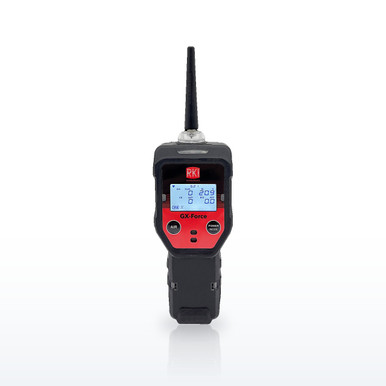 RKI Instruments 72-FA-A-A15 GX-Force 4-Gas Sample-Draw Monitor, LEL/O2/H2S/COPumped four-gas monitor for step 5, the test from outside: 100 ft sample range as RKI states it
Why the order matters. Each step in 1910.146 makes the next one safe to take. Isolation comes before testing because a line that can still flow or a machine that can still start makes any reading temporary. Testing comes before the attendant is posted because the attendant’s job is to watch conditions that have already been shown acceptable. The permit is signed last, after the entry supervisor has verified every test and every measure (j)(1), and posted at the entry so that anyone walking up can see what was checked and when (e)(2). Monitoring continues because conditions change: a disturbed sludge releases hydrogen sulfide, a ventilation hose slips, a nearby engine fills the space with carbon monoxide. The standard’s answer to a change is in (h)(5) and (i)(6): the entrant leaves and the attendant orders everyone out, and the sequence starts again at the test.
The twelve steps, with the paragraph of 1910.146 for each
The safety precautions, as the standard assigns them
- Entry supervisor (j): knows the hazards, verifies the tests and the measures, signs the permit, terminates the entry and cancels the permit, verifies rescue is available, removes unauthorized people, and reconfirms acceptable conditions when responsibility is transferred.
- Attendant (i): knows the hazards and the effects of exposure, keeps an accurate count, stays outside until relieved, communicates with entrants, monitors inside and outside, orders evacuation on a prohibited condition, an alarm or a sign of exposure, summons rescue, keeps unauthorized people out, and performs non-entry rescue only as the program allows and never enters.
- Entrant (h): knows the hazards and the signs of exposure, uses the equipment, communicates with the attendant, alerts the attendant to any warning sign, and exits on an order, a prohibited condition, an alarm or a sign of exposure.
- Rescue (k): a retrieval system (harness, line attached at the back near shoulder level, a mechanical device for vertical spaces more than 5 feet deep) unless it would increase the risk; an outside service evaluated for response time and equipment, or an in-house team trained and practicing yearly, with the respirators and PPE needed.
- Training (g): before first assignment, before a change in duties, when hazards change and when performance shows deviation, certified with the employee’s name, the trainer’s signature and the dates.
- Contractors (c)(8) and (9): the host employer tells the contractor the space is permit-required, the hazards and the precautions it uses, coordinates entries and debriefs; the contractor gets the information and follows a program.
- What the monitor does at each step: step 5, a pumped unit tests from outside (RKI Instruments’ GX-Force draws through up to 100 ft of hose; the RP-3R pump clips to a GX-3R or GX-3R Pro); step 10, a diffusion four-gas unit on the entrant alarms at the set points (RKI presets 10 percent LEL, 19.5 percent oxygen, 5 ppm H2S, 25 ppm CO); step 12, the datalog and the permit are the record.
Questions people ask
What are the steps involved in the entry procedure for a confined space?
In the order of 1910.146: identify and post the space, decide to enter and write the program, isolate it, provide the equipment, test the air from outside (oxygen, flammables, toxics), ventilate and retest if needed, station the attendant and assign the roles, fill out and sign the permit, post it, enter and monitor, exit on any alarm, cancel and keep the permit. Each step is on this page with its paragraph.
What are the safety precautions to take when entering a confined space?
Nobody enters until the air test is on the permit; the space is isolated and ventilated; an attendant stays outside the whole time; the entrant wears a monitor and leaves on the alarm; rescue is by retrieval line from outside; no rescuer enters without SCBA or supplied air; and the permit is signed by the entry supervisor and posted at the entry.
What are the safety procedures for confined space entry?
The written permit program 1910.146(d) requires, carried out in the twelve steps above and recorded on the permit; construction adds continuous atmospheric monitoring and a competent person’s identification of the spaces under 1926 Subpart AA.
What is the correct order of atmospheric testing before confined space entry?
Oxygen first, then combustible gases and vapors, then toxic gases and vapors (1910.146(d)(5)(iii)), from outside, at the top, middle and bottom.
What document must be prepared by the entry supervisor before workers can enter a confined space?
The entry permit, with the 15 items in 1910.146(f): the space, purpose, date and duration, entrants, attendants, entry supervisor and signature, hazards, isolation measures, acceptable entry conditions, test results with initials and time, rescue services, communication procedures, equipment, other information and additional permits such as hot work.
Who signs the confined space entry permit?
The entry supervisor, after verifying the tests and the measures (1910.146(e)(1) and (j)(1)); the testers initial each air reading.
When must the attendant order the exit of all personnel from a confined space?
When the attendant detects a prohibited condition, detects behavioral effects of exposure in an entrant, detects a situation outside the space that could endanger the entrants, or cannot effectively and safely perform the attendant’s duties (1910.146(i)(6)).
What are the responsibilities of a confined space attendant during a permit-required entry?
Know the hazards, keep the count, stay outside until relieved, communicate with the entrants, monitor conditions inside and outside, order evacuation when required, summon rescue, keep unauthorized people out, perform non-entry rescue as the program allows, and never enter the space (1910.146(i)).
What equipment do you need to enter a confined space?
The nine categories in 1910.146(d)(4): testing and monitoring, ventilation, communications, PPE, lighting, barriers and shields, ingress and egress, rescue and emergency equipment, and anything else needed; the equipment guide on this site covers them.
How long is a confined space permit good for?
Only for the time needed to complete the job (1910.146(e)(3)); it is canceled when the work is done or a prohibited condition arises (e)(5) and kept at least 1 year (e)(6).
Does OSHA require continuous monitoring during confined space entry?
In general industry, testing or monitoring as necessary to confirm acceptable conditions are maintained (1910.146(d)(5)(ii)); in construction, continuous monitoring unless the employer can show continuous equipment is not commercially available (1926.1204(e)).
Related guides
Permit-required confined space entryThe permit and the programWhat is a confined space?The OSHA definition and what makes one permit-requiredNon-permit confined spacesOSHA’s examples and reclassificationConfined space gas testing orderOxygen, then flammables, then toxicsConfined space entry equipmentWhat 1910.146 requiresConfined spaces in constructionHow Subpart AA differs from 1910.146The ratings, test results and standards shown here are the manufacturers' published values, reproduced as published. Nothing on this page is a recommendation by Bayshore Safety that any product is suitable for a particular task, hazard or workplace. Selecting safety products and protective equipment is the responsibility of the end user and the employer, based on their own hazard assessment and the regulations that apply to their work. Confirm every value on the manufacturer's own documentation before use.