
What are the four types of fall protection? Guardrails, safety nets, personal fall arrest and restraint, and the five-level hierarchy manufacturers teach
OSHA’s construction rule names three conventional systems for an unprotected edge: a guardrail system, a safety net system, or a personal fall arrest system (29 CFR 1926.501(b)(1)); the general industry rule adds a fourth, the personal fall restraint system, which keeps the worker from reaching the edge at all (1910.140). Those four, guardrail, net, arrest and restraint, are the “four types” the question means. Subpart M also allows positioning device systems, warning line systems, controlled access zones, safety monitoring systems, covers and a written fall protection plan in the situations 1926.501(b) and 1926.502 spell out. The “five levels” is the hierarchy of controls as the manufacturers teach it; Safewaze’s version runs elimination, passive fall protection, fall restraint, fall arrest and administrative controls, in that order. The “5 P’s” has no definition in OSHA or ANSI; the lists that are in the rules are below.
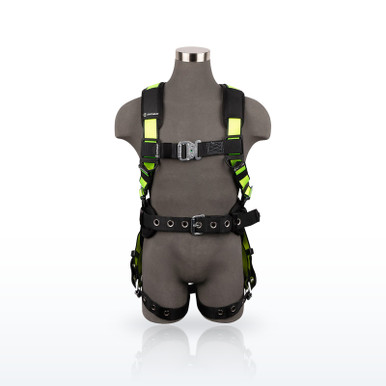 Safewaze PRO FS160–FS170 Harnesses, Construction, 3 D-Rings, Mating-Buckle ChestConstruction harness with back and side D-rings, the body wear in an arrest or restraint system (Safewaze data)
Why the four are different jobs. A guardrail and a net are passive: they work without the worker doing anything. Restraint and arrest are personal systems that depend on the harness, the connector and the anchor being right for the person wearing them. The difference between the last two is what happens at the edge: restraint is rigged so the worker cannot reach it (no free fall), arrest lets the fall start and stops it within the limits of 1926.502(d), which is why arrest needs fall clearance below and a rescue plan and restraint does not. The order manufacturers teach, remove the hazard first and arrest last, is the hierarchy of controls, and it is the reason a roof with a parapet or a guardrail needs no harness at all.
The four systems, as the rules define them
Each is a system under 1926.502 or 1910.140, with its own criteria.
The “five levels”: the hierarchy of controls as one manufacturer prints it
Safewaze’s training sheet ranks the controls this way; OSHA’s rules do not number them but 1926.501(b) lists them in the same order of preference for each situation:
- 1. Elimination: removing the fall hazard.
- 2. Passive fall protection: separation of hazard and worker (guardrails, nets, covers).
- 3. Fall restraint: prevents the worker from reaching the hazard.
- 4. Fall arrest: safely stops a worker who has fallen.
- 5. Administrative: practices and procedures that warn workers of the fall hazard area (warning lines, monitors, controlled access zones).
- The same sheet lists the trigger heights the rules set: 4 feet in general industry, 5 in shipyards, 6 in construction, 8 in longshoring, 10 on scaffolds, 15 for steel-erection decking and 30 for steel-erection bolting, and fall protection at any height over dangerous equipment.
What the rules themselves list
From the paragraphs, condensed:
- 1926.501(b)(1), unprotected sides and edges at 6 feet: guardrail systems, safety net systems, or personal fall arrest systems.
- 1926.501(b)(2), leading edges: the same three, or a fall protection plan under 1926.502(k) where the employer shows they are infeasible.
- 1926.501(b)(10), low-slope roofs: guardrail, net or arrest, or a warning line combined with one of them, or a warning line with a safety monitoring system; a safety monitoring system alone on a roof 50 feet or less in width.
- 1926.501(b)(11), steep roofs: guardrail systems with toeboards, safety net systems, or personal fall arrest systems.
- 1926.501(b)(13), residential construction: the same three, or a written fall protection plan where the employer shows they are infeasible or create a greater hazard.
- 1926.502(d): the personal fall arrest system criteria, from the 5,000-pound anchorage to the 1,800-pound force; the note after (d)(16) prohibits body belts in a personal fall arrest system since 1998.
- 1910.140(c): the general industry criteria for both arrest and restraint, including the restraint anchorage figure of 3,000 pounds or twice the maximum expected force.
The heights as FallTech states them
FallTech’s construction guide states the trigger the same way: fall protection at 6 feet or more to a lower level in nearly all construction work, with low-slope roofing allowing warning lines, fall arrest, guardrails or, on small projects, a safety monitoring system; its steel-erection guide notes that 1926.760 speaks of 15 and 30 feet for connectors and controlled decking zones while exposure above 6 feet can still be cited; and its California note records Cal/OSHA’s move to 6 feet for residential roofing and framing from July 1, 2025.
FallTech, “When Is Fall Protection Required in Construction?”, “Fall Protection for Steel Erectors: Meeting OSHA 1926.760 and Beyond” and “Cal/OSHA Lowers Fall Protection Height for Residential Work” (falltech.com, fetched Nov 8 2026).The four lanyard types as FallTech names them
FallTech’s lanyard guide names four types: restraint (a fixed length that stops the worker short of the edge, so clearance below is not in play), positioning (holds the worker in place hands-free and is always backed by a separate fall arrest system), energy-absorbing (arrests a fall; the absorber’s deployment adds to the fall distance) and tie-back (wraps a rated structural member and hooks back on itself, with reinforced ends and a 5,000 lb gate connector, only on approved shapes and never over a sharp edge). It gives free fall as D-ring height plus lanyard length minus the distance from the anchor to the edge, and minimum required fall clearance as lanyard length plus absorber deployment plus harness stretch and D-ring shift (about 1 ft) plus D-ring height (about 5 ft) plus a 1½ ft safety factor; lanyards come in 6 and 12 ft, and a 12 ft lanyard raises both free fall and clearance. Its product pages state the free-fall rating (6 ft, or 6 and 12 ft on the dual-class Ironman line), the maximum arrest force (1,800 lb) and the average arrest force (900 lb for a 6 ft free fall, 1,350 lb for 12 ft) for each lanyard.
FallTech, “Fall Protection Lanyard Types: How to Choose the Right Connection for the Job” (falltech.com, fetched Nov 8 2026); the Free Fall Rating, Maximum Arrest Force, Average Arrest Force and Lanyard Style fields on each FallTech lanyard page; FallTech Shock-Absorbing Lanyards manual MSAL01ALX.More questions people ask
Why are guardrails 42 inches high, how much force must a top rail take, and what are the hole cover, warning line and safety net rules?
The construction guardrail criteria are in 1926.502(b): the top edge of the top rail is 42 inches plus or minus 3 above the walking/working level (higher when conditions warrant, and raised by the height of stilts when workers use them), with midrails, screens, mesh or intermediate members between the top rail and the surface where there is no wall or parapet at least 21 inches high, midrails at mid-height and openings no more than 19 inches wide; the guardrail must withstand at least 200 pounds applied within 2 inches of the top edge in any outward or downward direction without failure, and under that downward load the top edge may not deflect below 39 inches; midrails take 150 pounds; surfaces are smooth enough not to puncture or snag; and rails must not overhang the posts where they could be a hazard. The 42 inches is the height at which a rail catches an adult at the waist or hips rather than tripping them over it, and 39 inches is the floor under load. Covers over holes must support at least twice the weight of employees, equipment and materials that may cross them, be secured against displacement and be marked “HOLE” or “COVER” or color-coded (1926.502(i)). Warning lines on low-slope roofs are rigged 34 to 39 inches high on stanchions with a minimum tensile strength of 500 pounds, flagged every 6 feet, and set 6 feet from the edge (10 feet where mechanical equipment is used) (1926.502(f)). Safety nets are installed as close as practicable under the work, never more than 30 feet below, extend 8 to 13 feet outward depending on the fall distance, are drop-tested with a 400-pound bag (1926.502(c)). A loading dock in general industry is an unprotected edge: 4 feet or more above a lower level it needs a guardrail, net or personal fall protection system, and only where the employer can demonstrate that is infeasible on the working side during the operation may the work proceed with access limited to trained, authorized employees (1910.28(b)(1)(i) and (iii)); a dockboard needs a guardrail or handrails at 4 feet unless used solely for motorized materials handling under 10 feet (1910.28(b)(4)).
Answers from the sources named above and in the byline.Questions people ask
What are the four types of fall protection?
Guardrail systems, safety net systems and personal fall arrest systems are the three 1926.501(b)(1) names; personal fall restraint, which keeps the worker from reaching the edge, is the fourth under 1910.140. Positioning devices, warning lines, monitors, controlled access zones and covers are allowed in the specific situations Subpart M lists.
What are the three main types of fall protection authorized by OSHA?
Guardrail systems, safety net systems and personal fall arrest systems. Those are the three conventional systems 1926.501(b)(1) names for an unprotected side or edge, and the three a fall protection plan must show are infeasible before anything else is used (1926.502(k)(5)). The general industry rule adds personal fall protection systems as a group: arrest, travel restraint and positioning (1910.28(b)(1)(i)(C)).
What are the 5 levels of fall protection?
The hierarchy of controls as manufacturers teach it: elimination, passive fall protection, fall restraint, fall arrest and administrative controls, in that order (Safewaze’s training sheet). OSHA’s rules list the allowed systems per situation in 1926.501(b) without numbering them.
What are the 5 P’s of fall prevention?
There is no definition of a “5 P’s” list in OSHA’s rules or the ANSI Z359 standards; it is a training mnemonic that varies by trainer. The lists that are in the rules are the systems in 1926.501(b) and the criteria in 1926.502, above.
What are some examples of primary fall protection methods?
Primary, or passive, methods keep the fall from happening and need nothing from the worker: a guardrail at 42 inches with a midrail (1926.502(b)), a cover over a hole able to hold twice the expected load (1926.502(i)), a safety net within 30 feet below the surface (1926.502(c)), and travel restraint that keeps the worker short of the edge (1910.140). Fall arrest is secondary: it acts after the fall has started.
What are the big three forms of fall protection?
The same three: guardrails, nets and personal fall arrest. Everything else in Subpart M (positioning devices, warning lines, controlled access zones, safety monitors, covers, fall protection plans) is allowed only in the situations 1926.501(b) and 1926.502 spell out.
What is the difference between active and passive fall protection?
Passive systems protect without the worker doing anything: guardrails, covers, nets, platforms. Active systems depend on the worker wearing and connecting equipment: a harness with a lanyard or SRL to an anchor, for arrest or for restraint. The hierarchy Safewaze prints puts elimination first, passive systems second, restraint third and arrest fourth, with administrative measures (warning lines, monitors, controlled access zones) last.
What are fall protection measures?
The systems and practices that keep a worker from falling to a lower level or stop the fall: the conventional systems (guardrail, net, personal fall arrest), the alternatives Subpart M allows in named situations (positioning, warning lines, controlled access zones, safety monitors, covers, a fall protection plan), and the duties around them: assessing the surface (1926.501(a)(2)), providing the equipment before the work starts (1926.502(a)(2)), training (1926.503) and rescue (1926.502(d)(20)).
What are the different types of fall protection systems used in construction?
Subpart M lists them by name: guardrail systems (1926.502(b)), safety net systems (c), personal fall arrest systems (d), positioning device systems (e), warning line systems (f), controlled access zones (g), safety monitoring systems (h), covers (i), protection from falling objects (j) and the fall protection plan (k). Which ones are allowed depends on the situation in 1926.501(b).
What is the maximum arresting force for a personal fall arrest system?
1,800 lb on a worker in a full body harness (1926.502(d)(16)(ii); 1910.140(d)(1)(ii)). The energy absorber in the lanyard or SRL is what keeps the force under that figure; Safewaze’s lanyard manual lists its average arrest forces at 900 lb or less for a 6-foot free fall.
What are the ABCs of fall protection?
Anchorage, body wear (the harness) and connector (lanyard or SRL); manufacturers add D for descent and rescue and E for education. OSHA’s definition of a personal fall arrest system in 1926.500(b) is the same three parts.
Is fall restraint the same as fall arrest?
No. Restraint is rigged so the worker cannot reach the edge and has no free fall; arrest stops a fall that has begun and must meet the 1926.502(d) force and clearance limits. The fall arrest vs restraint guide covers the rigging difference.
Does a guardrail count as fall protection?
Yes. A guardrail system meeting 1926.502(b) (42-inch top rail, 200-pound strength, midrail, toeboards where needed) is one of the three conventional systems and needs no harness.
Why are guardrails 42 inches high?
The construction rule sets the top rail at 42 inches plus or minus 3 above the walking surface (1926.502(b)(1)), the height that catches an adult at the waist or hips; under a 200 lb downward load the top edge may not deflect below 39 inches (b)(4).
How much force does OSHA require a top rail to withstand, and what is the maximum height of a top rail?
At least 200 lb applied within 2 inches of the top edge in any outward or downward direction without failure (1926.502(b)(3)); top rail at 42 inches plus or minus 3, so up to 45 inches, or higher when conditions warrant (b)(1).
What is considered a guardrail, and where are guardrails required?
A barrier erected to prevent employees from falling to lower levels (1926.500(b)), with a top rail, midrail and posts meeting 1926.502(b). Required, or an alternative, at unprotected sides and edges 6 ft or more above a lower level in construction (1926.501(b)(1)) and 4 ft in general industry (1910.28(b)(1)).
What are the three types of barriers that can be used to prevent falls?
Guardrail systems, covers over holes, and warning lines (with a monitor or other system) are the barrier-type measures in 1926.502(b), (i) and (f); safety nets catch rather than bar.
Do loading docks need covers and guardrails?
In general industry a dock edge 4 ft or more above a lower level needs a guardrail, net or personal fall protection system; where that is infeasible on the working side during the operation, access is limited to trained, authorized employees (1910.28(b)(1)(i) and (iii)). Dockboards need a guardrail or handrails at 4 ft unless used only for motorized materials handling under 10 ft (1910.28(b)(4)).
What size hole is considered a fall hazard?
Any hole 2 inches or more in its least dimension in a floor, roof or other walking surface is a hole under 1926.500(b), and employees more than 6 ft above a lower level must be protected from falling through one by a personal fall arrest system, a cover or a guardrail (1926.501(b)(4)(i)).
What is a safety net system, and what is its purpose?
Nets installed as close as practicable under the work, no more than 30 ft below, extending 8 to 13 ft outward, drop-tested with a 400 lb bag (1926.502(c)); they catch a worker who has fallen without the worker wearing anything, which is why they are a passive system.
What is the purpose of a stanchion, and what are stanchions made of?
In fall protection a stanchion is the post that holds a warning line (1926.502(f)) or a horizontal lifeline; the HLL stanchions on this site are zinc-plated or galvanized steel clamped to an I-beam, rated by their manufacturers. Warning line stanchions need a 500 lb minimum tensile strength on the line and must resist a 16 lb tip load.
What are the OSHA catwalk and platform handrail requirements?
A general industry walking surface 4 ft or more above a lower level needs a guardrail with a top rail 42 inches plus or minus 3, a midrail and, where there is a hazard below, a toeboard (1910.28(b)(1); 1910.29(b)); stair rails and handrails have their own heights in 1910.29(f).
What is the 4 ball rule for railing, and does OSHA require handrails to be yellow?
Neither is an OSHA rule. The “4-inch sphere” test comes from the building codes for residential guards; OSHA’s criterion is openings no more than 19 inches wide in a guardrail (1926.502(b)(2)(iv)). OSHA sets no guardrail color; yellow is a common site practice.
What is the minimum tensile strength required for warning lines?
500 lb (1926.502(f)(2)(iv)), with the line rigged 34 to 39 inches above the surface, flagged every 6 ft, and attached so pulling one section does not slacken the next.
The ratings, test results and standards shown here are the manufacturers' published values, reproduced as published. Nothing on this page is a recommendation by Bayshore Safety that any product is suitable for a particular task, hazard or workplace. Selecting safety products and protective equipment is the responsibility of the end user and the employer, based on their own hazard assessment and the regulations that apply to their work. Confirm every value on the manufacturer's own documentation before use.