
Bayshore Safety & Industrial Supplies Guide
First aid for welders and hot work: flash burns and arc eye, metal splinters and shavings in the hand, metal detectable bandages, what a welding blanket is for and the temperature it withstands, eye pain after welding, and the burn and eye items
The first aid a welding bay needs is for four things: skin burns from spatter, slag and hot metal; arc eye (welder’s flash), the ultraviolet burn to the cornea that shows up hours later; metal splinters and shavings in the hands from grinding and wire brushing; and the eye hit by a grinding spark or a chip. For burns the Red Cross steps are to cool the burn with cool running water, cover it loosely with a sterile dressing, and not to apply ice, butter or ointment to a severe burn, which is what the gel-soaked burn dressings and burn gel in a First Aid Only burn kit are for. For the eye, the Red Cross eye injury page says to flush a chemical splash with water until EMS arrives and begins care, keeping the affected eye lower than the other, and for "an imbedded object/splinter, seek immediate medical care"; it does not have you remove anything from the eye, and eye pain after welding is the arc eye guide’s subject. For metal splinters in the skin, the kit carries tweezers, forceps and splinter removers, and a splinter that is deep, that will not come out, or that is in the eye is a clinic visit, not a tweezers job. Welding blankets are not first aid at all: they are the fire-protection covering 1910.252 expects over combustibles that cannot be moved 35 feet from the work, rated by their manufacturers (1000 °F for Best Welds fiberglass, over 1000 °F for the Caiman silica blanket, 300 °F working temperature for Wilson’s acrylic-coated fiberglass) for the slag and spatter they catch.
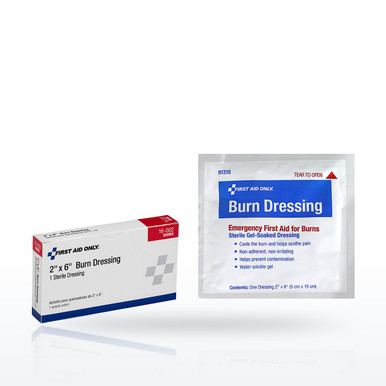 First Aid Only 16-00 Burn Dressing, 1 per Box, 2 SizesFirst Aid Only prints a gel-soaked burn dressing in two sizes, one per box
Why the welding questions land on a first aid page. Half of them are about the blanket, which is a fire-protection item, and half are about the welder: a metal splinter in the finger, eye pain after a day of welding, what welders wear. The PPE questions have live guides (welding PPE, grinding eye protection, the lens shade chart) and arc eye has its own page; what was missing is the kit by the bay and the straight answer on the blanket’s temperature, which is a manufacturer’s figure and not a standard. This page gives the Red Cross steps for burns and eye injuries as published, says what the kit holds and why the bandages are blue, and prints the blanket ratings the manufacturers put on their pages.
Burns and eye injuries, as the Red Cross states the care
From the American Red Cross burns and eye injury pages; a trained first aider follows the course, and anything with an asterisk on the Red Cross page is a 911 call.
- Burn: check the scene, put on gloves; stop the burning (remove the person from the source; smother flames; remove hot clothing and jewelry that is not stuck).
- Burn: cool the burn with cool (not cold) running water for at least 10 minutes or until the pain eases; do not use ice; a gel-soaked burn dressing is the kit’s way to keep cooling a burn when water is not at hand.
- Burn: cover loosely with a sterile, non-stick dressing; do not break blisters; do not apply butter, ointment or creams to a serious burn. Call 911 for a burn that is large, deep, on the face, hands, feet or groin, from electricity or chemicals, or with trouble breathing.
- Eye: for a chemical splash, flush with water until EMS arrives and begins care, head tilted so the affected eye is lower than the unaffected eye; the eyewash station is the flush.
- Eye: for an imbedded object or splinter, seek immediate medical care; do not remove it, do not rub the eye; cover the eye lightly and keep the person still.
- Eye: blurred vision, loss of vision, bleeding in the eye, a chemical or object in the eye, and continued pain are the Red Cross asterisk signs that mean immediate emergency medical treatment.
- Arc eye: pain, grittiness and light sensitivity that start hours after welding are the UV burn the arc eye guide describes; the Red Cross eye page’s "continued pain in eye" is the signal to be seen.
The questions, one by one
Is it bad to leave a metal splinter in your finger, and will a metal splinter come out on its own?
The Red Cross wound care steps are to clean a minor wound, cover it and watch for infection; a splinter that is shallow and visible is lifted out with the sterile tweezers or the splinter remover in the kit and the wound cleaned and covered. A splinter that is deep, that broke off under the skin, that is in or near the eye, or that is from contaminated metal, and any wound that reddens, swells or drains, is a clinic visit; we do not advise waiting for it to work out. The kit’s part is the tweezers, the antiseptic wipe and the bandage.
How to get metal shavings out of hands?
Wash the hands so the shavings that are on the skin come off, then use the magnifying forceps or the splinter remover for the ones that are in it; First Aid Only’s pointed steel forceps with magnifying glass (90893) and the Splinter Out kit (22-410) are built for that. Gloves are the prevention: the live grinding guide and the welding glove guide cover what to wear. Anything the tweezers cannot reach is a clinic visit.
How to treat eye pain from welding, and what is the most common eye injury that occurs to welders?
The common one is arc eye (photokeratitis), the ultraviolet burn from the arc that shows up 6 to 12 hours later as grit, pain and light sensitivity; the live arc eye guide covers what it is and how long it lasts, and the Red Cross page’s "continued pain in eye" is the sign to be seen by a clinician. Eye pain from a chip or spark is the imbedded object case: do not rub, cover lightly, immediate medical care. First aid does not treat either beyond that; the lens shade chart and the grinding eye protection guide are the prevention.
What is the maximum temperature a welding blanket can withstand, and do welding blankets insulate heat?
A manufacturer’s figure, not a standard: Best Welds rates its plain and acrylic-coated fiberglass blankets to 1000 °F and lists 600 °F and 3000 °F intermittent for other versions; Caiman states its 26-ounce Silkglass blanket "withstands temperatures over 1000 degrees Fahrenheit" with its high silica content; Wilson states a 300 °F working temperature for its acrylic-coated fiberglass. Those ratings are for the slag, sparks and spatter the blanket catches, which is what the FM 4950 test checks (no burn-through, underside under 500 °F in the live welding blanket guide’s description). A welding blanket is a barrier, not insulation: it stops hot metal from reaching what is under it and will get hot itself.
What is the purpose of a welding blanket?
To cover combustibles that cannot be moved and to catch slag and spatter, which is the 1910.252(a)(2) sequence: move the work, or move the combustibles 35 feet away, or shield them. The live welding blanket guide covers blankets, curtains and screens; the fire watch and the extinguisher are the hot work permit guide.
Which welding blanket for a smoker?
Different product: a "welding blanket" sold for a smoker or grill is a fiberglass mat laid under the cooker to catch grease and embers, rated by its manufacturer for radiant heat rather than for slag. The fiberglass welding blankets in the band are rated for sparks and spatter; whether one suits a smoker is the manufacturer’s statement on that product, and we do not rank them.
What do welders wear to protect themselves?
A welding helmet with the right shade, safety glasses under it, a flame-resistant jacket or leathers, welding gloves, leather boots and, for fume, a respirator: the live welding PPE guide prints the 1910.252 list and the shade chart, and the welding gloves and leathers guides cover the rest. First aid is what is on the wall when the PPE was not enough.
Why are the bandages blue?
Because a fab shop that also does food equipment, or any shop with a metal detector on the line, uses the blue metal detectable bandages First Aid Only states are "useful in food or pharmaceutical processing areas" with "an internal foil ... for quick metal detection". In a plain welding shop any bandage will do; the blue ones are in the band because many of the shops that ask are food-plant maintenance crews.
What first aid kit does a fab shop or welding shop keep?
A Class A or Class B kit sized to the headcount, with the burn kit beside it (gel dressings in 4 x 4 and larger, burn gel packets or a bottle, a burn sheet for a large burn), an eyewash station within 10 seconds of any pickling or cleaning chemicals and a bottle at the bay, eye pads, tweezers and splinter removers, and a CPR barrier. The welding blanket, the fire extinguisher and the fire watch are the hot work side and have their own pages.
In plain words
- Burns: cool running water, loose sterile cover, no ice, no butter or ointment on a serious burn; gel dressings when water is not at hand.
- Eye: chemical splash, flush until EMS arrives; object or splinter, do not remove, immediate medical care.
- Arc eye shows up hours later; continued eye pain is the Red Cross sign to be seen.
- Metal splinters: tweezers and splinter remover for the shallow ones; deep, broken-off or near the eye is a clinic visit.
- Welding blankets: manufacturer ratings (1000 °F Best Welds fiberglass, over 1000 °F Caiman silica, 300 °F Wilson working temperature); a barrier for slag, not insulation.
- The bay keeps a kit, a burn kit, an eyewash, eye pads, tweezers and a CPR barrier.
Questions people ask
What first aid does a welder need?
Burn care (gel dressings, burn gel), eyewash and eye pads, tweezers and splinter removers, a bandage, and a CPR barrier in a Class A or B kit.
How do you treat a welding burn?
As the Red Cross states it: cool running water, loose sterile dressing, no ice or butter; 911 for a large, deep, facial, hand or electrical burn.
How to treat eye pain from welding?
Arc eye is the UV burn that shows up hours later; continued eye pain is the Red Cross sign for medical care; a chip in the eye is immediate medical care without removing it.
Is it bad to leave a metal splinter in your finger?
A shallow one comes out with the kit’s tweezers; a deep, broken-off or near-eye splinter, or a wound that reddens or drains, is a clinic visit.
How to get metal shavings out of hands?
Wash, then magnifying forceps or the splinter remover; gloves for grinding are the prevention.
What temperature can a welding blanket withstand?
The manufacturer’s rating: Best Welds fiberglass 1000 °F, Caiman silica over 1000 °F, Wilson acrylic-coated 300 °F working temperature.
Do welding blankets insulate heat?
They are a barrier for slag and spatter and get hot themselves; not insulation.
What is the purpose of a welding blanket?
To shield combustibles that cannot be moved 35 feet from the work, per 1910.252.
Why blue bandages in a fab shop?
Shops with a metal detector or a food plant use blue metal detectable bandages; otherwise any bandage.
What do welders wear?
Helmet and shade, safety glasses, FR jacket or leathers, welding gloves, boots, respirator for fume; the welding PPE guide.
Related guides
What is arc eye (welder’s flash)?The UV burn, how long it lastsHow to treat a burn at workFirst aid and burn dressingsBurn dressings, burn gel and what to put on a burnAnd what never goes on oneWelding blankets, curtains and screensWhat 1910.252 requires for shieldingHot work permitsWhat 1910.252(a) requires before welding or cuttingWhat PPE does OSHA require for welding?1910.252 explainedEye protection for grinding and cuttingWhat OSHA requires and what to wearHow to use an eyewash stationThe 15-minute flush, clearance, height and costThe ratings, test results and standards shown here are the manufacturers' published values, reproduced as published. Nothing on this page is a recommendation by Bayshore Safety that any product is suitable for a particular task, hazard or workplace. Selecting safety products and protective equipment is the responsibility of the end user and the employer, based on their own hazard assessment and the regulations that apply to their work. Confirm every value on the manufacturer's own documentation before use.
© 2026 Bayshore Safety & Industrial Supplies, Inc. All rights reserved. This guide may not be copied or republished without written permission.