
Bayshore Safety & Industrial Supplies Guide
What gloves do mechanics wear for working on cars? Nitrile disposables for oil and fuel, mechanics gloves, impact gloves and heat-resistant gloves, by the manufacturers’ data
Three gloves do most of the work on a car, and they answer three different hazards. For oil, grease, brake fluid, coolant and fuel on the hands, the glove is a disposable nitrile, usually 5 to 8 mil, black or orange so grime does not show and tears do: OSHA’s PPE booklet describes nitrile as the material for oils, greases, acids, caustics and alcohols, and PIP’s permeation tables put its nitrile chemical gloves at level 6 against diesel and kerosene and 413 to more than 480 minutes against gasoline. For wrenching, lifting, pulling parts and the knuckle-scraping that goes with it, the glove is a mechanics glove: a synthetic or goatskin leather palm on a stretch back with a hook-and-loop or slip-on cuff, and the figure to read is the ANSI/ISEA 105 puncture and abrasion level, with a cut level where sheet metal is involved (MCR Safety lists its mechanics gloves from puncture 2 to 5 and cut A1 to A5) and an ANSI/ISEA 138 impact level where the back of the hand takes hits. For exhaust, brakes and engine parts still hot, the glove is one with an ANSI/ISEA 105 contact heat level: MCR Safety lists goatskin mechanics gloves at contact heat 3 (392 °F for 15 seconds) and 4 (500 °F), and the heat-resistant glove guide explains the scale. A heat-resistant mechanics glove is not a welding glove, a disposable nitrile is not a chemical glove for immersion, and no glove is worn near a spinning fan, belt or drill; the rest of this guide takes the questions one at a time.
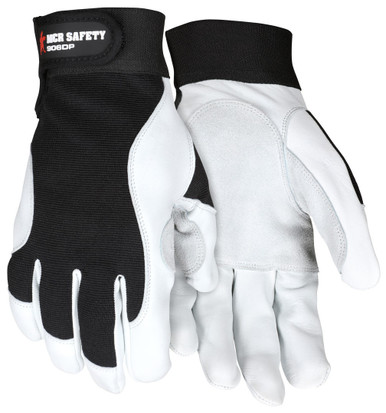 MCR Safety 906DP High Dexterity Gloves, Mechanics Work Gloves, Grain GoatskinMCR Safety lists this mechanics glove at ANSI/ISEA 105 abrasion 4, puncture 5, contact heat 3 (MCR Safety data)
Why a shop needs more than one glove. The hand hazards on a vehicle are not one hazard. The fluids are a skin-contact problem: used motor oil, brake fluid, gasoline, degreaser and coolant on bare hands all day is the exposure 1910.138(a) names as skin absorption of harmful substances, and the safety data sheet for each product names a glove material in its section 8. The parts are a mechanical problem: sharp sheet-metal edges, burrs, pinch points between a wrench and a block, and the knuckle hits that come with a slipped socket; those are the cut, abrasion, puncture and impact tests in ANSI/ISEA 105 and 138. The heat is a third problem: an exhaust manifold, a brake rotor or a radiator cap is a contact-heat exposure, which ANSI/ISEA 105 rates in five levels by the temperature a glove holds for 15 seconds without the inside reaching the pain threshold. One glove cannot carry all three figures, and the ones that try get thick. So shops stock a disposable nitrile for the fluids (and often wear it under the mechanics glove), a mechanics glove for the wrenching, and a heat-rated glove for the hot work, and the hazard assessment the employer writes under 1910.132(d) is the document that says which glove goes with which job. The question “are mechanics gloves worth it” has a plain answer from the data: the glove carries the puncture, abrasion and impact level the manufacturer tested it to, and the hazard decides whether that level is needed. Where the hazard is a rotating part, the answer is different again: OSHA’s machine guarding standard requires the point of operation and rotating parts to be guarded, and gloves near a spinning fan, pulley, grinder or drill chuck are a draw-in hazard that guards, not gloves, address.
The questions, one by one
Each answer is from the manufacturer’s figures or the OSHA text named.
Reading the mechanics glove page, line by line
What each line on an MCR Safety, PIP, DEWALT or Portwest mechanics glove page means, in the order it appears.
- Palm material: synthetic leather (polyurethane-coated microfiber, sold under names such as Clarino) or goatskin grain leather. MCR Safety grades its leather A to E; goatskin is the thinnest hide with the most feel, and the leather guide covers the hides.
- ANSI/ISEA 105 abrasion level (0 to 6): the Taber cycles the palm material survives; mechanics gloves run 2 to 4. Puncture level (0 to 5): the force a steel probe needs to go through; MCR Safety’s mechanics gloves run 2 to 5.
- ANSI/ISEA 105 cut level (A1 to A9): the grams of load a blade needs to cut through; A1 to A3 for light sheet metal and trim, A4 and up for body panels, glass and blades. Most plain mechanics gloves are unrated or A1; the cut-rated ones have an HPPE, aramid or steel-blend liner under the palm.
- ANSI/ISEA 105 contact heat level (1 to 5): 176, 284, 392, 500 and 608 °F held for 15 seconds without the inside of the glove reaching 77 °F above the starting temperature. A goatskin palm reaches 3 or 4; synthetic leather usually 1 or 2.
- ANSI/ISEA 138 impact level (1 to 3): the force transmitted through the back-of-hand padding; level 3 is the most protection. Printed only on gloves built with padding over the knuckles and fingers.
- Touchscreen fingertips: a conductive fingertip material that lets the phone or tablet read the finger through the glove; MCR Safety marks the 900, 950 to 954 and 960 with it. The touchscreen guide explains how it works.
- Cuff: hook-and-loop (adjustable closure) keeps debris out and the glove tight; slip-on is faster off, which matters when a glove catches. Neither cuff is a rating.
- Oil and fuel: a mechanics glove is not a chemical glove. The leather or synthetic palm soaks fluid up and holds it against the skin; the fluid layer is the disposable nitrile underneath, or a nitrile chemical glove for a parts washer.
MCR Safety mechanics gloves and their ANSI/ISEA figures, as the product pages state them
| Style | Palm | Cut | Puncture | Contact heat | Other |
|---|---|---|---|---|---|
| 900 | Synthetic leather | — | 2 | 2 | Touchscreen fingertips, adjustable cuff |
| 905 | Synthetic leather | — | 2 | 2 | Adjustable cuff; sizes S to 2XL |
| 906DP / 906DPO | Grain goatskin, double palm | — | 5 | 3 | Adjustable cuff; S to 2XL |
| 906DPOK | Grain goatskin, double palm | A5 | 4 | 2 | Cut liner; M to 3XL |
| 914 | Goatskin | A2 | 4 | 4 | Adjustable cuff; S to 3XL |
| 950 / 951 / 953 | Synthetic leather (HyperFit) | A1 | 2 | — | Touchscreen; slip-on; 953 hi-vis |
| 961 | Goatskin (TaskFit) | — | 3 | 3 | Adjustable cuff |
| 963 | Synthetic leather | A2 | 2 | — | Adjustable cuff |
| PD1901 (Predator) | Synthetic leather, silicone grip | — | 2 | 3 | TaskFit; S to 2XL |
| PD2906 (Predator) | PVC-coated, hi-vis | A2 | 2 | 1 | Slip-on |
| FT2905 (FlexTuff) | Synthetic leather, silicone tire-tread grip | — | 2 | 2 | Adjustable cuff |
| UT2952 | Nitrile-coated knit | A4 | 4 | 1 | Touchscreen, hi-vis; knit wrist |
“—” means MCR Safety prints no level for that test on that style.
Source: MCR Safety product pages on this site (mcrsafety.com data): ANSI/ISEA 105 cut, puncture and contact heat levels, leather type and grade, features.
More questions people ask
Do vibration-reducing gloves work?
Anti-vibration gloves tested to ANSI S2.73 / ISO 10819 reduce the vibration reaching the hand in a defined frequency range; they help with hand-arm vibration and do nothing for force or posture, as the ergonomics guide explains, so tool choice and exposure time come first. No Liberty Safety glove is sold as anti-vibration; the padded-palm mechanics gloves above are comfort, not a rating.
How thick are mechanic nitrile gloves?
The disposable nitrile mechanics reach for is 5 to 8 mil; Liberty Safety’s DuraSkin 2015W black is 5 mil and the 2018W and 2022W are 8 mil.
Answers from the sources named in the byline; Liberty Safety figures from the manufacturer’s product pages and spec sheets read Nov 11 2026.Questions people ask
What kind of gloves should you use when working on a car?
Disposable nitrile for fluids and grime, a mechanics glove with the ANSI/ISEA 105 puncture, abrasion and (where needed) cut level for wrenching and parts, and a glove with an ANSI/ISEA 105 contact heat level for hot exhaust and brake parts. The figures are on each product page.
Are nitrile gloves good for automotive use?
For oil, grease, fuel and coolant on the hands, yes: OSHA’s booklet names oils and greases among what nitrile protects against, and PIP’s tables rate its nitrile gloves level 6 against diesel and kerosene. A thin disposable gives no cut, puncture or heat protection.
What gloves do auto mechanics wear?
Black or orange disposable nitrile (5 to 8 mil) for fluids, often under a synthetic-leather or goatskin mechanics glove for wrenching; impact gloves where knuckles take hits; goatskin gloves with a contact heat level for hot parts. The product data above names the styles and their figures.
Do you need to wear gloves when changing oil?
At work, 1910.138(a) requires hand protection where hands are exposed to skin absorption of harmful substances, and the oil’s safety data sheet names the glove; nitrile is the material OSHA describes for oils and greases. The same data applies in a home garage, where no rule does.
Are mechanics gloves worth it?
They carry the puncture, abrasion, cut and impact levels the manufacturer tested them to; MCR Safety lists puncture 2 to 5 and contact heat 2 to 4 across its mechanics line. The hazard on the job decides whether a given level is needed.
What are some good heat-resistant mechanic gloves?
The ones with an ANSI/ISEA 105 contact heat level printed: MCR Safety 906DP and 906DPO (goatskin, contact heat 3, 392 °F) and 914 (goatskin, cut A2, contact heat 4, 500 °F). The level is 15 seconds of contact; it is not a welding or flame rating.
What gloves should I use for mechanic work on sheet metal and body panels?
A cut-rated glove: ANSI/ISEA 105 A2 to A5 on the mechanics gloves MCR Safety lists (914, 963, 906DPOK), or a cut-rated coated knit (UT2952 at A4). The cut level guide explains A1 to A9.
What is the point of wearing fingerless gloves?
Feel at the fingertips with the palm covered: small fasteners, connectors, inspection. The exposed fingers carry no rating, so they are an assembly glove, not a bodywork glove.
What do mechanic gloves do that work gloves do not?
The pattern: a thin, flexible palm, a stretch back, padding where tools hit and a close cuff, for dexterity around fasteners. A leather palm work glove is heavier and rated for abrasion and rough materials; the types of work gloves guide compares them.
Can I wear a disposable nitrile glove under a mechanics glove?
Yes; it keeps the fluids off the skin and the leather clean. OSHA’s booklet describes glove liners as a way to keep the hand dry and the outer glove serviceable.
Do touchscreen mechanics gloves work?
MCR Safety marks the 900, 950 to 954 and 960 with touchscreen fingertips, a conductive material the screen reads through the glove. The touchscreen glove guide explains the mechanism and its limits.
When should a mechanic not wear gloves?
Near rotating parts: a spinning fan, belt, pulley, drill chuck or grinder can catch a glove and draw the hand in, which is why OSHA’s machine guarding standard (1910.212) requires guards on rotating parts and why shop rules keep gloves off around them.
What do Milwaukee or other tool-brand mechanics gloves do?
The same job as any mechanics glove, rated to the same ANSI/ISEA 105 and 138 tests where the brand prints them. This site lists MCR Safety, PIP, DEWALT and Portwest mechanics gloves with the figures each prints; a brand that prints no level has no level to compare.
Related guides
What are the four main types of work gloves?Leather, coated knit, cut-resistant and disposableHeat-resistant glovesThe ANSI/ISEA 105 heat and flame levelsImpact-rated glovesWhat ANSI/ISEA 138 levels 1, 2 and 3 meanWhat is a glove coating?Nitrile, polyurethane, latex and foam comparedCowhide vs goatskin vs pigskin vs deerskinWhat the leather type and grade meanNitrile vs latex vs vinyl glovesWhat each material resistsHow do you clean work gloves, and how often should you replace them?Coated, cotton, leather and gardening glovesThe ratings, test results and standards shown here are the manufacturers' published values, reproduced as published. Nothing on this page is a recommendation by Bayshore Safety that any product is suitable for a particular task, hazard or workplace. Selecting safety products and protective equipment is the responsibility of the end user and the employer, based on their own hazard assessment and the regulations that apply to their work. Confirm every value on the manufacturer's own documentation before use.
© 2026 Bayshore Safety & Industrial Supplies, Inc. All rights reserved. This guide may not be copied or republished without written permission.