Home › Guides › Head › Hard hat weight, parts and fit
Guide · Head · Weight, the parts of a hard hat, and making one sit right

How much does a hard hat weigh, what are its parts, and how do you make one sit lower? Helmet weights, what Type II adds, the shell, suspension, brow pad, dial and slots, a hat that rides high, and what a chin strap or liner changes

A cap-style HDPE hard hat weighs under a pound, most of them 12 to 15 ounces (340 to 425 g); a Type II safety helmet weighs more because the side-impact liner adds material, and the figures Studson states for the SHK-1 are 495 g (1.1 lb) for the standard brim and 545 g (1.2 lb) for the full brim, with the HighBar version at 567 g. Three pounds is a motorcycle or ballistic helmet weight; nothing industrial comes near it. A hard hat that sits too high or wobbles is almost always a suspension set to the wrong depth or a headband left loose: the crown straps set how low the shell sits, the dial or ratchet sets how tight the band is, and the two are adjusted separately.
Bayshore Safety. Industrial safety and PPE supplier since 2017. · Current as of November 2026 · the Studson SHK-1 product pages and spec sheets (weights, sizes, fit system; studson.com, fetched Nov 10 2026); the weights and shell materials the other manufacturers print on the product pages on this site (Portwest PW67, DEWALT, Radians, PIP, MSA); ANSI/ISEA Z89.1-2014 (R2019) on head size ranges and marking, as the manufacturers state it; the hat size arithmetic on the live how-to-wear guide; OSHA Safety and Health Information Bulletin on safety helmets (March 6 2024, advisory)
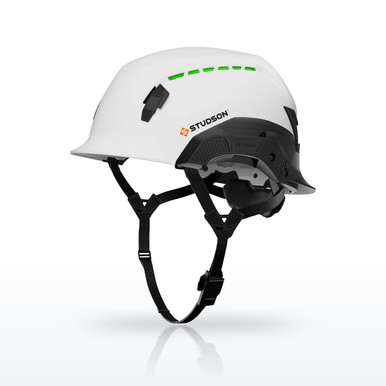
Studson SHK-1 Standard Brim Vented Type II Hard Hat, Class C, Cap StyleStudson SHK-1 Standard Brim Vented Type II Hard Hat, Class C, Cap StyleStudson lists the standard brim SHK-1 at 495 g, with a rear dial fit system and two size ranges

Weight and fit are the same question. People who ask what a hard hat weighs are usually asking why theirs is tiring, and the answer is rarely the ounces: a 14-ounce hat on a suspension that bottoms out on the crown, or a headband an inch loose, feels heavier at the end of a shift than a 20-ounce helmet whose weight is spread by a four-point strap and a brow pad. So this page starts with the weights (the manufacturers’ figures, and what Type II adds), then names the parts a hat is made of and what each one does, then goes through the fit problems in the order people ask them: sits too high, wobbles, rides up, too big, and what size to buy.

Weight, parts and fit, question by question

Weights are the manufacturers’ figures as printed on the product pages on this site; the fit rules are the manufacturers’ instructions and OSHA’s 2024 bulletin.

What is the normal weight of a hard hat or helmet?By type, as the manufacturers print it. A Type I cap-style HDPE hat: under a pound, typically 12 to 15 oz (Portwest prints its PW67 at under a pound; MSA, Fibre-Metal and PIP cap hats sit in the same range). A Type I full brim: a few ounces more for the brim. A Type II safety helmet: about 1 to 1.3 lb, because the shell carries a liner that absorbs side impacts; Studson states 495 g (17.5 oz) for the SHK-1 standard brim, 545 g (19.2 oz) for the full brim, 560 g for the dual-cert full brim and 567 g (20 oz) for the HighBar version. A welding helmet or a hard hat with a face shield and earmuffs mounted can reach 2 lb, which is why cap-mounted accessories are the heaviest thing most people put on their head.
How much does the Studson SHK-1 weigh, and why do two figures exist?As Studson states on the product pages: standard brim 495 g, full brim 545 g (1.2 lb / 19.2 oz), dual-cert full brim 560 g (19.8 oz), HighBar full brim 567 g (1.25 lb / 20 oz). The spec sheets print 525 g for the full brim and the SHK-2 sheet prints 560 and 600 g for the forthcoming standard and full brim; where Studson’s own documents differ, our listings carry the product-page figure. The difference between the shells is the brim and the chin strap hardware, not the liner.
Is 3 pounds heavy for a helmet?Yes, for anything industrial. Three pounds is a motorcycle, football or ballistic helmet; the heaviest Z89.1 helmet on this site is well under a pound and a half bare. A hard hat that feels like three pounds is one with a face shield, earmuffs and a lamp mounted on it, or one whose suspension is set so the shell rests on the head instead of floating above it.
What are the parts of a hard hat, and what does each do?The shell: the molded outer piece (HDPE on most Type I hats, ABS or polycarbonate on most Type II helmets) that spreads a blow and sheds a penetrator. The suspension or liner: on a Type I hat, a web of crown straps and a headband that hold the shell about an inch above the skull so the straps stretch and absorb the blow; on a Type II helmet, a foam or Koroyd liner that fills the shell and crushes on impact, with pads and a headband inside it. The headband with its adjustment: a ratchet dial, a pin-lock or a slide that sets the circumference (Studson’s is a rear dial; HighBar is the chin-strap version). The brow pad or sweatband at the front. The crown straps or their clips, which set the depth. The accessory slots on each side (the universal slot takes 30 mm earmuff blades and 7-slot face shield brackets) and, on some helmets, lamp clips and a rear rail. The chin strap, 2-point or 4-point, where fitted. The label inside with the Z89.1 type, class, size range and date.
How does a hard hat work?By keeping the blow off the skull and spreading it. A Type I hat works on the gap: the suspension holds the shell about an inch above the head, a falling object hits the shell, the shell flexes and the crown straps stretch, and what reaches the head is spread over the headband and reduced to below the limit Z89.1 sets. A Type II helmet adds a liner that crushes: Studson’s Koroyd tubes crumple on impact, EPS foam compresses, and either way the liner absorbs the energy of a side or off-center blow that a Type I suspension cannot reach. That is why the gap matters on a Type I hat (a suspension bottomed out on the head transmits the whole blow) and why a crushed liner on a Type II helmet means the helmet is finished. The protection guide linked below describes the tests.
How do I make my hard hat sit lower on my head?Adjust the depth, not the tightness. On a conventional suspension the crown straps clip into the headband at two or three heights; moving the clips to the lower setting lets the headband sit lower on the head while the shell keeps its clearance, and most people who ride high have the straps on the top setting. On a Type II helmet with a dial, the brow pad and the rear cradle set the depth: Studson’s SHK-1 has an extendable front brow pad and a rear dial, and the SHK-2 adds retention arms that move vertically to sit below the occipital bone. After the depth, set the headband so the hat does not shift when you nod and shake. Never remove crown straps or crush the suspension to drop the shell; the gap is the protection.
Why does my hard hat wobble or ride up, and how tight should it be?A wobble is a headband that is too loose or a suspension set too shallow; a hat that rides up is usually a headband sitting on the forehead instead of just above the eyebrows, or hair or a cap pushing it up. Set the band so the hat stays put through a vigorous nod and a head shake without pressure points, which on a ratchet is usually a click or two past comfortable. The front of the headband sits about an inch above the eyebrows, level, and the sweatband takes the pressure. A chin strap is the answer to a hat that comes off in wind, when bending over or when climbing; it does not fix a loose band.
What size hard hat do I need, and is 7 3/8 a big hat size?Measure the head with a tape around the widest part, just above the ears and eyebrows, in inches or centimeters; the live how-to-wear guide carries the chart. Hat size 6 1/2 is about 20 3/8 in (52 cm), 7 is 22 in (56 cm), 7 3/8 is 23 1/8 in (59 cm), 7 1/2 is 23 1/2 in (60 cm), 8 is 25 in (64 cm); 7 3/8 is in the upper middle of the range, not large. A 57 cm head is a 7 1/8. Most suspensions cover 6 1/2 to 8; Studson’s full brim is one size 53 to 63 cm (about 6 5/8 to 7 7/8) with an XXL at 60 to 65 cm, and its standard brim is L/XL 58 to 63 cm or M/L 53 to 59 cm. If a hat is slightly too big, the fix is the dial and the depth setting, not a thicker liner.
What does a chin strap, a liner or a cap under the hat change?A chin strap keeps the hat on; it adds nothing to impact protection but stops the hat leaving when you bend, climb or stand in wind, and OSHA’s bulletin suggests one for construction and work at height. A winter liner or a thin knit cap under the hat is allowed by most manufacturers if it is thin, flat and does not have a button, and the headband is let out to fit over it; the liners guide linked below covers it. A ball cap under a hard hat is the one most manufacturers rule out, because the button and the bill lift the hat off the suspension.
Which brand of helmet is lightweight?Weight tracks type and material more than brand: HDPE Type I cap hats are the lightest group on this site, polycarbonate and ABS Type I hats next, Type II helmets the heaviest because of the liner. Within Type II, the Studson figures above are typical, and the manufacturers that print a weight print it on the product page, which is where the rows below take theirs. Nothing on this page ranks one over another.

Weight and fit in plain words

  • Cap-style HDPE hard hat: under a pound. Type II helmet: 1 to 1.3 lb; Studson SHK-1 495 g standard brim, 545 g full brim, 567 g HighBar.
  • Three pounds is a motorcycle or ballistic helmet.
  • Parts: shell, suspension or liner, headband and dial, brow pad, crown straps or depth setting, side slots, chin strap, label.
  • A Type I hat works on the inch of gap above the head; a Type II helmet adds a liner that crushes once.
  • Sits too high: lower the crown strap clips or the brow pad. Wobbles: tighten the band. Rides up: band above the eyebrows, nothing bulky underneath.
  • Size: tape around the head above the ears; 7 3/8 is 59 cm; Studson full brim 53–63 cm, XXL 60–65 cm.
  • A chin strap keeps the hat on; a thin liner is fine with the band let out; a ball cap underneath is what the manufacturers rule out.
Manufacturer figures on the product pages on this site; Studson SHK-1 pages, fetched Nov 10 2026; OSHA SHIB March 6 2024.

Questions people ask

What is the normal weight of a helmet?

For a hard hat, under a pound for a cap-style HDPE hat and about 1 to 1.3 lb for a Type II safety helmet; Studson states 495 to 567 g for the SHK-1 versions.

How much does the Studson SHK-1 helmet weigh?

Studson states 495 g for the standard brim, 545 g (1.2 lb) for the full brim, 560 g for the dual-cert full brim and 567 g for the HighBar full brim.

Is 3 pounds heavy for a helmet?

Yes; that is a motorcycle or ballistic helmet weight. No Z89.1 helmet on this site is near it bare.

How do I make my hard hat sit lower on my head?

Move the crown strap clips to the lower setting, or on a dial helmet extend the brow pad and lower the rear cradle; then tighten the band. Never remove straps to drop the shell.

Why does my hard hat wobble?

The headband is loose or the suspension is set too shallow; tighten the dial until the hat stays put through a nod and a shake.

What are the parts of a hard hat?

Shell, suspension or impact liner, headband with its ratchet or dial, brow pad, crown straps, side accessory slots, chin strap where fitted, and the Z89.1 label inside.

How does a hard hat work?

The shell spreads the blow and the suspension gap or the crushable liner absorbs it, so what reaches the head stays under the Z89.1 limit; Type II adds the liner for side impacts.

What size helmet is 6 1/2 to 7 1/2?

About 52 to 60 cm around the head, or 20 3/8 to 23 1/2 inches; most suspensions cover 6 1/2 to 8.

Is 7 3/8 a big hat size?

No; it is 59 cm, upper-middle of the range, and inside every one-size helmet on this page.

What size is a 57 cm helmet?

Hat size 7 1/8, about 22 1/2 inches around.

What to do if a hard hat is slightly too big?

Tighten the dial or ratchet and lower the depth setting; a thin liner can take up a little, but the band is the adjustment.

Which brand of helmet is lightweight?

Weight follows type and material more than brand: HDPE Type I cap hats are lightest, Type II helmets heaviest. The manufacturers print their figures on the product pages.

Can I wear a cap under my hard hat?

A thin, flat knit cap or liner, yes, with the band let out; a ball cap with a button and bill is what most manufacturers rule out.

How much does an MSA V-Gard weigh?

0.86 lb for the V-Gard Cap as MSA’s technical sheet states, in Small (6 to 7 1/8), Standard (6 1/2 to 8) and Large (7 to 8 1/2) sizes.

The ratings, test results and standards shown here are the manufacturers' published values, reproduced as published. Nothing on this page is a recommendation by Bayshore Safety that any product is suitable for a particular task, hazard or workplace. Selecting safety products and protective equipment is the responsibility of the end user and the employer, based on their own hazard assessment and the regulations that apply to their work. Confirm every value on the manufacturer's own documentation before use.

Need hard hats or safety helmets for a crew?Call (925) 215-7337 or email us the trades and headcount and we will quote by the case with the Z89.1 type and class each manufacturer publishes. Contractor Direct orders ship free.
Hard hat selector
How to buyCard, purchase order or invoice terms; quotes on request; agencies and institutions welcome.
Live Service & SupportReal people who know the products, Monday to Friday 7:30am to 4pm Pacific. 925-215-7337
We DeliverWe ship nationwide. Parcel and LTL freight to job sites and businesses across the U.S.