
Studson SHK-1 questions answered: full brim or standard brim, vented or non-vented, Class C or Class E, HighBar, ANSI and CSA dual certification, weight, service life, pad care, Koroyd, Twiceme and Fidlock
The Studson SHK-1 is a Type II industrial safety helmet: Studson lists it as ANSI/ISEA Z89.1-2014 (R2019) Type I and Type II, with the vented shell carrying Class C (no electrical rating) and the non-vented shell Class E (proof tested at 20,000 volts). It comes as a full brim or a standard (cap-style) brim, in a Fidlock magnetic-buckle version, a HighBar dial-adjustable chin strap version and an ANSI plus CSA Z94.1 dual-certified full brim. Studson states a 3-year warranty, a field-use lifespan of 3 to 5 years and a shelf life of up to 10 years from the manufacture date, and the whole line is stocked here with the part number, color and size on each page.
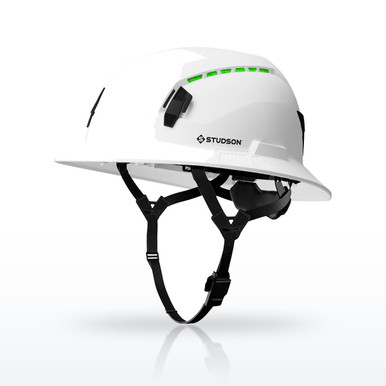 Studson SHK-1 Full Brim Vented Type II Hard Hat, Class C, 15 ColorsStudson lists the full brim vented SHK-1 as Type I and Type II, Class C, with EN 12492:2012 clauses, at 545 g
Why one helmet draws this many questions. The SHK-1 is sold in ten configurations that differ only in brim, venting, chin strap and certification, and the questions people ask (which one is Class E, does it come as a full brim, what does it weigh, how long is it good for, what is the chip in the shell for) are the differences between those ten. This page answers them from Studson’s own product pages and spec sheets, in the order they come up, and lists every version with its part number and current price. The Z89.1 types and classes themselves are covered in the live guides linked at the end; this page is about what Studson states for this helmet.
The SHK-1, question by question
Figures are Studson’s, as printed on the product page for each version; where the spec sheet and the product page differ, the product page figure is the one on our listing.
The SHK-1 in plain words
- Every SHK-1 is listed by Studson as Z89.1-2014 Type I and Type II; vented shells are Class C, non-vented shells are Class E.
- Full brim or standard brim decides which face shields, brackets and sun brims fit; glasses, the ED-3B and the chin straps fit both.
- Fidlock is the magnetic buckle; HighBar is the dial-adjustable chin strap sold on two full-brim versions.
- Dual-cert full brims are listed to ANSI Z89.1 Type II and CSA Z94.1 Type II; every other SHK-1 is ANSI only.
- Weights as Studson states them: 495 g standard brim, 545 g full brim, 560 g dual cert, 567 g HighBar.
- Studson states a 3-year warranty, 3 to 5 years of field use and up to 10 years of shelf life; any impact retires the helmet.
- Koroyd is the crumpling tube liner, Twiceme the NFC emergency chip, Ionic+ the silver antimicrobial pads (hand wash cold, air dry).
Questions people ask
Does Studson make a full brim hard hat?
Yes: the SHK-1 Full Brim, vented (Class C) or non-vented (Class E), plus carbon-finish, HighBar and ANSI plus CSA dual-certified versions. The standard brim is the cap-style shell.
Is the Studson SHK-1 Type 2?
Studson lists every SHK-1 as ANSI/ISEA Z89.1-2014 (R2019) Type I and Type II; Type II means it is tested for top and side impacts.
Is the SHK-1 Class E?
The non-vented versions are Class E (20,000 volt proof test, as Studson states it). The vented versions are Class C with no electrical rating, because vents open a path through the shell.
How much does the Studson SHK-1 helmet weigh?
Studson states 495 g for the standard brim, 545 g for the full brim, 560 g for the dual-cert full brim and 567 g for the HighBar full brim.
How long are Studson hard hats good for?
Studson states a 3-year warranty, a 3 to 5 year field-use lifespan and up to 10 years of shelf life from the manufacture date; a helmet that has taken an impact is retired regardless.
What is the HighBar on a Studson helmet?
A dial-adjustable chin strap: two arms above the jaw tightened by a grip-ring dial, with a padded chin cup, instead of fabric straps and a buckle. Sold on the full brim only.
What does dual certified mean on the SHK-1?
Listed to both ANSI/ISEA Z89.1-2014 Type II and CSA Z94.1-2015 Type II, so it can be issued in the United States and Canada. The other versions are ANSI only.
How to clean the padding in a Studson hard hat?
Pull the hook-and-loop pads out, hand wash cold, air dry; Studson says no machine washing or tumble drying. A worn set is replaced with the five-piece Ionic+ pad set for that helmet.
What is the chip in a Studson helmet?
A Twiceme NFC chip that stores emergency contacts and medical information on the chip; any NFC phone reads it with a tap, and the owner loads it through the Twiceme app.
What is Koroyd?
The impact liner in the SHK-1: welded plastic tubes that crumple on impact to absorb force, used in place of EPS foam. Because it crumples visibly, a daily look shows whether the helmet has been hit.
Who sells Studson hard hats?
Studson sells through its own site and dealers; we stock the full SHK-1 line and its accessories and ship to every state, with each part number on its own page.
Does the SHK-1 fit over a winter liner?
Studson sells a fleece liner made for the SHK-1 (97 percent polyester, 3 percent elastane); the rear dial gives the room, and the chin strap is re-adjusted over it.
Related guides
What accessories fit a hard hat, and is a chin strap required?Slots, rails, brackets and straps by helmetWhat is the 2 2 2 rule for helmets?The 5-year rule, the 10-year helmet and what Z89.1 and OSHA sayHow much does a hard hat weigh?And how to make one sit lowerType I vs Type II hard hatsWhat the types meanClass G, Class E and Class C hard hatsThe electrical ratingsVented hard hatsWhat the ventilation does to the electrical classEN 397 vs EN 12492 vs ANSI Z89.1What each helmet standard testsSafety helmet vs hard hatWhat the chin strap and Type II changeThe ratings, test results and standards shown here are the manufacturers' published values, reproduced as published. Nothing on this page is a recommendation by Bayshore Safety that any product is suitable for a particular task, hazard or workplace. Selecting safety products and protective equipment is the responsibility of the end user and the employer, based on their own hazard assessment and the regulations that apply to their work. Confirm every value on the manufacturer's own documentation before use.