
Safety glasses lens tints explained: clear, gray, amber, indoor/outdoor, mirror and shade, and the Z87.1 marks that go with them
The tint of a safety lens does two separate things: it sets how much visible light gets through, and it may carry a filter rating. ANSI/ISEA Z87.1 marks the ratings on the lens: U followed by a scale number for ultraviolet (U6 is the common clear-lens mark, meaning the lens passes almost no UV), L followed by a number for a visible-light (glare) filter, and W followed by the shade number for a welding filter. A clear polycarbonate lens blocks UV without any tint; gray and smoke cut glare outdoors without changing colors; amber and yellow raise contrast in low light; indoor/outdoor (I/O) is a light mirror or light tint for moving in and out of buildings; silver, blue and red mirrors are gray or smoke lenses with a reflective coat; shade 3 and shade 5 lenses carry a W mark for torch and cutting work and are not welding helmets. PIP lists the tint options per frame in the manufacturer’s data, and the eyewear below is grouped by the tints the manufacturer offers.
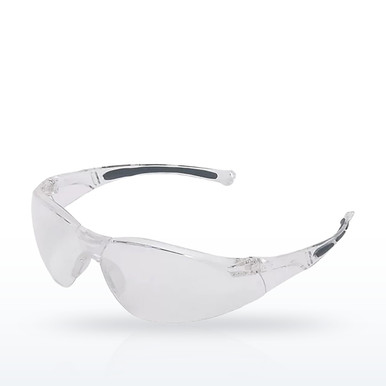 UVEX A800 A802 Safety Glasses, ANSI Z87.1+, 5 Lens Options, Anti-fog OptionsFrame offered in clear, gray and indoor/outdoor lenses as the manufacturer lists (PIP data)
Why tint and rating are different things. Polycarbonate blocks ultraviolet whether it is clear or tinted, so a clear Z87 lens protects against UV as well as a gray one; the gray lens adds glare control for outdoor work, which Z87.1 rates with the L mark if the manufacturer claims a visible-light filter. Shade numbers are the one tint that is a protection figure: a W3 or W5 lens is a welding filter for torch brazing, cutting and gas welding as the shade chart lists, while arc welding needs the shade 10 and up filters in a helmet. Amber and I/O lenses are about seeing, not protection: amber raises contrast in dim light and I/O passes enough light to work indoors while cutting glare at the door.
The common tints, as the manufacturers describe them
Lens Tint column of PIP’s product data; the marks are from Z87.1.
Z87.1 marks that go with a tint
| Mark on the lens | What it means | Where it appears |
|---|---|---|
| Z87 / Z87+ | Basic or high impact; not a tint mark | Every Z87.1 lens |
| U2 to U6 | Ultraviolet filter scale number; U6 passes the least UV | Clear and most tinted lenses |
| L1.3 to L10 | Visible light (glare) filter scale number | Gray, smoke, mirror and I/O lenses where rated |
| W1.3 to W14 | Welding filter shade number | Shade 3, 5 and the helmet filters |
| R1.3 to R10 | Infrared filter scale number | Some shade lenses |
| X | Anti-fog coating meets the fog test | Any tint; see the anti-fog guide |
| V, S | V photochromic (variable tint); S special purpose | Photochromic and specialty lenses |
A tint without a filter mark is a cosmetic or comfort tint; a filter claim has to carry the mark.
ANSI/ISEA Z87.1-2020 section 9; PIP Rich Product Data, October 2026.
MCR Safety’s light transmission by tint
MCR Safety’s lens guide gives a visible light transmission figure for each tint it makes, and names its coatings: Duramass hard coat (scratch resistance) and Duramass anti-fog, MAX3 hard coat (three times the scratch resistance of its standard coat), MAX6 anti-fog (six times the anti-fog of its standard coat) and BossMan mirror. The VLT field on each MCR Safety eyewear page here carries the figure for the tints that style comes in; the MCR Safety Klondike, MCR Safety Law, MCR Safety Dominator, MCR Safety Swagger and MCR Safety BearKat series pages list every lens option.
MCR Safety, “Eyewear Lens Guide” (things to consider when choosing a lens; lens coatings; tint pages); MCR Safety product pages and specification sheets for the styles shown, fetched Nov 6 2026MCR Safety lens tints and the light each transmits
| Tint | Visible light transmitted | MCR Safety’s description |
|---|---|---|
| Clear | 90% | General purpose; the color spectrum undistorted |
| Amber | 80% | Contrast in low light; blocks nearly all blue light, which distorts color recognition |
| Light blue | 68% | Reduces glare from halogen and fluorescent light; an indoor/outdoor option |
| Orange | 57% | Absorbs blue and green light; indoor, low light, cloudy or hazy days |
| Vermilion | 55% | Reduces all colors equally, keeping color recognition |
| Indoor/outdoor clear mirror | 36% | Clear lens with an outside mirror coat; moving between inside and outside |
| Brown | 13% | Distinguishes color while reducing glare; meets the ANSI Z80.3 traffic signal recognition requirement |
| Gray | 13% | Reduces light for sun and glare outdoors |
| Polarized | 13% | Cuts reflected glare; contrast and depth |
| Mirror (silver, blue, fire, emerald, black, blue diamond) | 9 to 13% | Gray lens with an outside mirror coat |
| Filter shade 3.0 (gray or green) | 12% | Molten metal, cutting, soldering and brazing; the shade number is on the lens |
| Filter shade 5.0 (gray or green) | 2% | Gas welding and cutting |
| Filter shade 2.0 (green) | 30% | Torch soldering |
Source: MCR Safety, “Eyewear Lens Guide”. MCR Safety: these are general definitions; the safety director at the facility decides the application.
Portwest’s tints and filter marks
Portwest lists its lens tints as clear, smoke, amber, blue mirror and polarized smoke, and pairs each with the European filter mark: EN 170 (ultraviolet filter) on clear and amber, EN 172 (sunglare filter) on smoke, mirror and polarized. It publishes no visible light transmission percentage on the US pages, so the band shows the tint and coating names Portwest states.
Portwest product pages and US data sheets for the styles shown (documents.portwest.com), fetched Nov 7 2026Lens colors as Radians rates them
Radians publishes a lens color page with the visible light transmission it assigns each tint: clear at maximum, light smoke and indoor/outdoor at about 50 percent, smoke at about 16 percent, amber at about 84 percent, vermilion 33 percent, orange and light blue 50 percent, copper about 20 percent, and the IRUV filter lenses in 2.0, 3.0 and 5.0 for work near brazing, soldering, gas welding and oxygen cutting. Its mirror lenses are dark tints with a reflective coating for very bright sun. The Lens Tint field on every Radians, Crossfire and DEWALT eyewear page on this site lists which of these the style comes in.
Radians Product Technologies page (radians.com/resources/product-technologies, radians.com, fetched Nov 8 2026)Lens colors and visible light transmission as Radians lists them
| Lens | Visible light transmission (Radians) | Where Radians places it |
|---|---|---|
| Clear | maximum | indoor work where impact protection is required |
| Light smoke | about 50% | shaded areas with the line of sight in direct sun; cuts glare with a brighter field than dark smoke |
| Smoke | about 16% | bright, sunny days; maximum glare reduction; true color, normal depth perception |
| Indoor/outdoor | about 50% | moving between indoor or shaded locations and direct sunlight |
| Amber | about 84% | low-light, low-contrast work; blocks much of the blue light |
| Vermilion | 33% | inspection where contrast is enhanced; red alignment or leveling beams |
| Orange | 50% | filters blue and green light; curing and inspection |
| Light blue | 50% | the smoke lens job with more light, indoor and outdoor |
| IRUV 2.0, 3.0, 5.0 | light, medium, heavy | near others torch brazing, soldering, gas welding or oxygen cutting |
| Copper | about 20% | medium to bright outdoor conditions; blue blocking |
| Desert tan, coffee | not stated | outdoor; depth perception; glare |
| Mirror (silver, electric blue, blue, electric orange, rose, black) | dark | very bright sun and glare outdoors |
Source: Radians Product Technologies page (radians.com/resources/product-technologies, radians.com, fetched Nov 8 2026). The Lens Tint line on each Radians, Crossfire and DEWALT eyewear page on this site lists the lenses offered for that style.
Questions people ask
What color safety glasses are used outdoors?
This site does not rank tints. Gray and smoke cut visible light without changing colors; mirror lenses add reflection on a gray base; the L mark shows where a manufacturer rates the glare filter.
What are amber safety glasses for?
Contrast in low light and overcast conditions; amber passes less blue light. The manufacturer lists amber as a tint option on the frames above.
What does indoor/outdoor mean on safety glasses?
A light mirror or light tint that passes most visible light so the glasses can be worn inside and cut glare at the door; listed as Indoor/Outdoor in the manufacturer’s data.
What are shade 5 safety glasses used for?
For the processes the shade chart lists at shade 3 to 5: torch brazing, soldering, oxy-fuel cutting and light gas welding. Arc welding needs a helmet filter at shade 10 and up; the welding lens shade guide has the table.
What do U6 and L mean on a lens?
U is the Z87.1 ultraviolet scale number (6 passes the least UV); L is the visible-light filter scale number for glare lenses.
Do safety glasses block UV light?
Polycarbonate safety lenses block almost all ultraviolet whether or not they are tinted; the Z87.1 mark for it is U followed by a scale number (U6 is the common clear-lens mark, passing the least UV). Portwest marks its lenses with the EN 170 ultraviolet filter code (2C-1.2 and the like) beside the Z87 marks.
What rating should safety glasses have for outdoor work?
The same ANSI/ISEA Z87.1 impact mark as indoors (Z87+ for flying particles), plus a lens that handles the light: a gray or smoke lens for glare, with the U mark for ultraviolet; OSHA sets no tint rule, only that the lens must let the wearer see the work. Indoor/outdoor lenses carry a light tint or light mirror for moving between the two.
What does the U6 rating on safety glasses mean?
A clear polycarbonate Z87.1 lens carries a U mark (U6 on most) and blocks almost all ultraviolet; tint is not what blocks UV.
What are the levels of safety glasses?
Two impact levels (Z87 basic, Z87+ high impact) and then marks for what else the lens was tested for: U scale numbers for ultraviolet, L numbers for visible-light glare filters, W shade numbers for welding filters, V for a photochromic lens, and D3, D4, D5 on goggles for splash and dust. The tint itself has no level; MCR Safety publishes the visible light transmitted for each of its tints (clear 90 percent, gray 13, shade 5 at 2).
Can you wear tinted safety glasses indoors?
The rule does not forbid tint, but OSHA’s guidance says a protector must not restrict vision for the task, and a 13 percent gray lens indoors does. Indoor/outdoor (MCR Safety: 36 percent visible light transmitted), amber (80 percent) and photochromic lenses are the tints made for crews that move between the two.
Do safety goggles block UV?
A polycarbonate goggle lens blocks nearly all ultraviolet whether clear or tinted, and the tested claim is the U mark: U6 means the lens passes the least UV on the Z87.1 scale. Tint is not the UV filter; a clear U6 lens blocks more UV than an unmarked dark lens. Shaded goggles for torch work carry a W mark with the shade number instead, which covers UV, visible and infrared together.
What is the purpose of the filter lens in a welding helmet?
To cut the arc's ultraviolet, visible and infrared radiation to a level the eye can take: the W-marked shade plate or auto-darkening filter in the helmet window is the filter 1910.252(b)(2) requires, with the shade number from OSHA's table (10 to 14 for arc welding by process and electrode size). The shade 3 and shade 5 safety glasses on this page are for torch brazing and light cutting, not for arc welding; the welding shade chart guide gives the numbers.
The ratings, test results and standards shown here are the manufacturers' published values, reproduced as published. Nothing on this page is a recommendation by Bayshore Safety that any product is suitable for a particular task, hazard or workplace. Selecting safety products and protective equipment is the responsibility of the end user and the employer, based on their own hazard assessment and the regulations that apply to their work. Confirm every value on the manufacturer's own documentation before use.