Home › Guides › Head › What is a face shield?
Guide · Eye and face · Face shields, visors, windows and brackets on a hard hat

What is a face shield, what is it called, and does it work? Visors, windows and brackets on a hard hat, Z87.1 and Z87+ marks, clear, tinted, mesh, shade 5 and 10 and arc-rated windows, grinding, UV, and what one costs

A face shield is a clear, tinted or mesh window that hangs in front of the whole face from a headgear or from a bracket on a hard hat; the trade also calls it a visor, a face protector or, for the window alone, a shield or lens. It works for what it is tested for: a Z87+ window has stopped a quarter-inch steel ball at 300 feet per second and a pointed 500-gram weight dropped from 50 inches, a D3 window has passed the splash test, and a shade-numbered window filters the light its number states. What it does not do is seal: a shield is open at the bottom and sides, which is why OSHA’s selection guidance says face shields are worn over safety glasses or goggles, not instead of them.
Bayshore Safety. Industrial safety and PPE supplier since 2017. · Current as of November 2026 · 29 CFR 1910.133(a)(1), 1926.102 and 29 CFR 1910 Subpart I Appendix B (face shields over primary eye protection), as quoted in the live face shield guide; ANSI/ISEA Z87.1-2020 marks (Z87, Z87+, D3, U, L, W) as the manufacturers state them; the Studson face shield, half shield, bracket and mesh shield product pages and the accessory spec sheet (studson.com, fetched Nov 10 2026), including the Paulson-made full brim shields; ASTM F2178 and NFPA 70E as Studson states them for the arc-rated shield
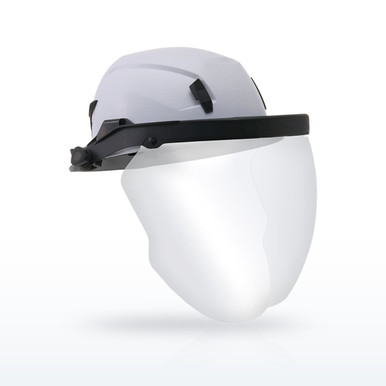
Studson Full Brim Face Shield with Bracket, Clear, Shade 5, Shade 10, Arc FlashStudson Full Brim Face Shield with Bracket, Clear, Shade 5, Shade 10, Arc FlashStudson lists the Paulson-made full brim shield as ANSI Z87.1+, toric, with a chin protector and permanent anti-fog and anti-scratch coatings

What the names mean before the questions start. The same object goes by half a dozen names: face shield, visor, face protector, face screen, window, lens, and on a welding or arc-flash job, hood or shield again. The parts are three: the window (the sheet in front of the face), the headgear or the hard hat bracket that carries it, and, on many shields, a crown or chin guard. Each part is rated separately under ANSI/ISEA Z87.1 and certified as a system by its manufacturer, which is why a window from one brand on a bracket from another may carry no rating at all. This page answers the questions in order: what a shield is and is called, whether it works and what it does not do, what the marks mean, the window types (clear, tinted, mirrored, mesh, shade 5 and 10, arc-rated), grinding, UV, wearing one without glasses, fitting one to a helmet, and what a shield costs.

Face shields, question by question

Test figures are from ANSI/ISEA Z87.1-2020 as the manufacturers state them; the OSHA wording is from 1910.133 and the Subpart I Appendix B selection guidance.

What is a face shield, and what is it called?A protector that covers the face from the forehead to below the chin, hung from a headgear with its own ratchet or from a bracket that clips into the slots of a hard hat. Names in use: face shield (the standard’s term), visor (the trade’s, and the usual word on a helmet), face protector and face screen (older catalogs and European usage), window or lens (the replaceable sheet itself), and half shield for the short visor that covers the eyes only. A welding helmet is a face shield with a filter window and its own name. Studson sells all of these for the SHK-1: a cap-style face shield with carrier, a half shield, and full brim shields made for it by Paulson.
Do face shields actually work, and what does a face shield aid with?For the hazards they are tested for, yes. A Z87+ window has passed the high-velocity test (a 6.35 mm steel ball at 300 ft/s), the high-mass test (a 500 g pointed weight from 50 inches) and the penetration test, which is the flying chip, the broken wire wheel and the dropped bolt; a D3 window has passed the splash test for liquids; a mesh window stops chips and brush; a shade window filters the light its number states; an arc-rated window has been tested to ASTM F2178 and carries an ATPV in cal/cm². What a shield adds over glasses is coverage: the cheeks, the chin, the forehead and the neck under the chin guard. What it does not do is seal around the eyes, which is the limit in the next card.
Can a face shield be used alone, instead of safety glasses?Not under OSHA’s selection guidance. 29 CFR 1910 Subpart I Appendix B, the guidance OSHA published for choosing eye and face protection, says face shields should only be worn over primary eye protection (spectacles or goggles), because the shield is open at the bottom and sides and a particle or splash that comes under or around it reaches an unprotected eye; the construction rule, 1926.102, reads the same way. The exceptions are protectors that seal: a full facepiece respirator or a loose-fitting hood with a Z87 visor, which Z87.1 tests as their own types. Studson prints the same practice on its half shield page by designing it to fit over prescription glasses. The live face shield guide covers when OSHA calls for a shield at all.
Should you wear a face shield while grinding?OSHA’s selection chart puts chipping, grinding, machining and sanding under impact and calls for spectacles with side protection, goggles or a face shield, with the instruction that severe exposure means a face shield over the glasses or goggles. In practice a bench or angle grinder is severe exposure: the wheel can shed, the work can be thrown, and sparks arrive from below the eye line. The grinding guide linked below goes through it by tool.
What is the difference between Z87 and Z87+ on a shield, and what does D3 mean?Z87 on a window means it passed the basic impact test (a one-inch steel ball dropped from 50 inches); Z87+ means it passed the high-velocity, high-mass and penetration tests described above, the mark Studson lists on its clear and shade windows and the one most industrial shields carry. D3 means the window passed the splash and droplet test; D4 and D5 are dust and fine dust. U with a number is a UV filter rating, L a visible-light filter, W a welding shade. The bracket or headgear is marked separately, and the manufacturer certifies window plus carrier as a system. The marks are molded into the window edge and the bracket.
Is a tinted or mirrored visor better, and what are the tint options?Neither is better; each matches a light condition, and the number that tells you is the VLT (visible light transmission). Studson prints the VLT on its half shield tints: clear 90 percent for indoors and low light, light grey 58 percent for mixed light, amber with silver mirror 24 percent for overcast and variable light, gold mirror 13 percent for bright glare. A mirror coating reflects glare off the outside surface; a tint absorbs light through the window. Neither is a welding filter: for welding, cutting and torch work the window is a numbered shade (Studson’s full brim shields come in shade 5 and shade 10) tested as a filter, and a dark tint without a W number is a tinted window, not a filter.
What are clear face shields made of, and what is a mesh shield for?Polycarbonate is the impact window, which is what every Z87+ window we carry is, including Studson’s Paulson-made full brim shields (polycarbonate with permanent anti-fog and anti-scratch coatings and a toric curve that widens the view). PETG and propionate are lighter, clearer and more chemical-resistant but lower in impact rating. Acetate is for chemical splash. A mesh shield (Studson’s 2107900A and FSMB-1 are black steel wire) stops chips, brush and sawdust while letting air and sound through, which is why tree work, landscaping and chainsaw crews use it; mesh stops no dust and no liquid, and the glasses rule applies underneath.
What is an arc-rated face shield?A window tested under ASTM F2178 for the heat of an electric arc and given an arc thermal performance value in calories per square centimeter; it is worn with arc-rated clothing of the same category for energized electrical work under NFPA 70E. Studson’s full brim arc flash shield (Paulson AMP1-12T) is listed at 12 cal/cm² ATPV with a grey window, an integrated chin protector and an ArcVent ventilation system, and Studson lists it to Z87.1+S, ASTM F2178 and NFPA 70E. The arc-rated face shield guide linked below covers which category needs which shield.
Does a face shield block UV, and can you wear a helmet without a visor?A clear polycarbonate window absorbs most UV by nature, but only a window tested and marked U under Z87.1 has a stated UV rating, so the mark is what to look for. A helmet without a visor is simply a helmet: no OSHA rule requires a face shield on a hard hat unless the hazard assessment finds a face hazard, and most hard hats are worn without one. The visor is added for grinding, brush, splash, heat or arc exposure; a half shield or safety glasses cover the eyes alone where the face is not at risk.
Will any visor fit any helmet, and how do you attach a face shield to a hard hat?No. A shield attaches to a hard hat by a bracket that fits the helmet’s slots (the universal pattern is the 7-slot bracket, which Studson’s 9102415 nylon bracket and 2107900A mesh shield use), by a carrier made for the helmet (Studson’s cap-style face shield and half shield fit the SHK-1 standard brim only, the Paulson full brim shields and the weight-compensating slotted cap bracket fit the SHK-1 full brim only), or by a headgear worn under the helmet. The manufacturer certifies the window and bracket as a system, so the shield for a helmet is the one its manufacturer lists for it; Studson states which of its shields fit which shell on every page. On a Class E helmet the bracket must be dielectric with no metal through the shell, which Studson’s nylon bracket is.
How much does a face shield cost, and where do you buy one?Current prices are on the rows below: a complete hard-hat-mounted shield with bracket runs from the Studson cap-style face shield with carrier at the price shown to the full brim clear shield and its shade and arc-rated versions; replacement windows cost less than the complete shield; a universal 7-slot bracket or a mesh window is the lowest-cost piece. A medical or CPR face shield is a different product (a thin film for droplets, no impact rating) and is not what this page or the Z87.1 marks cover. We stock every shield on this page in Pittsburg, California and ship to every state.
How do you stop a face shield fogging, clean it, and take it off?Fogging: an anti-fog coating (permanent on the Paulson shields, a treatment on the Studson half shield), venting between the brow and the window, and tilting the shield up during breaks. Cleaning: rinse grit off with water first, then mild soap and a soft cloth; never a dry wipe, solvents or paper towels, which scratch polycarbonate and strip coatings. Taking it off: on a shield worn for splash or droplets, lift it from the headgear or bracket, not the window, so the outside surface does not touch the face; on a hard hat shield, pivot it up and park it before removing the helmet.

Face shields in plain words

  • Face shield, visor, face protector, window, lens: one object, three parts (window, carrier or bracket, chin or crown guard), each rated separately.
  • Z87+ means the window stopped a steel ball at 300 ft/s and a 500 g pointed weight from 50 inches; D3 means it passed the splash test.
  • A shield is worn over safety glasses or goggles, never instead of them: OSHA’s Appendix B, because the shield is open at the bottom and sides.
  • Clear, grey, amber mirror and gold mirror are tints, told apart by VLT; shade 5 and 10 are welding filters; 12 cal/cm² is an arc rating.
  • Mesh stops chips and brush and lets air through; it stops no dust or liquid.
  • A shield fits the helmet its manufacturer lists it for: 7-slot bracket, model carrier or headgear; on a Class E helmet the bracket is dielectric.
  • Rinse, mild soap, soft cloth; lift it off by the carrier, not the window.
ANSI/ISEA Z87.1-2020 marks as the manufacturers state them; 29 CFR 1910.133 and Subpart I Appendix B; Studson product pages, fetched Nov 10 2026.

Questions people ask

Do face shields actually work?

For what they are tested for, yes: a Z87+ window has stopped a steel ball at 300 ft/s and a 500 g pointed weight; a D3 window has passed the splash test; a shade window filters light to its number. They do not seal, so glasses go underneath.

What are face shields called?

Face shield, visor, face protector, face screen; the sheet itself is the window or lens; a short one is a half shield; a welding helmet is a face shield with a filter.

What is a face protector?

An older name for a face shield: a window hung from a headgear or a hard hat bracket that covers the face from forehead to chin.

What does a face shield aid with?

Coverage of the whole face against flying chips, splash, sparks, heat and arc flash, over the safety glasses that protect the eyes themselves.

Can face shields be used alone to protect against impact hazards?

Not under OSHA’s selection guidance: a shield is worn over spectacles or goggles because it is open at the bottom and sides.

Can you wear a face shield instead of safety glasses?

No; OSHA’s Appendix B says face shields are worn over primary eye protection. A sealed full facepiece respirator is the exception.

Should you wear a face shield while grinding?

OSHA’s chart calls grinding an impact hazard and says severe exposure takes a face shield over glasses or goggles; a bench or angle grinder is severe exposure.

Is a tinted or mirrored visor better?

Neither; pick by VLT. Studson’s half shield runs clear 90 percent, light grey 58, amber mirror 24, gold mirror 13. Welding needs a numbered shade, not a tint.

What is a visor face shield?

The trade’s name for a hard-hat-mounted face shield; the visor is the window that pivots down from a bracket in the helmet slots.

What are clear face shields made of?

Polycarbonate for impact (the Z87+ windows), PETG or propionate for lighter splash shields, acetate for chemicals.

What class is a face shield, and what rating should it be?

Face shields carry Z87 or Z87+ impact marks, D3 for splash, a shade number for welding and an ATPV in cal/cm² for arc flash; the hazard assessment picks which.

Does a face shield protect from UV?

Only a window tested and marked U under Z87.1 carries a UV rating; look for the mark rather than assuming.

Will any visor fit any helmet?

No. The bracket must fit the helmet’s slots (7-slot is the universal pattern) or be the carrier made for that model, and the manufacturer certifies window plus bracket as a system.

How do you attach a face shield to a hard hat?

Clip the bracket into the helmet’s accessory slots, or use the carrier the helmet manufacturer makes; Studson lists which shield fits the standard brim and which the full brim.

Can you wear a helmet without a visor?

Yes; no rule requires a face shield on a hard hat unless the hazard assessment finds a face hazard, and most hard hats are worn without one.

How much does a face shield cost?

The current prices are on the rows above: a universal bracket or mesh window is the lowest-cost piece, a complete hard-hat shield more, a shade or arc-rated full brim shield the most.

Where do they sell face shields?

Safety distributors stock industrial shields with the Z87 marks; we stock the shields on this page and ship to every state. Medical face shields are a different, unrated product.

How do you keep a face shield from fogging?

An anti-fog coating (permanent on the Paulson shields Studson sells), a gap at the brow for air, and tilting the shield up on breaks.

What are the OSHA requirements for face shields?

1910.133 requires eye or face protection suited to the hazard and meeting Z87.1; the Appendix B guidance says shields go over glasses or goggles. The live face shield guide covers when a shield is required.

The ratings, test results and standards shown here are the manufacturers' published values, reproduced as published. Nothing on this page is a recommendation by Bayshore Safety that any product is suitable for a particular task, hazard or workplace. Selecting safety products and protective equipment is the responsibility of the end user and the employer, based on their own hazard assessment and the regulations that apply to their work. Confirm every value on the manufacturer's own documentation before use.

Need hard hats or safety helmets for a crew?Call (925) 215-7337 or email us the trades and headcount and we will quote by the case with the Z89.1 type and class each manufacturer publishes. Contractor Direct orders ship free.
Hard hat selector
How to buyCard, purchase order or invoice terms; quotes on request; agencies and institutions welcome.
Live Service & SupportReal people who know the products, Monday to Friday 7:30am to 4pm Pacific. 925-215-7337
We DeliverWe ship nationwide. Parcel and LTL freight to job sites and businesses across the U.S.