
Which standard must a full-body harness meet? ANSI Z359.11, CSA Z259.10, EN 361 and ASTM F887 beside OSHA 1926.502(d), and how to read the label
In the United States the law is OSHA, and OSHA does not name a harness standard: 1926.502(d) and 1910.140 set performance rules for the whole fall arrest system (1,800 lb maximum arresting force with a harness, 6 ft free fall, 3.5 ft deceleration, 5,000 lb D-rings proof-tested to 3,600 lb, synthetic webbing, a dorsal attachment, inspection before use) and leave the harness design to the manufacturer. The standard the US manufacturers build and label full-body harnesses to is ANSI/ASSP Z359.11, Safety Requirements for Full Body Harnesses, in its 2021 edition, which sets the design, dynamic and static tests, the 130 to 310 lb capacity range, the visual load indicator and the label contents; a harness meeting it is what every product page in our band lists. Canada uses CSA Z259.10, Europe EN 361, and harnesses for electrical work add ASTM F887 (arc flash) on top of Z359.11. None of these is a legal requirement in a US workplace; the OSHA performance rules are, and the ANSI label is the manufacturer’s evidence that the harness was designed and tested to meet them. FallTech states the relationship the same way: OSHA is the legal minimum, ANSI/ASSP Z359 the consensus standard that adds design, testing and labeling, and the two are read together.
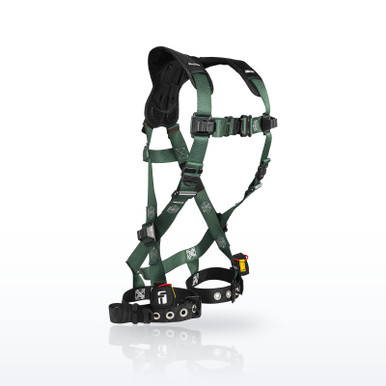 FallTech 1910 Harnesses, FT-1910 1D Standard Non-Belted, Tongue Buckle LegsListed to ANSI Z359.11-2021 and CSA Z259.10-2018, with the capacities FallTech states for each (FallTech data)
Why OSHA does not approve harnesses. OSHA writes rules for employers, not product certifications, so no harness carries an OSHA approval, and a seller who claims one is wrong. What OSHA does is tell the employer what the system has to do in a fall and what the hardware has to withstand; the consensus standards tell the manufacturer how to design and test a harness so that a system built from it can do those things, and the label tells the buyer which standards were met and in which edition. That is why a harness label is worth reading: it is the only place the standard, the edition, the capacity, the size, the date of manufacture and the inspection record meet. A harness with no legible label cannot be identified or inspected to its instructions, and every manufacturer’s manual says to remove it from service.
The standards, and what each one is
The ANSI number is the US consensus standard; the others are the counterparts the manufacturers list for other markets or hazards.
What OSHA requires beside what Z359.11 adds, as FallTech describes the standard
| OSHA 1926.502(d) / 1910.140 | ANSI/ASSP Z359.11-2021 (as the manufacturer describes it) | |
|---|---|---|
| Capacity | None stated for the harness; the system is tested to a 310 lb (140 kg) weight in appendix C/D, with the employer to modify the criteria for a heavier combined weight | 130–310 lb user, clothing and tools; FallTech states 130–425 lb under OSHA for most of its harnesses by reading 1926.502(d)(16) with its own testing |
| Arresting force | 1,800 lb maximum with a body harness | Dynamic performance tests of the harness at the standard’s drop; the force limit stays OSHA’s |
| Hardware | D-rings and snap hooks 5,000 lb tensile, 3,600 lb proof load; locking snap hooks | Static tests of each attachment element and buckle; connector details in Z359.12 |
| Webbing | Synthetic fibers | Material and strength requirements, abrasion and UV considerations in the manufacturer’s instructions |
| Load indicator | Not required | Required: a visual indicator at the dorsal attachment that shows the harness has arrested a fall |
| Label | Not specified | Model, size, standard and edition, date of manufacture, capacity, warnings, inspection record |
| Attachment points | Dorsal, center of the back near shoulder level, or above the head; sternal allowed where free fall is 2 ft or less (1910.140(c)(22)) | Requirements for dorsal, sternal, frontal, hip and shoulder elements and the uses each is tested for |
| Inspection | Before each use; after a fall, out of service until a competent person clears it | Before use by the user; periodic by a competent person at the interval in Z359.2 and the manufacturer’s instructions |
The ANSI column is the standard as the manufacturers describe it on their pages; the standard’s own text is sold by ANSI and ASSP.
Source: 29 CFR 1926.502(d), 1926 Subpart M appendix C, 1910.140(c)(22) and (d) (e-CFR text as of Nov 5 2026); FallTech, “The Complete Guide to Full Body Harnesses”; FallTech “Fall Protection Weight Capacity” and FallTech’s article on ANSI labels against certificates (“Are Your Products Actually ANSI …, or Just Labeled ANSI?”, 2026) (falltech.com, fetched Nov 8 2026).
How to read a harness label, and what FallTech states about “labeled ANSI”
From the FallTech pages:
- The standard and edition: “ANSI/ASSP Z359.11-2021” means the 2021 edition; “Z359.11-2014” the one before it. FallTech states that no grandfathering applies in the Z359 code: a product made after a new edition’s effective date is tested to the new edition, and the label shows which.
- Capacity: the ANSI range (130–310 lb) and, where the manufacturer states one, the OSHA range (FallTech prints 130–425 lb or 130–420 lb on most harnesses and 310–425 lb on its heavyweight line). The figure is user plus clothing, tools and equipment.
- Size, model, serial or lot, date of manufacture, materials, and the warnings the standard requires; a grommet or printed inspection grid where the periodic inspection is recorded.
- Testing evidence: FallTech states that a product can carry an ANSI number because the manufacturer tested it in house, had it tested by a third party, or had it certified by a third-party body accredited to ISO/IEC 17065; its own products carry a declaration of conformity (the manufacturer’s statement) and, where applicable, a third-party certificate, and it names the declaration on each product page we list (for example B0930212a for the FT-1910 line). Its piece on “labeled ANSI” describes the difference between a label and a certificate and states that buyers may ask the manufacturer for the test report.
- What the label cannot tell you: whether the harness is the right one for the anchor and connector in use, whether it fits the wearer, and whether the combined weight is within the stated capacity. Those are the employer’s hazard assessment and the manufacturer’s instructions, not the standard.
- Our band: every harness row carries the standard and edition the manufacturer lists, with its capacity statement and, for FallTech, the declaration of conformity and manual MFBH04; the product page carries the full label text.
Questions people ask
What standard must a full-body harness meet?
In the US, the OSHA performance rules for the system (1926.502(d), 1910.140) are the law, and the manufacturers design and label the harness to ANSI/ASSP Z359.11 (2021 edition). Canada: CSA Z259.10. Europe: EN 361. Arc flash: ASTM F887 added to Z359.11. The label lists each standard and edition the harness was tested to.
What are OSHA’s regulations for harnesses?
OSHA regulates the system, not the harness design: 5,000 lb D-rings proof-tested to 3,600 lb, locking snap hooks, synthetic webbing, 1,800 lb maximum arresting force with a harness, 6 ft maximum free fall, 3.5 ft maximum deceleration distance, dorsal attachment, inspection before each use, removal from service after a fall, prompt rescue (1926.502(d); 1910.140(c)–(d)).
Does OSHA approve harnesses?
No. OSHA does not approve or certify products. A harness labeled to ANSI/ASSP Z359.11 is the manufacturer’s statement that it was designed and tested to the consensus standard; the employer’s duty is that the system it is part of meets 1926.502(d) or 1910.140.
What is the difference between ANSI Z359.11-2014 and Z359.11-2021?
The edition year on the label. FallTech states that the Z359 code does not grandfather products: a harness made after the 2021 edition took effect is tested to it, and products on this site carry the edition their declaration names. The capacity range, load indicator and label requirements are in both editions.
What is a Class A harness, and what is a class 4 harness?
The class letters are CSA Z259.10 groups by attachment point: A fall arrest, D controlled descent, E confined space (shoulder attachments), L ladder climbing (frontal), P work positioning (hip). “Class 4” is not a harness class in the US or Canadian standards; the number in a US harness name is usually the D-ring count (1D, 3D, 4D, 5D), as the D-ring guide explains.
What is the minimum tensile strength for D-rings and snap hooks?
5,000 lb (22.2 kN), proof-tested to 3,600 lb (16 kN) without cracking, breaking or permanent deformation (1926.502(d)(3)–(4); 1910.140(c)(7)–(8)). General industry adds a 3,600 lb gate strength for snap hooks and carabiners.
How much weight is a full body harness rated for?
ANSI Z359.11: 130 to 310 lb including clothing and tools. FallTech states 130–425 lb under OSHA for most of its harnesses (130–420 on some, 310–425 on its heavyweight line), and CSA up to 350 lb; the product page states each. OSHA’s appendix tests use a 310 lb weight and tell the employer to modify the criteria above it.
Does a harness need a load indicator?
ANSI Z359.11 requires a visual indicator at the dorsal attachment that deploys in a fall; OSHA does not mention one. Every harness in our band is listed to Z359.11 and carries one; a deployed indicator takes the harness out of service.
What is ASTM F887 on a harness label?
The arc flash test added to Z359.11 for harnesses worn near energized equipment: webbing and hardware are exposed to an electric arc and must retain strength. FallTech lists it on its FT-Arc, Arc Flash and Carbon FT-Arc Tower lines; a harness without it is not arc rated.
What does the harness label have to show?
Under Z359.11 as the manufacturers describe it: model, size, standard and edition, date of manufacture, capacity, materials, warnings and an inspection record. OSHA requires none of it directly but requires that the harness be inspected to its instructions, which a harness with no label cannot be.
Related guides
OSHA safety harness requirementsWhat 1926.502(d) saysHow much weight can a safety harness hold?The 310 lb and 420 lb figuresWhat are the types of safety harnesses?By the D-rings the manufacturer listsArc flash and welding harnessesWhat ASTM F887 testsHow often must a harness be inspected?And what to look forWhat are the D-rings on a harness for?Dorsal, side, front, sternalThe ratings, test results and standards shown here are the manufacturers' published values, reproduced as published. Nothing on this page is a recommendation by Bayshore Safety that any product is suitable for a particular task, hazard or workplace. Selecting safety products and protective equipment is the responsibility of the end user and the employer, based on their own hazard assessment and the regulations that apply to their work. Confirm every value on the manufacturer's own documentation before use.