
Bayshore Safety & Industrial Supplies Guide
How high do you mount a first aid cabinet, where does the first aid box go, and what does the first aid sign look like? The ADA reach range, OSHA on locked cabinets, the green and white sign colors of 1910.145, and the first aid symbol
No OSHA rule gives a mounting height for a first aid cabinet; the rule is that supplies are "readily available" (1910.151(b)) and, on construction, "easily accessible" (1926.50(d)(1)). The height that satisfies everyone is the ADA reach range: the 2010 ADA Standards section 308 set an unobstructed forward or side reach at 48 inches maximum and 15 inches minimum above the floor, so a cabinet whose latch and top shelf are no higher than 48 inches can be opened from a wheelchair, and a latch at about 48 inches with the cabinet body hanging below it is the common install. Placement follows the same rule: where the people are, on the path they walk, in sight, with a clear floor in front, and never behind a locked door; OSHA’s January 2007 letter says a first aid cabinet "can be locked; however, they must be readily accessible in the event of an emergency", and that "locking the cabinet may limit accessibility". The sign is a safety instruction sign under 1910.145(d)(6): white background, green panel with white letters, which is why the first aid cross is a white cross on green and why the green-cross symbol means first aid, safe condition and the way to the kit; a sign is not required by 1910.151, but the eyewash sign is expected by ANSI Z358.1 and Cal/OSHA 5162, and a cabinet that is not in plain sight gets a sign.
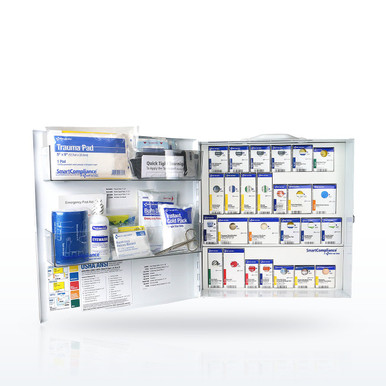 First Aid Only 9133 First Aid Cabinet, Class A, Metal, 2 VersionsFirst Aid Only prints a Class A metal first aid cabinet in two versions, baked enamel, wall mounted, with the Z308.1 fill
Why we answer height with the ADA and not with OSHA. People search for a first aid cabinet mounting height expecting an OSHA number like the fire extinguisher’s; there is none. The fire extinguisher height comes from NFPA 10, which OSHA adopts, and the live extinguisher mounting guide prints it. For the first aid cabinet the only numbers that bind are the ADA reach ranges, which apply to any element a building occupant is expected to use, and the practical rule that the cabinet is where the injured person or the first aider can get to it in seconds. This page gives the ADA figures, OSHA’s two words and its locked-cabinet letter, the sign colors from 1910.145, the Z358.1 and Cal/OSHA sign and location wording for eyewash, and the prices of the wall-mounted boxes people ask about.
Mounting and placement figures from the rules that give them
| Item | Figure | Source | What it means for the install |
|---|---|---|---|
| First aid cabinet height | No OSHA figure; "readily available" (1910.151(b)), "easily accessible" (1926.50(d)(1)) | 29 CFR 1910.151 Medical services and first aid (eCFR) | Reachable in seconds by the people it serves |
| Reach range | 48 inches maximum high reach, 15 inches minimum low reach, unobstructed forward or side reach | 2010 ADA Standards for Accessible Design, section 308 Reach Ranges (ada.gov) | Latch and top shelf at or below 48 inches; nothing stored below 15 inches |
| Obstructed reach | 48 inches maximum where the reach depth is 20 inches or less (forward) or 10 inches or less (side) | 2010 ADA Standards for Accessible Design, section 308 Reach Ranges (ada.gov) | A cabinet over a counter or bench still has to meet 48 inches |
| Locked cabinet | "First aid cabinets can be locked; however, they must be readily accessible in the event of an emergency. Locking the cabinet may limit accessibility." | OSHA letter of interpretation, January 23 2007, Locked first aid cabinets in the workplace | A key on a hook beside it, a breakaway seal, or an unlocked cabinet |
| Sign colors | Safety instruction signs: white background, green panel with white letters; letters on the white are black | 29 CFR 1910.145 Specifications for accident prevention signs and tags (eCFR) | The white cross on green is the first aid sign |
| Biohazard sign | Fluorescent orange-red with the symbol in a contrasting color | 29 CFR 1910.1030(g)(1) | On the BBP kit and the regulated waste container, not on the first aid cabinet |
| Eyewash location and sign | Within 10 seconds of the hazard (about 55 feet) on the same level, well lit, identified with a highly visible sign; Cal/OSHA: within 10 seconds, area kept clear | ANSI/ISEA Z358.1-2014 as Cal/OSHA section 5162 and the manufacturers state it (the live rule page) | The eyewash gets a sign by the standard; the first aid cabinet gets one by good sense |
| Eyewash nozzle height | 33 to 53 inches above the floor, 6 inches from obstructions | ANSI/ISEA Z358.1-2014 as Cal/OSHA section 5162 and the manufacturers state it (the live rule page) | The eyewash station’s own mounting figure |
| Fire extinguisher | NFPA 10: top of the extinguisher no higher than 5 feet (40 pounds or less) or 3.5 feet (heavier); bottom at least 4 inches off the floor | NFPA 10 as the live extinguisher mounting guide states it | The neighbor on the wall; not the first aid rule |
Source: As cited in each row
The questions, one by one
How high should a first aid cabinet be mounted?
With its latch and highest shelf at or below 48 inches above the floor, which is the ADA unobstructed high reach, and nothing in it below 15 inches, the ADA low reach. A 16-inch-tall First Aid Only three-shelf cabinet hung with its top at 48 inches has its bottom shelf at about 32 inches, inside the range. There is no OSHA height; "readily available" is the rule, and the ADA figure is the one an inspector or an architect will ask about.
Where is your first aid box located, and where should it go?
Where the injuries happen and where the people walk past: the break room or copy room on an office floor, the shop entrance or the foreman’s desk in a plant, the trailer and each crew truck on a jobsite, the kitchen line in a restaurant, the custodian’s closet for the body fluid kit. In sight from the work area, with a clear floor in front, not behind a locked office door, not above a bench. OSHA’s letter on supplies specific to the workplace expects the employer to have assessed where injuries occur and put the kit there.
Can a first aid cabinet be locked?
OSHA’s January 2007 letter: yes, but it must remain readily accessible in an emergency, and locking may limit accessibility. The usual answers are a breakaway tamper seal (which shows the cabinet was opened without stopping anyone), a key on a hook beside the cabinet, or a lockable cabinet left unlocked during working hours. First Aid Only’s SmartCompliance cabinets are sold lockable; the lock is for the inventory, and the key stays with the cabinet.
What kind of sign is a first aid sign, and what color should it be?
A safety instruction sign under 1910.145(c)(3) and (d)(6): used "where there is a need for general instructions and suggestions relative to safety measures", with a white background and a green panel with white letters. The first aid sign is the white cross on a green panel, usually with the words FIRST AID and an arrow. The live safety sign guide covers danger, warning, caution and notice; green is the one color in that rule reserved for safety instruction.
What does the first aid symbol represent, and is it green or red?
The white cross on green is the first aid and safe-condition symbol; green is the safety instruction color in 1910.145 and in ANSI Z535, and the same green cross marks first aid in the ISO 7010 sign set. The red cross on white is the emblem of the Red Cross and Red Crescent movement and is protected by law; it is not a general first aid symbol and is not printed on signs. A green cross stands for first aid, safety and the way out.
What are the 5 main safety signs, and what are emergency signs?
OSHA 1910.145 has three classes (danger, caution, safety instruction) plus the biohazard sign and accident prevention tags; ANSI Z535 adds warning and notice to make five: danger (red), warning (orange), caution (yellow), notice (blue) and safety instruction (green). Emergency signs are the green ones: first aid, eyewash, emergency shower, AED, exit, assembly point. The live color code guide prints the Z535 colors.
Where can I get a first aid sign or a safety sign?
From any sign company or safety supplier; we sell the eyewash sign that goes with the eyewash stations (the Fendall emergency eyewash sign) and the cabinets themselves, most of which carry FIRST AID across the front in the green-and-white scheme so that the cabinet is its own sign. Ask us for a first aid sign when you order the cabinet and we will quote one.
What is the price of a wall mounted first aid box?
The first group in the band prints the price on each First Aid Only cabinet, from the Class A metal cabinet to the 200-person five-shelf cabinet; the second group is the wall-mountable kits with mounting holes in the case, which start under $30. The price is the fill more than the box: a 25-person kit costs less than a 100-person cabinet because it holds a quarter of the supplies.
How far can a first aid kit be from the work?
No federal figure; near enough to be readily available, which OSHA’s proximity letters measure in minutes for the clinic (3 to 4 minutes where serious injury is possible) and which a site applies to the kit in seconds. The eyewash is the one with a number: 10 seconds, about 55 feet, on the same level. A kit every 50 people or every floor meets the spirit; the how-many-kits guide works it out.
Where does the eyewash go, and does it need a sign?
Within 10 seconds of the hazard on the same level with a clear path, nozzles 33 to 53 inches above the floor and 6 inches from the wall, lit and marked with a highly visible sign, as Z358.1 and Cal/OSHA 5162 state it; the live eyewash requirements guide and the Z358.1 rule page carry the full figures. The sign is part of the standard for eyewash; for the first aid cabinet it is a courtesy.
In plain words
- No OSHA height; "readily available" is the rule.
- Use the ADA reach range: latch and top shelf at or below 48 inches, nothing below 15.
- Put it where the injuries are and the people walk, in sight, clear floor in front, never behind a locked door.
- Locked is allowed only if it stays readily accessible; a breakaway seal or a key on a hook.
- First aid sign: white cross on a green panel, white background, per 1910.145 safety instruction colors.
- Green cross means first aid and safe condition; the red cross is the Red Cross emblem.
- Eyewash: 10 seconds, nozzles 33 to 53 inches, signed; extinguisher: NFPA 10 heights.
Questions people ask
How high do you mount a first aid cabinet?
No OSHA figure; use the ADA reach range, latch and top shelf at or below 48 inches and nothing below 15.
Where should the first aid box be located?
Where injuries happen and people walk: break room, shop entrance, trailer and trucks, kitchen line; in sight with a clear floor.
Can a first aid cabinet be locked?
Yes per OSHA’s 2007 letter, but it must stay readily accessible; a breakaway seal or a key beside it.
What kind of sign is a first aid sign?
A safety instruction sign: white background, green panel, white letters, the white cross on green.
Is the first aid symbol green or red?
Green; the red cross is the Red Cross emblem and is protected.
What does a green cross stand for?
First aid, safe condition, the way to the kit or the exit.
What are the 5 main safety signs?
Danger, warning, caution, notice and safety instruction, per ANSI Z535; OSHA 1910.145 names danger, caution and safety instruction.
Does a first aid cabinet need a sign?
Not under 1910.151; the eyewash does under Z358.1 and Cal/OSHA 5162; most cabinets carry FIRST AID on the front.
What is the price of a wall mounted first aid box?
On each row in the band; wall-mountable kits start under $30 and cabinets scale with the fill.
How far can the kit be from the work?
No federal figure; readily available, which sites read as seconds; the eyewash is 10 seconds, about 55 feet.
Related guides
How many first aid kits does a workplace need?And where they goOSHA first aid kit requirementsWhat 1910.151 and ANSI Z308.1 requireOSHA eyewash station requirementsWhat 1910.151(c) and ANSI Z358.1 requireHow high should a fire extinguisher be mounted?NFPA 10 mounting height and travel distanceOSHA safety sign requirementsDanger, warning, caution and noticeWhat color codes does OSHA require?Red, yellow and the ANSI Z535 colorsFirst aid kits for offices, schools, daycare and churchesDoes an office legally need one?AED questions answeredCPR or AED first, the 3-minute rule, pads, batteries and cabinetsThe ratings, test results and standards shown here are the manufacturers' published values, reproduced as published. Nothing on this page is a recommendation by Bayshore Safety that any product is suitable for a particular task, hazard or workplace. Selecting safety products and protective equipment is the responsibility of the end user and the employer, based on their own hazard assessment and the regulations that apply to their work. Confirm every value on the manufacturer's own documentation before use.
© 2026 Bayshore Safety & Industrial Supplies, Inc. All rights reserved. This guide may not be copied or republished without written permission.