
Bayshore Safety & Industrial Supplies Guide
Which gloves for sheet metal, glass and sharp edges? The Armor Guys styles listed for sheet metal, stamping, steel and glass by their printed cut, abrasion and puncture levels, sanding, grinding, lumber, metal gloves, and gloves near machinery
For sheet metal, glass and anything with a sharp edge, read three figures the manufacturer prints and match them to the edge: the ANSI/ISEA 105 cut level, A1 to A9, for the slicing edge; the abrasion level, 0 to 6, for how long the palm lasts against the surface; and the puncture level, 1 to 5, for burrs, slivers and wire ends. Armor Guys lists sheet metal handling and metal stamping on its A4 to A6 coated knits (the Basetek Plus 12-400 and 12-420, the Extraflex Plus 14-400 and 14-420, the Kyorene 00-420 and 00-450 and the Kyorene Pro 00-840 series), glass handling on the crinkle-latex Kyorene 00-606 and the Extraflex 04-350 and 04-367, and glass manufacturing with steel processing on its A7 to A9 Kyorene Pro 00-870, 00-880 and 00-890, each with the level printed. OSHA 1910.138 makes severe cuts, abrasions and punctures hazards the employer must select gloves for; Cal/OSHA 3384(b) adds that gloves are not worn where there is a danger of them being caught in moving machinery, which is the rule behind the grinding and sanding questions.
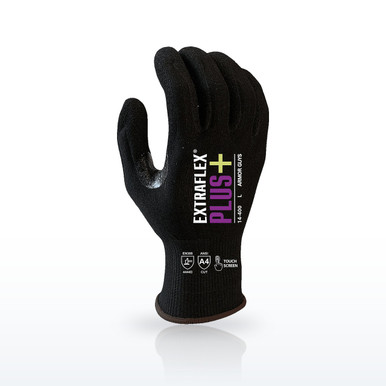 Armor Guys 14-400 Extraflex Plus Cut Resistant Gloves, ANSI A4, Foam NitrileArmor Guys lists sheet metal handling, metal stamping and construction on the Extraflex Plus 14-400 and prints ANSI/ISEA 105 A4, abrasion 6, puncture 5 and EN 388 4X43D on it: an 18-gauge knit with a micro-foam nitrile palm, $114.09 a dozen
Match the figure to the edge. A sheared sheet-metal edge is a slicing hazard, so the cut level leads: Armor Guys puts A4 at the start of its medium-hazard range and lists sheet metal handling from A4 up. A stamped part has burrs, so the puncture level matters next; the Extraflex Plus 14-400 and 14-420 print puncture 5, the top of the ANSI scale, and the Kyorene Pro 00-840 series prints puncture 4. Glass is a slicing edge with no burr, so the cut level and a palm that grips a smooth, sometimes wet, surface: the 00-606 is the one Armor Guys lists for glass handling and bottling with a crinkle-latex palm, and the A7 to A9 Kyorene Pro styles are the ones it lists for glass manufacturing. Rough lumber is splinters and abrasion more than slicing, which is why a puncture figure and a thicker palm lead there and a thin A1 knit does not.
What the ratings are not. No glove is cut-proof; A9 means 6,000 grams or more on a straight blade in the TDM-100 test, as the cut-rating guide linked below explains, not immunity. The cut level is tested on the palm material; a knit with a coated palm and an uncoated back has the printed level on the palm, and a knuckle-coated or back-of-hand-rated style, like the Perfotek 07-002 with a stated back-of-hand A4, is the exception that prints it. And the ratings say nothing about catching: Cal/OSHA 3384(b) states that hand protection "shall not be worn where there is a danger of the hand protection becoming entangled in moving machinery or materials", with an exception for machinery that has a momentary contact device, so the question for a grinder, a drill press or a lathe is the machine’s rotating parts before it is the glove’s figure.
The questions in short
From the Armor Guys application lists and printed figures, and the OSHA and Cal/OSHA texts; the long answers follow.
The questions, one by one
Each answer draws on the Armor Guys product pages, spec sheets and workbook and the OSHA and Cal/OSHA texts named in the byline.
Which type of gloves must always be worn when working with sheet metal?
No rule names a type; 29 CFR 1910.138(a) requires appropriate hand protection where hands are exposed to severe cuts or lacerations, severe abrasions and punctures, and 1910.138(b) bases the choice on the task and the hazards. In practice a sheet metal shop writes the cut level into its hazard assessment, and A4 is where most start, because Armor Guys and the other manufacturers put A4 at the beginning of the medium-hazard range and list sheet metal handling from there. The Armor Guys styles that print sheet metal handling and metal stamping on the spec sheet are the Basetek Plus 12-400 (A4, micro-foam nitrile) and 12-420 (A4, polyurethane), the Extraflex Plus 14-400 and 14-420 (A4, abrasion 6, puncture 5), the Extraflex 04-420HV (A4, hi-vis), the Kyorene 00-420 and 00-450 (A4, 13 gauge) and the Kyorene Pro 00-840, 00-842 and 00-843 (A4, 18 gauge, touchscreen). For a wet or oily sheet the micro-foam nitrile palm; for a dry, clean part the polyurethane palm, which Armor Guys describes as thin with good dry grip.
What gloves should be worn when working with sharp edges?
The cut level that matches the edge, and the puncture level if the edge has burrs or points. Armor Guys’ catalog puts A1 to A3 at light hazards, A4 to A6 at medium, and A7 to A9 at high to extreme, with the gram scores behind them in the cut-rating guide linked below. Sheared sheet, trimmed plastic and cardboard knives sit in the A2 to A4 band; stamped parts, glass and steel coil in A4 to A6; steel processing, recycling and glass manufacturing in A7 to A9, where Armor Guys prints those applications on its 00-870, 00-880 and 00-890 and the Extraflex Plus 14-700 and 14-720.
What gloves do you wear when sanding, and when grinding?
Two different questions. Sanding by hand, a sanding block or a sheet, is an abrasion hazard with no slicing edge, so a thin coated knit with a stated abrasion level and a palm that does not load up with dust, and no cut level needed. A powered sander, a bench grinder, an angle grinder, a drill press or a lathe is a rotating machine, and Cal/OSHA 3384(b) states that hand protection "shall not be worn where there is a danger of the hand protection becoming entangled in moving machinery or materials", with the note that use around smooth-surfaced rotating equipment is not an entanglement hazard "if it is unlikely that the hand protection will be drawn in". Federal OSHA has no sentence that plain in 1910.138, but the machine-guarding rules point the same way. So for grinding the answer is the machine first: a snug, thin glove where the employer’s assessment finds no catch point, no glove where it finds one, and an A4 to A6 glove with a high abrasion level for handling the hot, burred parts afterward.
What is a metal glove called?
A metal mesh glove, also called a chain mail glove, a stainless steel glove or a butcher’s glove: interlocking steel rings worn on the non-knife hand in meat, poultry and fish cutting, and in some oyster and die-cutting work. It is rated for cut like any other glove, and the cut-through guide linked below covers where it sits against the knit A9 styles. Armor Guys does not make a mesh glove; its highest-rated knits, the Kyorene Pro 00-890 and 00-897 and the Perfotek 07-002 at A9, are the styles it lists for recycling, trash handling, mining and steel.
What are good gloves for lumber work?
Rough lumber gives splinters and abrasion, not a slicing cut, so the figures to read are puncture and abrasion, and the palm thickness. Armor Guys lists wood handling on the Perfotek 07-002, which prints A9 cut on the palm side, a stated back-of-hand A4 and ASTM F2878 needlestick puncture level 4, and recycling, trash collection and material handling on the Duty 06-019, a 10-gauge crinkle-latex palm with no cut level stated. The leather gloves in the thorn-and-brush guide linked below are the other answer for green lumber and fence posts.
What gloves for angle grinding, and for stained glass?
Angle grinding: see the grinding answer above; the rotating disc is an entanglement and a contact hazard, and the glove question is settled by the employer’s assessment of that tool, not by a cut level. Stained glass: small sharp pieces, came and a soldering iron, which calls for a thin A4 or higher glove with fingertip feel; Armor Guys lists glass handling on the 00-606 (A6, crinkle latex, with bottling) and glass manufacturing on the 18-gauge Kyorene Pro styles, and the 18-gauge A4 00-840 series is the thinnest A4 it prints for touch work.
Which gloves for handling glass?
Glass is a clean slicing edge that is often wet or smooth, so the cut level and the grip. Armor Guys prints glass handling on the Kyorene 00-606 (A6, crinkle-latex palm, listed with bottling and heavy material handling) and the Extraflex 04-350 and 04-367 (A3), and glass manufacturing on the Kyorene Pro 00-870 (A7), 00-880 (A8) and 00-890 (A9) and the Extraflex Plus 14-700 and 14-720 (A7). A latex palm is the wet-grip choice in Armor Guys’ coating notes; a micro-foam nitrile palm is the oily one.
Do cut-resistant gloves protect the back of the hand?
Only when a back-of-hand figure is printed. The ANSI/ISEA 105 cut level is a palm-material test; most coated knits have the same yarn front and back but the printed level is for the palm. Armor Guys prints a separate back-of-hand A4 on the Perfotek 07-002 and the ANSI/ISEA 138 impact level on its impact styles, which is what the impact guide linked below covers. For forearms the sleeve guide covers the cut-resistant sleeves; Armor Guys makes Taeki5 and Kyorene sleeves we do not list at this time.
In plain words
- Sheet metal: cut level A4 or higher, plus a puncture level for burrs. Armor Guys lists sheet metal handling from A4 up.
- Glass: the cut level and a palm that grips a smooth wet surface; crinkle latex for wet, micro-foam nitrile for oily, polyurethane for dry.
- Steel processing, recycling, glass manufacturing: A7 to A9, which Armor Guys prints on its Kyorene Pro 00-870, 00-880 and 00-890.
- Lumber: puncture and abrasion before cut; the Perfotek 07-002 and the crinkle-latex Duty 06-019 are the Armor Guys styles listed for wood and recycling.
- Sanding and grinding: a rotating machine is an entanglement hazard; Cal/OSHA 3384(b) says no glove where it can be caught.
- A metal glove is a metal mesh (chain mail) glove for knife work; no glove is cut-proof, and A9 is a test score, not immunity.
Questions people ask
Which gloves must be worn for sheet metal?
No rule names one; OSHA 1910.138 requires gloves selected for severe cuts, abrasions and punctures, and shops write A4 or higher into the assessment, where Armor Guys lists sheet metal handling.
What cut level for sharp edges?
A4 to A6 for sheared metal and glass, A7 to A9 for steel processing, recycling and glass manufacturing, as Armor Guys lists the applications on its styles.
Can you wear gloves when grinding?
Cal/OSHA 3384(b) says not where there is a danger of the glove being caught in moving machinery; the employer’s assessment of the tool decides.
What gloves for sanding by hand?
A thin coated knit with a stated abrasion level; no cut level is needed for a sanding block.
What is a metal glove called?
A metal mesh or chain mail glove, worn for knife work in meat and poultry cutting.
What gloves for lumber?
A palm with a stated puncture and abrasion level, such as the Armor Guys Perfotek 07-002 (A9, ASTM F2878 needlestick puncture level 4) or a leather glove.
What gloves for stained glass?
A thin A4 or higher knit with fingertip feel and grip; the 18-gauge Armor Guys Kyorene Pro A4 styles and the crinkle-latex 00-606 print the figures.
Does an A4 glove protect the back of the hand?
The cut level is a palm test; only a printed back-of-hand figure, such as the Perfotek 07-002’s back-of-hand A4, says otherwise.
Related guides
How are cut-resistant gloves rated and tested?The TDM-100 test, the gram scores and the 2024 badgeANSI A4 vs A5 vs A6 glovesWhat the levels protect againstWhat are the gloves called that you can’t cut through?The levels in the trade’s wordsWhat is an ANSI puncture rating?And what is needle-stick puncture?Impact-rated glovesWhat ANSI/ISEA 138 levels 1, 2 and 3 meanCut-resistant sleevesLength, cut level and the thumb holeWhat gloves will thorns not go through?Puncture levels, hides and cuffsWhat is a glove coating?Nitrile, polyurethane, latex and foam comparedOSHA 1910.138 Hand ProtectionThe rule pageThe ratings, test results and standards shown here are the manufacturers' published values, reproduced as published. Nothing on this page is a recommendation by Bayshore Safety that any product is suitable for a particular task, hazard or workplace. Selecting safety products and protective equipment is the responsibility of the end user and the employer, based on their own hazard assessment and the regulations that apply to their work. Confirm every value on the manufacturer's own documentation before use.
© 2026 Bayshore Safety & Industrial Supplies, Inc. All rights reserved. This guide may not be copied or republished without written permission.