
Is it a legal requirement to wear a hard hat? Who decides, who pays, what OSHA cites, whether a Type II helmet or a chin strap is required, the marks every hard hat must carry, and the 2026 changes
Yes, where the hazard exists: 29 CFR 1910.135 requires the employer to ensure each affected employee wears a protective helmet “when working in areas where there is a potential for injury to the head from falling objects,” and 1926.100 says the same for construction, adding flying objects and electrical shock and burns. Neither rule names a job, a site or a trade; the employer’s written hazard assessment under 1910.132(d) decides where the hazard exists, and the employer pays for the helmet under 1910.132(h). There is no federal requirement for a Type II helmet or a chin strap, but OSHA has said it will cite an employer who issues a Type I hat where the assessment shows a side-impact hazard.
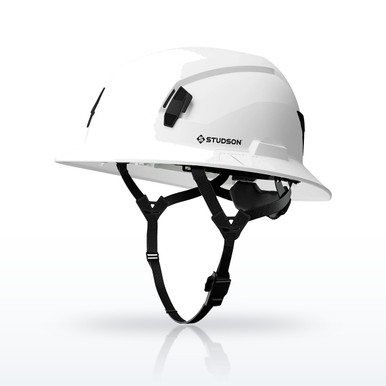 Studson SHK-1 Full Brim Non-Vented Type II Hard Hat, Class E, 15 ColorsStudson lists the non-vented SHK-1 Full Brim as Type II, Class E: the combination OSHA’s bulletin describes for construction and electrical work
What “required” means here. People ask the question three ways: is a worker breaking a law by taking the hat off, can an employer be fined, and is a particular hat (Type II, chin strap, a certain brand) now mandatory. The answers come from two short OSHA rules and one general one, read with a 2026 letter in which OSHA explained how it enforces them. The rules put the duty on the employer, tie it to a hazard rather than a job title, require a helmet that meets ANSI/ISEA Z89.1, and say nothing about brands, colors or stickers. This page walks through them in order: when a hat is required, who decides, who pays, what happens when it is not worn, whether Type II is required, what every hard hat must carry on its label, and the changes people have heard about for 2026.
The legal questions, one by one
Quotations are from the eCFR text of 29 CFR 1910.132, 1910.135 and 1926.100 and from OSHA’s August 17 2026 letter of interpretation; the March 2024 bulletin is quoted where it is relevant and is advisory, as it says itself.
The law in plain words
- 1910.135(a)(1): the employer shall ensure each affected employee wears a protective helmet where there is a potential for head injury from falling objects; (a)(2) adds electrical shock near exposed conductors.
- 1926.100(a) (construction): impact, falling or flying objects, electrical shock and burns.
- The employer’s written hazard assessment under 1910.132(d) decides where the hazard exists; the employer pays under 1910.132(h).
- The helmet must meet ANSI/ISEA Z89.1 (1997, 2003 or 2009 edition) or be shown at least as effective; OSHA does not approve brands.
- No rule requires Type II or a chin strap; OSHA’s 2026 letter says it will cite a Type I hat issued where a side-impact hazard was identified.
- Every Z89.1 hat is marked with the manufacturer, the standard, Type, Class, size range and date; no legible label, no proof it meets the rule.
- Backwards wearing needs the reverse-donning mark; stickers follow the manufacturer’s instruction.
Questions people ask
Is it a legal requirement to wear a hard hat?
Yes where the employer’s hazard assessment finds a falling-object, impact or electrical hazard to the head: 29 CFR 1910.135 (general industry) and 1926.100 (construction) require the employer to ensure a protective helmet is worn there.
Does OSHA require hard hats on all construction sites?
1926.100 requires them where there is a possible danger of head injury from impact, falling or flying objects, or electrical shock; most general contractors make that the whole site in their safety plan.
Does an employer have to provide hard hats?
Yes, at no cost to the employee, under 1910.132(h); hard hats are not among the exceptions (non-specialty safety-toe shoes, non-specialty prescription safety glasses, everyday clothing and weather items).
Can you be fined for not wearing a hard hat?
OSHA fines employers, not workers, under 1910.135, 1926.100 or 1910.132(d); the worker’s consequence comes from the employer’s own site rules.
Does OSHA require Type 2 hard hats?
No. OSHA’s August 2026 letter says 1910.135 requires a Z89.1 helmet but not a particular type; it will, however, cite an employer who issued Type I hats where the assessment identified side-impact hazards.
Is OSHA requiring chin straps on hard hats?
No rule requires one. OSHA’s 2024 bulletin says they should be considered for all head protection and suggests them for construction and work at height; an employer can require them through its hazard assessment.
Which characteristic must be present on all hard hats?
The Z89.1 label: manufacturer, standard and edition, Type, Class, size range and date of manufacture. Without it the hat cannot be shown to meet the rule.
Which hard hat brands does OSHA approve for 2026?
None, because OSHA approves no brands or products. The rule is that the helmet meets ANSI/ISEA Z89.1, which the manufacturer certifies on the label.
What are the new OSHA hard hat requirements for 2026?
The head protection rules did not change; the August 2026 letter clarifies how OSHA enforces them, the 2025 construction PPE fit rule applies to hard hats, and the Z89.1-2026 revision is a standards change, not yet an OSHA one.
Is it against OSHA to wear a hard hat backwards?
Not by rule, but OSHA’s position is that only a hat with a reverse-donning mark may be worn in reverse, because that is how the manufacturer tested it.
Is it against OSHA to put stickers on hard hats?
No rule bans them; the manufacturer’s instruction governs, and most allow small stickers that do not hide damage. See the stickers guide.
What happens if you don’t wear a helmet at work?
Legally, the employer is the one exposed to a citation; practically, site rules usually treat it as a disciplinary matter, and the head is unprotected against the hazard the assessment found.
Does OSHA approve carbon-finish hard hats?
OSHA approves no hat. A helmet in a carbon-finish shell meets the rule the same way any other does: by its Z89.1 label and a class that matches the hazard.
Are the self-employed exempt from the hard hat rule?
OSHA’s PPE rules bind employers with employees; a sole proprietor with none is not covered, but most sites require the helmet of everyone who enters.
Related guides
OSHA hard hat requirementsWhat 1910.135 and 1926.100 sayOSHA 1910.135 Head ProtectionThe rule pageOSHA 1926.100 Head Protection (Construction)The rule pageWhat are hard hats designed to protect you from?Top impact, penetration and electrical contactType I vs Type II hard hatsWhat the types meanBump cap vs hard hatWhen a bump cap is allowedDoes OSHA allow stickers on hard hats?What the manufacturer statesOSHA compliance updates 2025–2026The PPE fit rule, HazCom and the heat ruleWhat is the 2 2 2 rule for helmets?The 5-year rule, the 10-year helmet and what Z89.1 and OSHA sayThe ratings, test results and standards shown here are the manufacturers' published values, reproduced as published. Nothing on this page is a recommendation by Bayshore Safety that any product is suitable for a particular task, hazard or workplace. Selecting safety products and protective equipment is the responsibility of the end user and the employer, based on their own hazard assessment and the regulations that apply to their work. Confirm every value on the manufacturer's own documentation before use.