
Bayshore Safety & Industrial Supplies Guide
Rebar positioning lanyards: chain vs web, the rebar hook, and why a positioning lanyard is not fall arrest
A rebar positioning lanyard is a short assembly, chain or web, with a large-gate rebar hook at one end and snap hooks for the harness side D-rings at the other. Clipped around vertical rebar or a form, it holds the worker leaning back with both hands free. It is a positioning device under 29 CFR 1926.502(e): rigged so the worker can free fall no more than 2 feet, on an anchorage that holds 3,000 lb or twice the potential impact load, and it is not a fall arrest system. FallTech’s manual says the same in the manufacturer’s words: the assemblies are designed for a work positioning system that holds and supports the user at a work location, including concrete form work and steel erection, and are not designed for fall arrest, restraint or personnel riding; FallTech directs a stand-by personal fall arrest system beside them, with free fall limited to 6 ft and arrest force to 1,800 lb. The hook is the reason the lanyard exists: a rebar hook’s gate opens 2 to 2½ inches so it closes around a bar or a form member that a ¾-inch snap hook cannot.
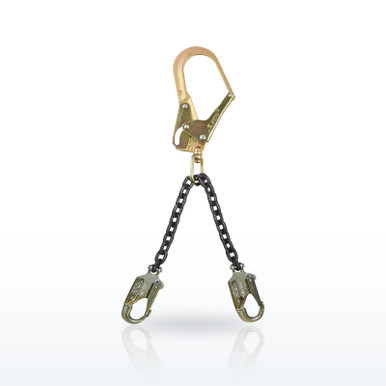 FallTech 8250 Positioning Lanyards, 23 in Premium Rebar, ChainRebar positioning lanyard: chain, swivel rebar hook and snap hooks for the side D-rings (FallTech data)
Why positioning and arrest are kept apart. A positioning lanyard is loaded all day, gently, by a worker leaning into it; a fall arrest connector is loaded once, hard, by a worker who has fallen. The hardware differs (no energy absorber, a hook sized for rebar), the D-rings differ (side rings on the hips, which FallTech and every harness manual say are never for arrest), and the anchorage rule differs (3,000 lb or twice the impact load for positioning, 5,000 lb or a 2:1 certified system for arrest). The 2-foot free-fall limit in 1926.502(e)(1) is what keeps a positioning fall survivable without an absorber. That is why the manual asks for a second system: the dorsal D-ring, an energy-absorbing lanyard or SRL and a 5,000 lb anchorage, standing by for the fall the positioning lanyard is not built to catch.
The positioning rule and the two assemblies
From 1926.502(e) and the FallTech manual.
What the FallTech manual states, in order
Sections 3.1 through 4.6 of MPOL01:
- Purpose: a work positioning system that holds and supports the user at a work location, including concrete form work and steel erection.
- Not designed for fall arrest, restraint or personnel riding systems.
- A stand-by personal fall arrest system is used in conjunction with the equipment; maximum permissible free fall is six feet.
- Rescue requires specialized equipment beyond the manual; the employer has a rescue plan and the means to carry it out.
- PFAS anchorage strength: two times the maximum arrest force where certified, or 5,000 lb in the absence of certification; select the anchorage for structural strength, obstructions in the fall path and swing fall.
- Inspect before each use; remove from service anything subjected to fall arrest forces or that fails inspection; no rebar hooks, large carabiners or large snap hooks connected to a harness D-ring.
Questions people ask
What is a rebar positioning lanyard?
A short chain or web assembly with a 2 to 2½-inch-gate rebar hook and snap hooks for the harness side D-rings, used to hold a worker in place on vertical rebar or formwork with both hands free. It is a positioning device under 1926.502(e), not fall arrest.
What is an OSHA positioning device system?
“A body belt or body harness system rigged to allow an employee to be supported on an elevated vertical surface, such as a wall, and work with both hands free while leaning” (1926.500(b)). It is rigged so the free fall cannot exceed 2 feet, its anchorage holds twice the potential impact load or 3,000 lb, and its connecting assembly has 5,000 lb tensile strength (1926.502(e)). On rebar it is the chain or web lanyard between the side D-rings with a rebar hook around the bar.
Is a positioning lanyard fall protection?
It is a positioning device system, one of the systems Subpart M allows, but it does not arrest a fall. FallTech states its rebar positioning lanyards are not designed for fall arrest, restraint or personnel riding and directs a stand-by personal fall arrest system alongside.
How far can workers fall using positioning devices?
No more than 2 feet; 1926.502(e)(1) requires the system to be rigged so free fall cannot exceed that.
What does the anchorage for a positioning lanyard have to hold?
Twice the potential impact load or 3,000 pounds, whichever is greater (1926.502(e)(2)). The stand-by arrest system behind it needs 5,000 lb or a certified 2:1 anchorage.
What are rebar hooks used for?
To close around a reinforcing bar or a structural member too large for a standard snap hook: the hook’s throat opens 2¼ inches or more and its gate is rated like any Z359.12 connector. On a positioning lanyard it holds the worker at the wall; on an energy-absorbing lanyard or SRL-P leg it is the anchor-end connector for tying off to rebar or steel. It never goes on the harness D-ring.
Chain or web?
Both carry the same hook and side-D snap hooks; FallTech lists grade 80 and grade 43 chain and double-layer polyester web versions, 17 to 24 inches. The product page gives the material, length and hook for each.
Can I clip a rebar hook to my harness D-ring?
No. FallTech’s manuals direct that rebar hooks, large carabiners and large snap hooks are not connected to a harness D-ring; the rebar hook goes around the rebar, the snap hooks go to the side D-rings.
The ratings, test results and standards shown here are the manufacturers' published values, reproduced as published. Nothing on this page is a recommendation by Bayshore Safety that any product is suitable for a particular task, hazard or workplace. Selecting safety products and protective equipment is the responsibility of the end user and the employer, based on their own hazard assessment and the regulations that apply to their work. Confirm every value on the manufacturer's own documentation before use.
© 2026 Bayshore Safety & Industrial Supplies, Inc. All rights reserved. This guide may not be copied or republished without written permission.