
Bayshore Safety & Industrial Supplies Guide
What does a fall arrester do? Rope grabs, retractable blocks and the names the US rules use for them
A fall arrester is any device that lets a worker move freely along a line and then locks onto it the instant a fall starts, so the fall is stopped close to where it began. The word comes from the European and ISO standards (EN 353 guided-type fall arresters on a rigid or flexible anchor line, EN 360 retractable-type fall arresters) and is common wherever those standards are used; in the US rules the same devices appear under other names. A guided-type fall arrester on a rope is OSHA’s rope grab, “a deceleration device which travels on a lifeline and automatically, by friction, engages the lifeline and locks so as to arrest the fall of an employee” (1926.500(b)), and the manufacturers list it to ANSI/ASSP Z359.15 with its vertical lifeline. A retractable fall arrester block is OSHA’s self-retracting lifeline/lanyard, “a deceleration device containing a drum-wound line which can be slowly extracted from, or retracted onto, the drum under slight tension during normal employee movement, and which, after onset of a fall, automatically locks the drum and arrests the fall,” listed to ANSI/ASSP Z359.14. A fall arrester on a fixed ladder’s cable or rail is the sleeve of a ladder safety system (1910.140(b), ANSI A14.3). FallTech’s product names use the word directly: its 7489 and 8388 are “Hinged Trailing Fall Arrester” rope grabs listed to Z359.15, and its glossary defines an SRL as “a mechanical fall arrestor with a locking mechanism and energy absorber.”
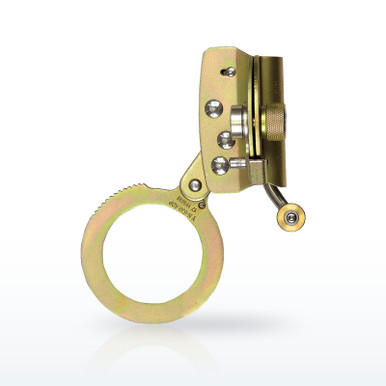 FallTech 7489 Rope Grabs, Hinged Trailing Fall Arrester, Alloy Steel, Anti-panicA hinged trailing fall arrester (rope grab) listed to ANSI Z359.15, for a vertical lifeline (FallTech data)
Why the word causes confusion. An American crew says rope grab, SRL, yo-yo, ladder sleeve; a British or Indian or Gulf safety manual says fall arrester, retractable fall arrester block, guided-type fall arrester. They are the same hardware doing the same job, and the search for “fall arrester” lands on pages that explain the European standard and never mention 1926.502 or Z359. The job itself is worth understanding on its own terms: every fall arrester has to solve the same two problems, follow the worker without snagging while nothing is happening, and then lock within inches when something is. How it senses the fall (speed on a drum, a cam loaded by the lanyard, a sleeve that tilts on a cable) is what separates the types, and what decides where each can be used.
The types of fall arrester, and what each one is called here
Grouped by what the device runs on. The US name and the standard the manufacturers list follow each.
The same device under each set of names
| Device | European and ISO name | US rule name | Standard the manufacturers list in the US |
|---|---|---|---|
| Rope grab on a vertical rope | Guided-type fall arrester including a flexible anchor line (EN 353-2) | Rope grab; deceleration device; with its lifeline, part of a personal fall arrest system | ANSI/ASSP Z359.15 (CSA Z259.2.5) |
| Ladder sleeve on a cable or rail | Guided-type fall arrester including a rigid anchor line (EN 353-1) | Ladder safety system (carrier, safety sleeve, lanyard, connectors, harness) | ANSI A14.3 |
| SRL, SRD, yo-yo, retractable block | Retractable-type fall arrester (EN 360) | Self-retracting lifeline/lanyard; deceleration device | ANSI/ASSP Z359.14-2021, Class 1 or Class 2 |
| Energy absorber on a lanyard | Energy absorber (EN 355) | Deceleration device (rip-stitch, tearing or deforming lanyard) | ANSI/ASSP Z359.13 |
Nothing on this page states that a product listed to one of these standards meets another; the label on the device names the standards it was tested to.
Source: 29 CFR 1926.500(b) and 1910.140(b) (e-CFR text as of Nov 5 2026); the EN titles are those of the European standards as the manufacturers cite them on dual-listed products; the ANSI numbers are from the FallTech product pages on this site.
How a fall arrester works, as FallTech describes its own
From the FallTech pages and manuals:
- A trailing rope grab rides a 5/8-inch rope lifeline behind the worker; its cam is held open by the hinged body while the lanyard is slack and clamps the rope when the lanyard loads it sharply. FallTech’s 7489 and 8388 are hinged trailing fall arresters listed to ANSI Z359.15-2014 (the 8388 also to CSA Z259.2.5-2017) with an anti-panic feature on the 7489; its 7479 and 7491 are hinged trailing rope adjusters, and its 8353, 8358 and 8368 are manual rope adjusters with a 3 ft ViewPack or soft-pack energy-absorbing lanyard attached. The vertical lifelines they run on, 8150, 8149 and their variants, are 3-strand twisted polyester or copolymer rope listed to Z359.15-2014 in 25 to 300 ft lengths.
- An SRL senses the speed of the line leaving the drum. FallTech describes the self-retracting lifeline as a device whose drum pays out under slight tension and locks when the onset of a fall accelerates the line past the locking speed, with an energy absorber, internal brake or external pack, limiting the force; the line stays short and taut, so free fall and clearance are smaller than with a 6 ft lanyard. Its Class 1 devices are for anchorage at or above the dorsal D-ring; its Class 2 devices are tested for anchorage up to 5 ft below the D-ring over a steel edge.
- A ladder sleeve on a cable system follows the climber up and down and locks when the climber’s weight comes onto it; FallTech’s fixed-ladder guide describes the ladder safety system under 1910.28(b)(9) as the option that lets the climber keep both hands on the rungs with a sternal connection, and lists the front D-ring harness as the body support for it.
- The rule that goes with every rope-type arrester: each employee is attached to a separate vertical lifeline (1926.502(d)(10), 1910.140(c)(3)); lifelines are protected from cuts and abrasion (d)(11); lanyards and vertical lifelines hold 5,000 lb (d)(9); knots in a lanyard or lifeline are inspected by a competent or qualified person before use (1910.140(c)(6)). Devices on a horizontal lifeline that may become vertical must lock in both directions (1926.502(d)(7)).
- Which fall arrester for vertical movement: the rules do not choose. A rope grab and lifeline suit a fixed climb with an overhead anchor (a roof hatch, a tank ladder, a scaffold climb); a ladder safety system suits a fixed ladder; an SRL suits movement within reach of an overhead anchor. The manufacturer’s instructions for each device state the anchor location, the lifeline it runs on and the clearance it needs.
Questions people ask
What does a fall arrester do?
It follows the worker along a line (rope, cable, rail or its own drum-wound lifeline) and locks the instant a fall starts, stopping the fall close to where it began. In US terms it is a deceleration device: a rope grab, a self-retracting lifeline or the sleeve of a ladder safety system.
What is a retractable fall arrester block?
A self-retracting lifeline (SRL, SRD): a drum-wound line that pays out and retracts under slight tension during normal movement and locks the drum at the onset of a fall (1926.500(b)). US manufacturers list them to ANSI/ASSP Z359.14-2021, Class 1 or Class 2.
How does a retractable fall arrester work?
The drum senses the speed of the line leaving it; when a fall accelerates the line past the locking speed, pawls lock the drum and an energy absorber, an internal brake or an external pack, limits the force. FallTech describes the line staying short and taut so that free fall and clearance are smaller than with a fixed lanyard.
Which type of fall arrester is used for vertical movement?
On a rope lifeline with an overhead anchor, a rope grab listed to Z359.15; on a fixed ladder, the sleeve of a ladder safety system to A14.3; within reach of an overhead anchor, an SRL to Z359.14. The manufacturer’s instructions state the anchor location and lifeline for each; the rules do not choose between them.
What is the difference between a rope grab and a rope adjuster?
A rope grab (fall arrester) locks automatically on the lifeline in a fall and is listed to Z359.15; a manual rope adjuster is positioned by hand and FallTech lists those models with an energy-absorbing lanyard attached rather than as fall arresters. The product page’s ANSI Standards field shows which a part is.
Is a fall arrester the same as a fall arrest system?
No. The arrester is one component, the deceleration device. OSHA’s personal fall arrest system is the anchorage, connectors and body harness together, which may include a lanyard, deceleration device or lifeline (1926.500(b)).
What are the two types of lifelines?
Vertical lifelines, which hang from an anchorage and carry a rope grab, each used by one employee at a time (1926.502(d)(10)); and horizontal lifelines, which run between anchorages under a qualified person’s design with a safety factor of two (1926.502(d)(8)). An SRL’s drum-wound line is also called a lifeline.
Where can a fall arrester be used?
Wherever a personal fall arrest system is one of the systems the rule allows for the situation and the device’s instructions fit the anchor: overhead anchors for Class 1 SRLs and rope grabs, foot-level anchors only for Class 2 SRLs, fixed ladders for ladder safety systems. The clearance below has to be checked for every arrester except a ladder system used as instructed.
What is the difference between a fall arrester and a fall restraint?
An arrester stops a fall that has started; a restraint keeps the worker from reaching the edge so no fall can start. A restraint lanyard has no locking device or energy absorber and is never used for fall arrest.
What standard covers rope grabs in the US?
ANSI/ASSP Z359.15, the standard for single-anchor lifelines and fall arresters for personal fall arrest systems, which the manufacturers list on rope grabs and vertical lifelines; some carry CSA Z259.2.5 as well. OSHA requires the lifeline to hold 5,000 lb and the device to be part of a system meeting 1926.502(d).
Related guides
What is a self-retracting lifeline?And how it differs from a lanyardSRL vs PFL, Class 1 vs Class 2What the 2021 standard changedFall protection on laddersWhat 1910.23 and 1926.1053 requireFixed ladder fall protectionWhat 1910.28(b)(9) requiresHow to calculate fall clearanceThe numbers behind the 10 feet and the 18 feetWhat is a personal fall arrest system?The ABCsThe ratings, test results and standards shown here are the manufacturers' published values, reproduced as published. Nothing on this page is a recommendation by Bayshore Safety that any product is suitable for a particular task, hazard or workplace. Selecting safety products and protective equipment is the responsibility of the end user and the employer, based on their own hazard assessment and the regulations that apply to their work. Confirm every value on the manufacturer's own documentation before use.
© 2026 Bayshore Safety & Industrial Supplies, Inc. All rights reserved. This guide may not be copied or republished without written permission.