
Bayshore Safety & Industrial Supplies Guide
What are the 5 pieces of lab safety equipment? Eyewash, safety shower, fire extinguisher, first aid kit and spill kit in a laboratory under OSHA 1910.1450, how long to flush at a lab eyewash, what to do when something spills, and the 7 lab rules
The five pieces of lab safety equipment the question means are the eyewash station, the safety shower, the fire extinguisher, the first aid kit and the spill kit; a fume hood and a fire blanket are the sixth and seventh on longer lists. OSHA’s laboratory standard, 1910.1450, requires a written Chemical Hygiene Plan and, in its non-mandatory Appendix A, states that "an adequate number and placement of safety showers, eyewash units, and fire extinguishers should be provided for the laboratory" and that "safety equipment, including spill control kits, safety shields, fire safety equipment, PPE, safety showers and eyewash units, and emergency equipment should be available in well-marked highly visible locations in all chemical laboratories". The eyewash itself is required by 1910.151(c) wherever eyes may be exposed to injurious corrosives, which is every chemistry lab, and the flush is 15 minutes: ANSI Z358.1 as Cal/OSHA 5162 and the manufacturers state it sets 0.4 gallons per minute for 15 minutes to both eyes, within 10 seconds of the hazard, and the Red Cross eye injury page says to flush a chemical splash "until EMS arrives and begins care". When something spills in the lab, Appendix A says to contact the Chemical Hygiene Officer or EHS office for instructions before cleaning it up, to follow the SDS and label, and to wear the PPE the SDS names; the spill kit, the first aid kit and the extinguisher are the three things Appendix A tells every lab worker to know the location of before starting work.
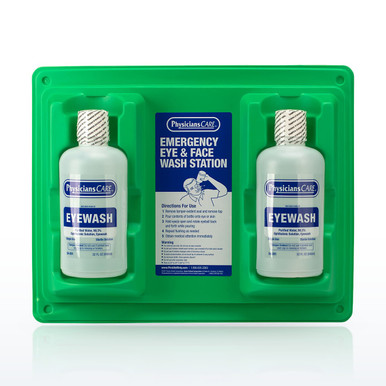 First Aid Only 24-300 Eyewash Station, Double 32 oz Screw Cap BottleFirst Aid Only prints a double 32-ounce screw-cap bottle eyewash station, wall mounted
Why a chemistry teacher and a QC lab ask the same five questions. The lab questions are school quiz questions ("the 5 pieces of lab safety equipment", "the 7 lab safety rules") and working-lab questions ("how long at the eyewash", "what if something spills") that have the same answers, because OSHA’s laboratory standard is written for both: the rule covers any employer whose employees use hazardous chemicals on a laboratory scale, and its Appendix A is a plain list of practices drawn from the National Research Council’s Prudent Practices. This page prints the five pieces with the paragraph that calls for each, the eyewash figures from the standard and the state rule, the spill steps as Appendix A states them, and the seven rules as the appendix’s own list, then bands the eyewash, first aid and spill products a lab buys.
The five pieces of lab safety equipment, and what calls for each
| Equipment | The rule or guidance | The figure or the wording | What to buy |
|---|---|---|---|
| Eyewash station | 1910.151(c); 1910.1450 Appendix A; ANSI Z358.1; Cal/OSHA 5162 | 0.4 gpm for 15 minutes to both eyes, within 10 seconds of the hazard, nozzles 33 to 53 inches, hands-free stay-open valve, weekly activation (monthly under 5162); bottles supplement, never replace | A plumbed unit at the sink or a self-contained gravity station; 16 or 32 ounce bottles at each bench |
| Safety shower | 1910.151(c); Appendix A; Z358.1 | 20 gpm for 15 minutes, head 82 to 96 inches, within 10 seconds, tepid water | A plumbed shower; the live emergency shower guide covers it |
| Fire extinguisher | 1910.157; Appendix A ("all personnel are aware of the locations of fire extinguishers and are trained in their use") | The class the lab’s fuels call for; NFPA 10 mounting and travel distance | ABC or clean agent by the exit; the live extinguisher guides |
| First aid kit | 1910.151(b); Appendix A (emergency equipment in well-marked locations) | Z308.1 Class A sized to the lab’s headcount, with burn care added | A 25 or 50 person kit or SmartCompliance cabinet plus a burn kit |
| Spill kit | Appendix A ("spill control kits ... in well-marked highly visible locations"); the Chemical Hygiene Plan | Sized and typed to the chemicals on hand: acid, base, solvent, mercury, biological | Chemical hazmat socks and pillows, a universal kit, a body fluid kit for the biology lab |
| Fume hood (the sixth) | 1910.1450(e)(3)(iii): the employer must ensure fume hoods and other protective equipment function properly | Face velocity and inspection per the Chemical Hygiene Plan | Not a product we sell |
| Fire blanket (the seventh) | Appendix A lists fire safety equipment | Wool or fiberglass; the pass-1 fire blanket guide | A wool fire blanket in a hanging pouch |
Source: 29 CFR 1910.1450 Occupational exposure to hazardous chemicals in laboratories, with Appendix A (eCFR); ANSI/ISEA Z358.1-2014 as Cal/OSHA section 5162 and the manufacturers state it (the live rule page)
The questions, one by one
What are the 5 pieces of lab safety equipment, and the five?
Eyewash station, safety shower, fire extinguisher, first aid kit, spill kit. Some lists swap the spill kit for the fume hood or the fire blanket; Appendix A names all seven in its emergency-equipment sentence and the lab keeps all seven. The table above gives the rule and the figure for each.
What are the OSHA requirements for laboratory safety?
1910.1450 applies where hazardous chemicals are used on a laboratory scale. It requires exposure monitoring where a PEL may be exceeded; a written Chemical Hygiene Plan with standard operating procedures, control measures, fume hood and equipment checks, training, prior approval for certain operations, medical consultation, and a designated Chemical Hygiene Officer; information and training at assignment, including the location and availability of the plan, the PELs, the signs and symptoms of exposure, and the location of reference material; medical consultation and examination, including "whenever an event takes place in the work area such as a spill, leak, explosion or other occurrence resulting in the likelihood of a hazardous exposure"; labels and SDSs kept; respirators per 1910.134; and records. The eyewash and shower come from 1910.151(c); the PPE from 1910.132 and the live goggles and lab coat guides.
How long to use the eyewash station in a lab?
15 minutes. ANSI Z358.1 sizes a station for 15 minutes of flow to both eyes (0.4 gallons per minute), Cal/OSHA 5162 requires potable water "at the flow rates and time durations specified in ANSI Z358.1", OSHA’s 2009 letter on eyewash describes flushing "for at least 15 minutes as first aid", and the Red Cross says to flush a chemical splash until EMS arrives and begins care. A 16-ounce bottle is seconds of flushing, which is why the standard and the state rule call bottles a supplement to the station and not a replacement; the live eyewash bottle guide works through it.
What should you do if you spill something in the lab?
As 1910.1450 Appendix A states it: "workers should contact the CHO or EHS office for instructions before cleaning up a chemical spill", follow all SDS and label instructions, and wear the PPE the SDS names during cleanup; before starting work, "know your facility’s policies and procedures for how to handle an accidental release of a hazardous substance, a spill or a fire" and "know the location of all safety equipment and the nearest fire alarm and telephone". If anyone was splashed, the eyewash or shower comes first, for 15 minutes, and the rule gives that person a medical consultation. The live chemical spill guide walks the cleanup; the spill kit in the band is sized to the bottles on the shelf.
What are the 7 lab safety rules?
The school lists vary; Appendix A’s own practice list is the version with a rule behind it: know the hazards of the chemicals before using them (read the SDS and label); know the location and proper use of safety equipment and the nearest alarm and telephone; wear the PPE the task calls for (eye protection, lab coat, gloves, long pants and closed-toe shoes); never work alone when the plan says not to; never eat, drink, smoke or apply cosmetics in the lab; label everything and keep the work area and exits clear; report every spill, exposure and injury and use the first aid, eyewash and shower immediately. The live goggles guide covers the eye protection rule in detail.
What are the different types of PPE found in the lab?
Chemical splash goggles (Z87.1 D3) or a face shield over them, a lab coat in the fabric the hazard calls for (cotton, FR, or a chemical-resistant apron), gloves selected by the chemical resistance chart, closed-toe shoes and long pants, and a respirator where the Chemical Hygiene Plan calls for one. Each has a live guide; the first aid side is the eyewash and the burn kit for when the PPE is not enough.
What is lab safety, and what are some alternatives to lab safety equipment?
Lab safety is the Chemical Hygiene Plan in practice. There are no alternatives to the eyewash and shower where corrosives are used (Cal/OSHA 5162 says a sink faucet or hose "are not acceptable eyewash facilities"); the alternative to a plumbed station where there is no plumbing is a self-contained gravity station that meets the 15-minute flow, with bottles at the benches for the first seconds.
Is the biology lab different?
The biology lab adds 1910.1030 for blood and the listed body fluids: a body fluid or bloodborne pathogen spill kit, the biohazard bag and label, sharps containers, and the exposure control plan. The BBP exposure guide and the body fluid spill guide linked below cover it; the chemistry equipment stays the same.
What does a school science lab keep that a QC lab does not?
The same five pieces; the school adds the pediatric first aid items where the students are young and keeps the kit in the office rather than on the bench. The office and school guide linked below covers the school kit; the Chemical Hygiene Plan is the teacher’s as much as the chemist’s where the school is an employer under the rule or the state plan.
In plain words
- The five: eyewash, safety shower, fire extinguisher, first aid kit, spill kit; the fume hood and fire blanket make seven.
- Eyewash: 15 minutes at 0.4 gpm, within 10 seconds, bottles only as a supplement.
- Spill: call the Chemical Hygiene Officer or EHS before cleanup; SDS and label; the PPE they name.
- Know where the equipment, the alarm and the phone are before starting.
- A spill or exposure earns a medical consultation under the rule.
- Biology labs add the bloodborne pathogen kit and the exposure control plan.
Questions people ask
What are the 5 pieces of lab safety equipment?
Eyewash station, safety shower, fire extinguisher, first aid kit and spill kit; fume hood and fire blanket make seven.
What does OSHA require for lab safety?
1910.1450: a written Chemical Hygiene Plan, a Chemical Hygiene Officer, training, medical consultation after a spill or exposure, labels and SDSs; eyewash and shower under 1910.151(c).
How long do you flush at a lab eyewash?
15 minutes, the Z358.1 and Cal/OSHA 5162 duration; the Red Cross says until EMS arrives and begins care.
What do you do if something spills in the lab?
Contact the Chemical Hygiene Officer or EHS for instructions before cleanup, follow the SDS and label, wear the PPE named; anyone splashed goes to the eyewash or shower first.
What are the 7 lab safety rules?
Know the hazards, know the equipment locations, wear the PPE, do not work alone against the plan, no eating or drinking, label and keep clear, report and treat every spill and exposure.
Can a sink be the lab eyewash?
No; Cal/OSHA 5162 says sink faucets and hoses are not acceptable eyewash facilities, and the standard calls bottles a supplement.
What PPE is in a lab?
Splash goggles or face shield, lab coat, gloves by the chemical, closed-toe shoes, respirator where the plan calls for it.
What does a biology lab add?
The bloodborne pathogen kit, biohazard bags, sharps containers and the exposure control plan under 1910.1030.
Related guides
OSHA eyewash station requirementsWhat 1910.151(c) and ANSI Z358.1 requireAre eyewash bottles OSHA compliant?What a personal wash unit can and cannot doEmergency showersWhat ANSI Z358.1 requires for flow, height and temperatureHow to clean up a chemical spillThe steps and the PPEWhat are safety goggles for?Chemistry lab and splash goggles, D3, D4 and D5What is a lab coat for?Which fabric for which hazardHow to use an eyewash stationThe 15-minute flush, clearance, height and costHow do you manage a body fluid spill?Vomit, dried blood, biohazard bags and labelsWhat is a fire blanket used for?And what it is not forThe ratings, test results and standards shown here are the manufacturers' published values, reproduced as published. Nothing on this page is a recommendation by Bayshore Safety that any product is suitable for a particular task, hazard or workplace. Selecting safety products and protective equipment is the responsibility of the end user and the employer, based on their own hazard assessment and the regulations that apply to their work. Confirm every value on the manufacturer's own documentation before use.
© 2026 Bayshore Safety & Industrial Supplies, Inc. All rights reserved. This guide may not be copied or republished without written permission.