
Bayshore Safety & Industrial Supplies Guide
What are OSHA’s Focus Four hazards? Falls, struck-by, caught-in or -between, electrocution, and why falls take the most hours
The Focus Four, which OSHA also calls the Fatal Four, are the four hazard groups that cause most construction deaths: falls, struck-by, caught-in or -between, and electrocution. OSHA built its Construction Focus Four Training around them, and the Outreach Training Program requires the module in every OSHA 10-hour and 30-hour construction class: 4 hours of Focus Four in the 10-hour card, 6 hours in the 30-hour card, and in both “most construction fatalities are caused by fall hazards; therefore, falls must be covered for a minimum of 1 hour and 30 minutes,” with the other three topics at least 30 minutes each. So the answer to “does OSHA 30 include fall protection?” is yes, by rule: fall hazards are the largest required block of the course. OSHA’s own figures in the fall hazard instructor guide put the four at 59 percent of construction worker deaths in 2009, with falls alone at 34 percent, and the long-run split of fatal falls at about one third from roofs, 18 percent from scaffolds and staging, 16 percent from ladders and 8 percent from structural steel. On the enforcement side, fall protection general requirements (1926.501) has been the most-cited OSHA standard every year for more than a decade and leads the preliminary fiscal 2026 list with 4,041 citations, with fall protection training (1926.503) eighth at 1,273.
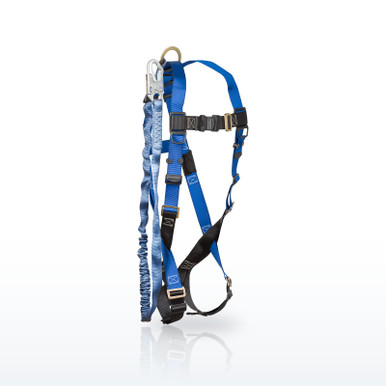 FallTech 70158259 Fall Protection Kits, 7015 harness, 8259 lanyardA harness and energy-absorbing lanyard kit, the personal fall arrest system the Focus Four fall module teaches (FallTech data)
Why four, and why falls first. OSHA chose the four from Bureau of Labor Statistics fatality data: between them they account for most of the deaths on construction sites year after year, and each has a short list of causes that training can reach. Falls lead the list by a distance, which is why the Outreach rules give them the longest required block and why the training objectives are written the same way for all four: identify the major hazards, describe the types, protect yourself, and recognize what the employer has to do. The fall module’s own structure is useful on a jobsite with or without a card: it names the three places people fall from (unprotected edges and holes, scaffolds, portable ladders), the equipment and rules that answer each, and the employer duties behind them. The product band below is the fall module’s equipment list.
The four hazards, as the Focus Four materials describe them
OSHA’s Outreach curriculum pairs each hazard with examples and the rules that address it.
Focus Four hours in the OSHA 10 and OSHA 30 construction cards
| Topic | OSHA 10-hour construction | OSHA 30-hour construction |
|---|---|---|
| Introduction to OSHA | 2 hours (required) | 2 hours (required) |
| Focus Four hazards, total | 4 hours (required) | 6 hours (required) |
| of which falls | at least 1 hour 30 minutes | at least 1 hour 30 minutes |
| of which electrocution, struck-by, caught-in or -between | at least 30 minutes each | at least 30 minutes each |
| Personal protective equipment | 30 minutes (required) | 2 hours (required) |
| Health hazards in construction | 30 minutes (required) | 2 hours (required) |
| Stairways and ladders | elective | 1 hour (required) |
| Electives (confined spaces, concrete, cranes, excavations, scaffolds, fall protection in depth, and others) | 2 hours, at least two topics | 12 hours, at least six topics |
| Optional topics chosen by the trainer | 2 hours | 4 hours |
The hour figures are the 2024 procedures; the elective list in each card includes fall protection as a topic that may be expanded beyond the required Focus Four block.
Source: OSHA Outreach Training Program, Construction Industry Procedures (OTP_Construction_Procedures_2024.pdf), Section I, required and elective topics, and Appendix C, Focus Four Hazards Training Requirements, Section I.A (10-hour) and I.B (30-hour) topic lists.
The fall module’s equipment and employer duties, with the figures behind them
From the OSHA materials and the FallTech pieces:
- Provide fall protection at 6 feet: guardrail systems (top rail 42 inches plus or minus 3, 200 lb), safety net systems (no more than 30 ft below the work, drop-tested with a 400 lb bag), or personal fall arrest systems (5,000 lb anchorage, full-body harness, lanyard or SRL limiting force to 1,800 lb and free fall to 6 ft), with covers over holes and toeboards, screens or canopies against falling objects (1926.501(b)–(c), 1926.502(b)–(d)).
- Scaffolds: fall protection at 10 feet by guardrail or personal fall arrest, full planking, proper access and footing, inspection by a competent person before each shift (1926.451(e), (f)(3), (g)). Scaffolding was the fourth most-cited standard on the preliminary 2026 list with 1,725 citations.
- Portable ladders: the right ladder for the job, set at the 4-to-1 angle, extended 3 feet above the landing, secured, three points of contact, no standing on the top step; the instructor guide’s worker guidelines add specialized training before working on scaffolds, lifts or ladders. Ladders were fifth on the 2026 list with 1,659 citations (1926.1053).
- Train before exposure: 1926.503 requires a program that lets each employee recognize fall hazards and know the procedures to minimize them, given by a competent person, with a written certification record and retraining when the workplace, systems or the employee’s performance call for it. The instructor guide’s worker list: understand the written fall protection plan, attend training, use the equipment when required and make sure it fits and is in good condition, inspect it before each use, keep holes and shafts covered or railed.
- The enforcement picture FallTech reports from the National Safety Council’s preliminary list: 17,701 citations across the fiscal 2026 Top 10, down nearly 25 percent from 23,537; fall protection general requirements 4,041 (from 5,914 in 2025 and 6,307 in 2024), more than twice the second-ranked standard; fall protection training 1,273; the two fall categories about 30 percent of the Top 10 together. FallTech notes the figures are preliminary and reflect inspections, not injury rates.
- What the 1926.501 citations are for, as FallTech describes the standard’s reach: unprotected sides and edges, holes, roofs, ramps, excavations and the other walking and working surfaces the duty paragraphs name, across many trades; its earlier piece attributes the persistence of the number one ranking to schedule pressure, inspection and rescue time not spent, and an OSHA rulebook that has not had a major fall protection revision in more than 20 years while ANSI/ASSP Z359 is revised continually.
Questions people ask
What are the top 4 hazards according to OSHA?
The Construction Focus Four: falls, struck-by, caught-in or -between, and electrocution, the hazard groups behind most construction deaths. OSHA’s instructor guide puts them at 59 percent of construction worker deaths in 2009, falls alone at 34 percent.
What are the four topics covered in OSHA’s Focus Four training?
Falls (at least 1 hour 30 minutes), electrocution, struck-by (falling objects, trucks, cranes) and caught-in or -between (trench hazards, equipment), each at least 30 minutes, with the same four objectives for every topic: identify major hazards, describe their types, protect yourself, and recognize employer requirements.
Does OSHA 30 include fall protection?
Yes. The 30-hour construction card requires 6 hours of Focus Four hazards, with falls covered for at least 1 hour 30 minutes, plus 1 hour on stairways and ladders, and fall protection may be taken further as an elective. The 10-hour card requires 4 hours of Focus Four with the same 1 hour 30 minutes on falls.
Is an OSHA 10 or OSHA 30 card the fall protection training 1926.503 requires?
No. The cards record attendance at a voluntary awareness class. 1926.503 requires the employer to train each employee who might be exposed to fall hazards in the hazards and procedures of that work, by a competent person, with a written certification record, before the exposure.
What are the most common fall hazards in construction?
OSHA’s fall module names unprotected roof edges, roof and floor openings, structural steel and leading edges; improperly constructed scaffolds; and unsafe portable ladders. Its long-run split of fatal falls: about a third from roofs, 18 percent from scaffolds and staging, 16 percent from ladders, 8 percent from girders or structural steel.
What is OSHA’s most cited violation?
Fall protection, general requirements, 1926.501, for more than a decade running. FallTech reports the preliminary fiscal 2026 count at 4,041 citations, more than twice the second-ranked standard (hazard communication, 1,961), with fall protection training (1926.503) eighth at 1,273.
What are the OSHA fall protection requirements the Focus Four module teaches?
Protection at 6 feet by guardrail, safety net or personal fall arrest system; covers over holes; toeboards, screens, canopies or barricades plus hard hats against falling objects; scaffold guardrails or PFAS at 10 feet with full planking and daily inspection; ladders set, secured and extended properly; and training under 1926.503.
What is the difference between the Focus Four and the Fatal Four?
Nothing but the name. OSHA’s instructor guide writes “Fatal [Focus] Four” for the same four hazard groups; the training program uses Focus Four.
Is Focus Four testing required?
No. OSHA’s FAQ states that trainers may use the tests provided but testing is not required and must not be counted toward the required contact hours. Authorized trainers get answer sheets from their Authorizing Training Organization.
What are 5 common workplace hazards?
OSHA’s construction list is four, the Focus Four. For a fifth on a jobsite the Outreach cards add a required block on health hazards (noise, hazard communication, silica and others) and on personal protective equipment; a site’s own hazard assessment decides what else belongs on its list.
Related guides
Fall protection trainingWhat 1926.503 requiresWhen is fall protection required?The OSHA height rulesOSHA fall protection requirements explained1926 Subpart M, section by sectionFall protection on scaffoldsWhen it is required and what kindFall protection on laddersWhat 1910.23 and 1926.1053 requireTool tethering and dropped-object rulesANSI/ISEA 121 and how a tether is ratedThe ratings, test results and standards shown here are the manufacturers' published values, reproduced as published. Nothing on this page is a recommendation by Bayshore Safety that any product is suitable for a particular task, hazard or workplace. Selecting safety products and protective equipment is the responsibility of the end user and the employer, based on their own hazard assessment and the regulations that apply to their work. Confirm every value on the manufacturer's own documentation before use.
© 2026 Bayshore Safety & Industrial Supplies, Inc. All rights reserved. This guide may not be copied or republished without written permission.