
Bayshore Safety & Industrial Supplies Guide
What PPE is worn in a warehouse, and what first aid does a warehouse need? The hazards OSHA names for warehousing, the kit by headcount and by dock, the eyewash where batteries are charged, and the PPE the hazard assessment usually names
OSHA’s warehousing page names the hazards: "powered industrial trucks (forklifts), ergonomics, material handling, hazardous chemicals, slip/trip/falls, and robotics", and says "the most common injuries are musculoskeletal disorders (mainly from overexertion in lifting and lowering) and being struck by powered industrial trucks and other materials handling equipment". The PPE follows from the hazard assessment 1910.132(d) requires rather than from a warehouse-specific list: safety-toe footwear on the dock and around pallet jacks, hi-vis where forklifts run, cut-resistant gloves for box cutters and strapping, safety glasses where strapping and banding are cut, hearing protection where the conveyors and compressors reach 85 dBA, and a hard hat where loads are lifted overhead. The first aid is the 1910.151(b) kit sized to the headcount per shift and placed by the dock, the break room and the office so that no one is more than a minute from one, with bleeding control for the box-cutter and strapping cuts that are a warehouse’s commonest wound, cold packs for the strains and bumps, and, wherever forklift batteries are charged, an eyewash: 1910.178(g)(2) requires "facilities ... for flushing and neutralizing spilled electrolyte" in battery charging areas, and 1910.151(c) requires flushing facilities wherever eyes may be exposed to injurious corrosives, which battery acid is.
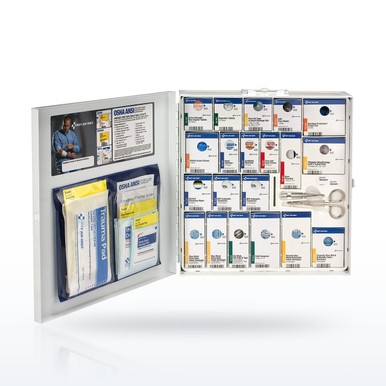 First Aid Only 746005 SmartCompliance First Aid Cabinet, 50 Person, Class A+First Aid Only prints a SmartCompliance 50-person Class A+ first aid cabinet with refill boxes
Why "what is PPE in a warehouse" has no list. The question gets asked as if OSHA published a warehouse PPE list; it did not, and the warehousing page it does publish is a hazard list. The PPE comes out of the employer’s hazard assessment, which is why two warehouses an exit apart wear different things. This page prints the OSHA hazard list, matches each hazard to the PPE and the first aid item that answers it, gives the headcount-and-placement rule for the kits, and names the one piece of first aid equipment a warehouse forgets until the inspector asks: the eyewash in the battery charging room.
The hazards OSHA’s warehousing page names, the PPE the assessment usually answers them with, and the first aid item
| Hazard (OSHA warehousing page) | PPE the hazard assessment usually names | First aid item on the wall | The live guide |
|---|---|---|---|
| Powered industrial trucks (forklifts): struck-by, tip-over | Hi-vis vest or shirt for pedestrians and operators; safety-toe footwear; seat belt on the truck | Bleeding control kit and trauma pads; the response bag for a crush injury; 911 | Hi-vis requirements; bleeding control |
| Ergonomics and material handling: overexertion in lifting and lowering | Gloves with grip; no back belt as PPE (OSHA does not treat them as protection) | Cold packs, elastic wraps; the 1904.7 first aid list counts hot or cold therapy and non-rigid support as first aid | What is ergonomics; back supports |
| Hazardous chemicals: cleaners, battery electrolyte, spilled product | Chemical splash goggles, chemical gloves, apron for battery work | Eyewash station at the charging area for immediate use (1910.178(g)(2), 1910.151(c)); ANSI Z358.1 puts it within 10 seconds; spill kit; SDS binder | Eyewash requirements; hazard communication |
| Slips, trips and falls: wet dock plates, strapping on the floor | Slip-resistant safety-toe footwear | Cold packs, elastic wraps, triangular bandages for a sling; splint in a Class B kit | Safety-toe shoes |
| Cutting strapping, banding and boxes | Cut-resistant gloves (ANSI A3 to A5), safety glasses | Fingertip and knuckle bandages, gauze, trauma pads; bleeding control for the deep ones | ANSI cut levels; fingertip bandages |
| Noise: conveyors, compressors, dock traffic | Ear plugs or earmuffs where the 8-hour average reaches 85 dBA | None; hearing conservation is a program, not a kit item | When is hearing protection required |
| Overhead loads, racking | Hard hat or bump cap where the assessment finds a struck-by-falling hazard | Cold packs; the response bag | Bump cap vs hard hat |
| Robotics and automation | Lockout and the guarding program; PPE per the assessment | Bleeding control | Lockout tagout |
Source: OSHA Warehousing industry page (osha.gov); 29 CFR 1910.151 Medical services and first aid (eCFR)
The questions, one by one
What is PPE in a warehouse, and what PPE should be worn in a warehouse?
What the hazard assessment under 1910.132(d) finds, which in most warehouses is safety-toe footwear, hi-vis where forklifts run, cut-resistant gloves for strapping and box cutters, safety glasses for banding and cutting, hearing protection where the floor is loud, and a hard hat or bump cap where loads go overhead. OSHA’s warehousing page is a hazard list, not a PPE list; the live PPE hazard assessment guide shows how the assessment is written and the live PPE types guide lists the equipment by body part.
What is safety equipment in a warehouse?
Beyond the PPE: the first aid kits by headcount, a bleeding control kit at the dock, the eyewash in the battery charging room, the spill kit for the chemicals on hand, the fire extinguishers, the forklift seat belts and horns, the dock plates and wheel chocks, the guarding on the conveyors, and the lockout kit for the automation. The first aid side is the band below; the rest has its own guides.
How many first aid kits does a warehouse need, and where do they go?
One wherever a worker is more than a minute or two from another: the dock office, the break room, the far end of the pick aisles, the battery room, and the office. Size each to the headcount on the largest shift in that zone; a 50-person cabinet with refill boxes at the dock and 25-person kits at the far ends is the usual pattern, and the live how-many-kits guide works it through. The kit at the dock carries the bleeding control, because that is where the strapping and the box cutters are.
Does a warehouse need an eyewash station?
Wherever forklift batteries are charged or changed, yes: 1910.178(g)(2) requires facilities for flushing and neutralizing spilled electrolyte in the charging area, and 1910.151(c) requires quick drenching or flushing facilities where eyes may be exposed to injurious corrosives. A gravity-fed self-contained station at the chargers meets it where there is no plumbing; ANSI Z358.1 puts the station within 10 seconds of the hazard; bottles at the chargers are the supplement. A warehouse with sealed lithium-ion forklift batteries and no acid has a different answer, and the hazard assessment records it. The cleaning closet with concentrated degreasers is the other place to look.
What first aid does a forklift crew need?
The same kit as the floor plus the eyewash for the charging room and the response bag for the one injury a forklift causes that a kit cannot answer, the crush or struck-by, where the first aider’s job is bleeding control, keeping the person still and warm, and 911. The pass-1 IFAK and trauma kit guide covers what a response bag holds; First Aid Only’s first responder kit (91170) and AED response bag (91744) are built for it.
What first aid counts as first aid for recordkeeping in a warehouse?
Cleaning and covering a cut, hot or cold therapy, an elastic wrap, removing a splinter with tweezers, eye irrigation for a foreign body, and the rest of the 1904.7(b)(5)(ii) list; a case that needs stitches, a prescription, a rigid splint or days away is recordable on the 300 Log. The treatment log guide linked below prints the list and the forms; a warehouse with a high headcount keeps the log at the dock office.
What does a cold storage warehouse add?
Cold stress: insulated gloves and clothing on the PPE side, and on the first aid side hand warmers, blankets and the cold-weather first aid the OSHA cold stress page states (the cold weather guide linked below). The ergonomics do not change; the gloves get thicker.
What does OSHA say the common warehouse injuries are?
From its warehousing page: "musculoskeletal disorders (mainly from overexertion in lifting and lowering) and being struck by powered industrial trucks and other materials handling equipment". The first is a cold pack, a wrap and a lifting program; the second is a bleeding control kit, a response bag and a traffic plan.
In plain words
- OSHA names the hazards (forklifts, lifting, chemicals, slips, robotics); the PPE comes from the hazard assessment.
- Usual PPE: safety-toe shoes, hi-vis near forklifts, cut gloves and glasses for strapping, hearing protection on a loud floor, a hard hat under overhead loads.
- Kits by headcount per zone: dock office, break room, far aisles, battery room, office.
- Battery charging room: an eyewash in the work area for immediate use (1910.178(g)(2), 1910.151(c)); ANSI Z358.1 puts it within 10 seconds.
- Bleeding control at the dock for strapping and box-cutter cuts; a response bag for the forklift injury.
- Cold packs and wraps for the strains, which are the commonest injury.
Questions people ask
What PPE is worn in a warehouse?
What the hazard assessment finds: usually safety-toe shoes, hi-vis near forklifts, cut-resistant gloves and safety glasses for strapping, hearing protection, a hard hat under overhead loads.
What is safety equipment in a warehouse?
PPE plus first aid kits by headcount, bleeding control at the dock, eyewash in the battery room, spill kit, extinguishers, forklift and dock equipment, guarding and lockout.
What hazards does OSHA name for warehousing?
Forklifts, ergonomics, material handling, hazardous chemicals, slips, trips and falls, robotics; the common injuries are overexertion and struck-by.
Does a warehouse need an eyewash?
Where forklift batteries are charged (1910.178(g)(2)) and wherever eyes may meet an injurious corrosive (1910.151(c)).
How many first aid kits does a warehouse need?
One per zone where a worker is more than a minute or two from another, sized to the shift headcount in that zone.
What first aid does a forklift crew need?
The floor kit, the charging-room eyewash, and a response bag with bleeding control for a crush or struck-by injury.
What counts as first aid for the 300 Log?
The 1904.7 list: cleaning and covering, hot or cold therapy, wraps, tweezers, eye irrigation; stitches, prescriptions and rigid splints are medical treatment.
What does cold storage add?
Insulated PPE, hand warmers, blankets and the OSHA cold stress first aid.
Related guides
How many first aid kits does a workplace need?And where they goOSHA first aid kit requirementsWhat 1910.151 and ANSI Z308.1 requireWhat is a PPE hazard assessment?What 1910.132(d) requiresWhat does PPE stand for?The types OSHA names, by body partOSHA eyewash station requirementsWhat 1910.151(c) and ANSI Z358.1 requireBleeding control kits and tourniquetsWhat Stop the Bleed and Z308.1 sayFirst aid treatment log and OSHA 300 recordkeepingWhat is first aid, what is recordableCold weather first aid suppliesHand warmers, blankets and frostbite first aidWhat is ergonomics?And what are ergonomic hazards at workThe ratings, test results and standards shown here are the manufacturers' published values, reproduced as published. Nothing on this page is a recommendation by Bayshore Safety that any product is suitable for a particular task, hazard or workplace. Selecting safety products and protective equipment is the responsibility of the end user and the employer, based on their own hazard assessment and the regulations that apply to their work. Confirm every value on the manufacturer's own documentation before use.
© 2026 Bayshore Safety & Industrial Supplies, Inc. All rights reserved. This guide may not be copied or republished without written permission.