
Bayshore Safety & Industrial Supplies Guide
What are hi-vis shirts made of? Microfiber polyester, Cool Touch UPF 50+ and black bottom fabrics in ML Kishigo’s Class 2 and Class 3 shirts, short vs long sleeve in heat, what a safety shirt is called, polos, FR hi-vis shirts, and rated washes
Polyester, almost always, because polyester takes the fluorescent dye the standard requires and holds it through the wash, and because it dries fast. ML Kishigo prints "microfiber polyester material wicks away moisture" on its standard Class 2 and Class 3 T-shirts and long sleeves (the 9110, 9118, 9134), "premium Cool Touch fabric with moisture wicking and anti-odor properties" and "sun protection UPF 50+" on its Cool Touch shirts (the 9173, 9175, 9177, 9189) with "micro mesh on front, back and in high heat areas to promote exceptional breathability" and "black micro mesh panels placed in high stress areas to conceal perspiration", and "UPF rated fabrics provide sun protection and reduce heat stress" on the 9179 and 9181. The FR shirts are different: an "FR modacrylic blend" that does not melt, with an arc rating in cal/cm². A hi-vis shirt is a Class 2 garment when it is short-sleeved and Class 3 when the sleeves carry bands, and in both cases it is the shirt, worn as the shirt, not over one; a "safety shirt", a "reflective T-shirt" and a "Class 2 shirt" are the same thing. The guide below goes through the fabrics, the heat question (short or long sleeve in summer), the washes, the polos and the FR shirts, with the ML Kishigo line in the bands.
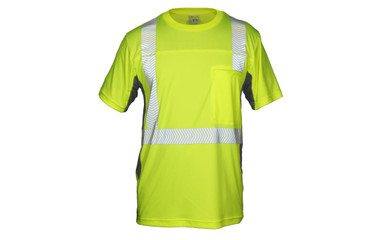 ML Kishigo 9173 Hi Vis Shirt, Class 2 Type R, Lime / Black, 1 PocketML Kishigo labels it ANSI/ISEA 107 Type R Class 2: Cool Touch fabric, UPF 50+, micro mesh, Premium Black Series
Why a shirt and not a vest. A Class 2 or Class 3 shirt is the hi-vis for crews that would otherwise wear a vest over a T-shirt all summer: one layer instead of two, the bands sewn into fabric that wicks, and nothing to leave in the truck. ML Kishigo makes the standard shirts in microfiber polyester, rated 50 washes, and the Cool Touch and UPF-rated shirts in a polyester-spandex with mesh panels, rated 25 washes, which is the trade: more comfort in heat, fewer rated washes. The black-bottom and black-sides shirts (9114, 9115, 9134, 9135, 9162, 9179, 9181) keep the fluorescent material where the standard counts it and put black "to keep T-shirt appearance clean and professional" where the belt and the dirt are. Under the MUTCD a Class 2 shirt meets the daytime roadway and a Class 3 long sleeve is what a night flagger should wear; under 1910.132(h)(4)(ii) an employer need not pay for "everyday clothing, such as long-sleeve shirts", which is why a hi-vis shirt is PPE when the employer issues it against a struck-by hazard and clothing when the worker buys it to skip the vest.
The fabrics, in ML Kishigo’s words
Each description is from the product page or spec sheet; the class is what the label says.
The questions, one by one
Answers from the ML Kishigo product pages, the FAQ and the rules named in the byline.
What is a hi-vis shirt, and what is it called?
A T-shirt, long sleeve or polo made of fluorescent fabric with retroreflective bands, labeled ANSI/ISEA 107 Type R Class 2 (short sleeve) or Class 3 (long sleeve with bands on the sleeves). "Safety shirt", "reflective T-shirt", "Class 2 shirt" and "hi-vis tee" are the same garment; Kishigo’s FAQ lists shirts among the HVSA the standard covers.
What is the most breathable type of hi-vis shirt?
A knit with mesh panels: ML Kishigo’s Cool Touch shirts print "micro mesh on front, back and in high heat areas to promote exceptional breathability" and the 9179 and 9181 a "micro mesh back"; the standard microfiber shirts breathe as a polyester knit does and wick. A mesh vest over a cotton T-shirt is the other hot-weather answer; the shirt wins when the crew would otherwise skip the vest.
Are long sleeves better than short sleeves in hot weather?
For sun, yes: Kishigo prints "perfect for protecting your arms from the sun while staying cool" on its long sleeves and "UPF 50+" on the Cool Touch and UPF shirts, and the UPF guide linked below explains the rating. For the standard, the long sleeve is also the Class 3 garment, which is why a crew that works nights buys the 9118, 9134 or 9177 and wears it in July as well. Short sleeve is cooler on the arms and is Class 2.
What fabric are work shirts, and are hi-vis shirts cotton?
Hi-vis shirts are polyester or polyester-spandex, because cotton does not hold a fluorescent dye to the standard; ML Kishigo’s one polyester-cotton garment is a Non-ANSI vest. The cotton and polycotton work shirts people ask about are a different product with no class, which the work-pants-and-jackets fabric guide linked below covers.
What is a cooling T-shirt?
A shirt built to move sweat and heat: Kishigo’s Cool Touch fabric, which it prints as having an "increased transfer rate of nearly 7 percent of total heat loss (Qt) value compared to the competition", with micro mesh and anti-odor treatment. It is not an evaporative cooling garment; the cooling-vest guide linked below explains those.
How many washes is a hi-vis shirt rated for?
50 on the microfiber polyester shirts (9110, 9111, 9114, 9115, 9118, 9134, 9135, 9162, 9220), 25 on the Cool Touch and UPF polyester-spandex shirts (9173, 9175, 9177, 9179, 9181, 9189, 9222) and on the FR shirts, as each spec sheet prints; the care label is "Machine Wash Cold, No Bleach, Tumble Dry Low, Do Not Dry Clean, Do Not Iron" (warm wash and air dry on the FR modacrylics). The cleaning guide linked below has the routine.
Do hi-vis shirts shrink?
Polyester does not shrink in a cold wash and a low dryer, which is what the label calls for; a hot dryer can tighten a polyester-spandex knit and will dull the tape either way. Buy the shirt size you wear; the chart on the 9110 spec sheet runs from a 32 to 34 inch chest at small to 58 to 60 at 5X.
Does OSHA require hi-vis shirts?
OSHA requires hi-vis, not a shirt: a Class 2 shirt, a Class 2 vest and a Class 3 jacket all meet a requirement for Class 2 or 3 under the MUTCD and 1926.201. The employer chooses the garment; where it chooses a shirt and issues it, the shirt is PPE the employer pays for.
What is a hi-vis polo, and is it Class 2?
A collared short-sleeve shirt with the bands: ML Kishigo’s 9220 ("UPF rated, extremely lightweight with exceptional breathability", a "micro sport mesh" back) and 9222 (Cool Touch, UPF 50+), both Type R Class 2. The polo is the supervisor’s and the delivery driver’s hi-vis.
What is a safety shirt for electricians?
An FR hi-vis shirt with an arc rating that meets the job’s category: ML Kishigo’s F506 (Class 3, ATPV 16 cal/cm², CAT 2) or the F709 and F710 long sleeves (ATPV 9.8 and 16), on a modacrylic blend that does not melt. A polyester hi-vis shirt is the wrong garment where an arc flash hazard exists; the FR hi-vis guide and the electrician PPE guide linked below cover the rules.
In plain words
- Hi-vis shirts are polyester: microfiber polyester on the standard ML Kishigo shirts (50 washes), Cool Touch and UPF polyester-spandex with mesh on the premium ones (25 washes), modacrylic on the FR shirts.
- Short sleeve is Class 2, long sleeve with sleeve bands is Class 3; the shirt is worn as the shirt.
- Long sleeves protect the arms from sun; UPF 50+ is printed on the Cool Touch shirts.
- Where an arc flash hazard exists, the shirt has to be FR with an arc rating, never plain polyester.
Questions people ask
What material are hi-vis shirts?
Polyester on nearly all of them; ML Kishigo prints microfiber polyester on the standard shirts and polyester/spandex Cool Touch on the premium ones, with modacrylic on the FR shirts.
Is a hi-vis T-shirt Class 2 or Class 3?
Class 2 when short-sleeved, Class 3 when the sleeves carry bands; ML Kishigo makes both and prints the class on each.
Do hi-vis shirts have UPF?
The ML Kishigo Cool Touch shirts print UPF 50+ and the 9179, 9181 and 9220 print UPF rated; the standard microfiber shirts print no UPF figure.
What is a black bottom shirt?
A hi-vis shirt with the fluorescent material on top and black below the chest to hide dirt; the class is unchanged.
How much is a hi-vis shirt?
$18.49 to $68.99 in the ML Kishigo line at our prices today, by fabric and sleeve.
Can I wear a hi-vis shirt instead of a vest?
Yes where Class 2 is required and the shirt is labeled Class 2; where Class 3 is required, a Class 3 long sleeve or a Class 2 shirt with Class E pants.
Are hi-vis shirts flame resistant?
Only the FR styles; ML Kishigo labels its polyester shirts "Not FR" under ANSI/ISEA 107 and its modacrylic F506, F709 and F710 with an arc rating.
How do I wash a hi-vis shirt?
Cold, no bleach, low dry, no iron; 50 rated washes on the microfiber shirts and 25 on the Cool Touch and FR shirts.
Related guides
What is a Class 2 safety shirt, and what is a high-visibility jacket?Vest vs shirt vs jacketWhat does UPF 40+ or 50+ mean on work clothing?And how it differs from SPFHow do you clean a hi-vis vest?The care label and the rated washesFlame-resistant hi-visWhen you need both ratingsWhat PPE should an electrician wear?What 1910.335 and 1910.269 requireHow do cooling vests and cooling towels work?And when they helpWhat are work pants and jackets made of?Polycotton, cotton duck, twill and ripstopWhat are the levels of safety vests?Class 1, 2, 3 and E, Type R, O and PWhat size hi-vis vest should you get?The ML Kishigo chest and length chartThe ratings, test results and standards shown here are the manufacturers' published values, reproduced as published. Nothing on this page is a recommendation by Bayshore Safety that any product is suitable for a particular task, hazard or workplace. Selecting safety products and protective equipment is the responsibility of the end user and the employer, based on their own hazard assessment and the regulations that apply to their work. Confirm every value on the manufacturer's own documentation before use.
© 2026 Bayshore Safety & Industrial Supplies, Inc. All rights reserved. This guide may not be copied or republished without written permission.