
What is the OSHA 4-foot rule? General industry fall protection under 1910.28, case by case
The 4-foot rule is OSHA’s general industry trigger height: in a plant, warehouse, shop, yard or any workplace that is not construction, each employee on a walking-working surface with an unprotected side or edge 4 feet (1.2 m) or more above a lower level must be protected by a guardrail system, a safety net system, or a personal fall protection system (fall arrest, travel restraint or positioning). That sentence is 29 CFR 1910.28(b)(1)(i). The same 4-foot figure runs through the rest of the section, for hoist areas, holes, dockboards, runways, dangerous equipment, wall openings, stairway landings and rope descent, and the section then sets its own figures where 4 feet is the wrong measure: a fixed ladder that extends more than 24 feet, a low-slope roof measured 6 and 15 feet from the edge, a repair pit less than 10 feet deep, and dangerous equipment, where protection is required at any height. Construction has its own rule at 6 feet (1926.501); scaffolds at 10 feet (1926.451) and steel erection at 15 and 30 feet (1926.760) are separate rules again. The maximum height anyone can work at without fall protection is therefore not one number: it is 4 feet in general industry, 6 feet in construction, and lower still over machinery.
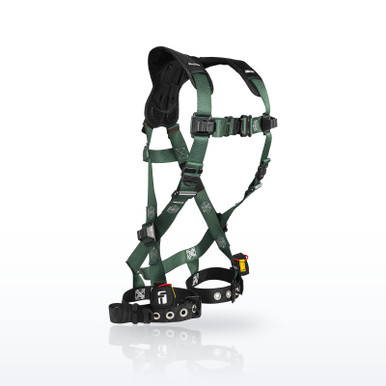 FallTech 1910 Harnesses, FT-1910 1D Standard Non-Belted, Tongue Buckle LegsA dorsal D-ring harness is the body support in the personal fall arrest and travel restraint systems 1910.28 allows at 4 feet (FallTech data)
Why 4 feet and not 6. OSHA writes two rulebooks. Part 1926 is construction, and its fall protection subpart (M) uses 6 feet as the floor for most work. Part 1910 is general industry, every fixed workplace that is not building something, and when OSHA rewrote its walking-working surfaces rules in 2016 it kept the 4-foot trigger that had been in the old Subpart D since 1971. The two numbers are not a contradiction: a mezzanine in a distribution center is a 4-foot edge every day of the year, a roof deck going up is a 6-foot edge for a few weeks. The question that decides which rule applies is what the work is, not where it is. A contractor repairing the roof of a plant is doing construction work under 1926; the plant’s own maintenance crew changing a filter on the same roof is doing general industry work under 1910.28. The height figures below are the general industry set; the construction set is on the Subpart M guide and the when-is-fall-protection-required guide linked at the end.
The 4-foot cases in 1910.28(b), one by one
Each paragraph names the situation and the systems allowed. The wording “personal fall protection system” means fall arrest, travel restraint or positioning, as 1910.140 defines them.
The trigger heights, general industry beside construction
| Situation | Rule | Height at which protection is required |
|---|---|---|
| Unprotected edge, general industry | 1910.28(b)(1) | 4 ft |
| Unprotected edge, construction | 1926.501(b)(1) | 6 ft |
| Dangerous equipment, either rulebook | 1910.28(b)(6); 1926.501(b)(8) | Any height (guardrail or equipment guard below the trigger; full systems above it) |
| Scaffold platform | 1926.451(g)(1) (applies in general industry through 1910.28(b)(12)) | 10 ft |
| Steel erection | 1926.760(a)(1) and (b)(3) | 15 ft; 30 ft or two stories for connectors |
| Fixed ladder | 1910.28(b)(9) | Ladder extends more than 24 ft |
| Low-slope roof, general industry | 1910.28(b)(13) | Within 6 ft of the edge always; 6–15 ft designated area allowed; beyond 15 ft no system for infrequent, temporary work |
| Repair or service pit | 1910.28(b)(8) | Under 10 ft deep: markings, warning line and signs instead of a system |
| Portable ladders | 1910.28(a)(2)(i) | Section does not apply |
The heights are the OSHA floors. An employer’s written program may set a lower trigger; a state plan (Cal/OSHA, for one) may differ, as the residential guide below describes.
Source: 29 CFR 1910.28 and 1926.501, 1926.451, 1926.760 (e-CFR text as of Nov 5 2026).
What the 4-foot rule does not cover, and what sits beside it
From the section’s scope paragraph and the sections it points to:
- Portable ladders (1910.28(a)(2)(i)); the ladder rules are in 1910.23. Inspecting or assessing a workplace before work starts or after it ends, unless fall protection has already been installed and is available (a)(2)(ii).
- Stages and rail platforms, powered platforms under 1910.66, aerial lifts under 1910.67, telecommunications and electric power work under 1910.268 and 1910.269 (a)(2)(iii)–(vii), which carry their own fall rules.
- The systems themselves. 1910.28 says when; 1910.29 says what a guardrail, cover, designated area or ladder safety system must be (a top rail 42 inches plus or minus 3, 200 lb); 1910.140 says what a personal fall arrest, travel restraint or positioning system must be (5,000 lb anchorages, 1,800 lb maximum arresting force, 6 ft free fall, the dorsal attachment).
- Training. 1910.30 requires training by a qualified person for every employee who uses a personal fall protection system or works where 1910.28 applies, before the exposure, with retraining when conditions or equipment change.
- Falling objects. 1910.28(c) requires head protection and toeboards, screens, canopies or barricades wherever employees are exposed to falling objects, at any height.
- FallTech’s reading of the two rulebooks: its construction height guide lists the 6-foot trigger with the 10-foot scaffold and 15- and 30-foot steel erection figures, and its ANSI-versus-OSHA piece describes OSHA’s rules as the legal minimum with the ANSI/ASSP Z359 code adding design, testing and program requirements above it (FallTech, “When Is Fall Protection Required in Construction?”; FallTech, “ANSI vs. OSHA” (its article setting the Z359 code beside the OSHA rules)).
Questions people ask
What is the OSHA 4 foot rule?
In general industry, each employee on a walking-working surface with an unprotected side or edge 4 feet or more above a lower level must be protected by a guardrail system, a safety net system, or a personal fall protection system (fall arrest, travel restraint or positioning). 29 CFR 1910.28(b)(1)(i).
What is the maximum height you can work at without fall protection?
There is no single number. In general industry it is just under 4 feet; in construction just under 6 feet; on a scaffold just under 10 feet; in steel erection 15 feet (30 for connectors); and over dangerous equipment there is no height at all, protection is required from the floor up.
When must you wear a safety harness?
When the employer has chosen a personal fall arrest or travel restraint system to meet the trigger (4 ft in general industry, 6 ft in construction) instead of a guardrail or net; always for rope descent, for leaning through a hoist-area opening, and on a fixed ladder over 24 feet fitted with a personal fall arrest system. 1910.28(b)(2)(ii), (b)(9), (b)(12)(ii).
Is the 4-foot rule the same as the 6-foot rule?
No. 4 feet is the general industry trigger (1910.28); 6 feet is the construction trigger (1926.501). The work decides which rulebook applies, not the building.
Does the 4-foot rule apply to ladders?
Not to portable ladders, which 1910.28 excludes. Fixed ladders have their own paragraph: a ladder that extends more than 24 feet needs a personal fall arrest system or a ladder safety system (cages and wells on older ladders are accepted until November 18, 2036).
Is fall protection required on a roof in general industry?
On a low-slope roof, yes within 6 feet of the edge, with a designated area allowed from 6 to 15 feet for infrequent and temporary work, and no system required 15 feet or more from the edge for infrequent, temporary work if a rule keeps everyone else back. 1910.28(b)(13).
Can I use a warning line or floor marking instead of fall protection?
Only where 1910.28 says so: around a repair pit less than 10 feet deep (markings or a warning line 6 feet from the edge, with signs and trained employees) and as the boundary of a designated area on a low-slope roof. Elsewhere a line is not a system.
What does a personal fall protection system have to meet in general industry?
1910.140: anchorages of 5,000 lb per employee or engineered to a safety factor of two, D-rings and snap hooks of 5,000 lb tensile and 3,600 lb proof load, automatic-locking connectors, a 5,000 lb lanyard or restraint line, arresting force limited to 1,800 lb with a harness, free fall of 6 feet or less, the dorsal attachment, inspection before each shift and prompt rescue.
Does OSHA require training for the 4-foot rule?
Yes. 1910.30 requires each employee who uses a personal fall protection system, or who works where 1910.28 requires protection, to be trained by a qualified person before exposure, and retrained when the workplace, systems or the employee’s performance show the need.
What are the hazards and control measures for working at height?
OSHA’s rules put them in an order: a surface that can carry the load, then guardrails, covers and nets that need nothing from the worker, then travel restraint that keeps the worker from the edge, then fall arrest with a rescue plan, then the administrative measures (designated areas, warning lines, training) where the rule allows them. The working-at-height guide below walks through each.
Related guides
When is fall protection required?The OSHA height rulesOSHA fall protection requirements explained1926 Subpart M, section by sectionWorking at height: hazards and control measuresThe hierarchy as the OSHA rules apply itFixed ladder fall protectionWhat 1910.28(b)(9) requiresOSHA 1910 vs 1926General industry and constructionWhat are the components of a fall restraint system?Anchorage, connector, body support and the lengthThe ratings, test results and standards shown here are the manufacturers' published values, reproduced as published. Nothing on this page is a recommendation by Bayshore Safety that any product is suitable for a particular task, hazard or workplace. Selecting safety products and protective equipment is the responsibility of the end user and the employer, based on their own hazard assessment and the regulations that apply to their work. Confirm every value on the manufacturer's own documentation before use.