
Working at height: the hazards and the control measures, in the order the OSHA rules apply them
The hazards of working at height are the ways a person or an object gets to a lower level: an unprotected edge or leading edge, a hole or skylight, a fragile or overloaded surface, a scaffold without rails or planking, a ladder that slips or is overreached, an aerial lift that tips or throws its occupant, a steel member being connected, a confined space entered from above, and the tools and material that fall on whoever is below. OSHA’s rules answer those hazards in an order that is the hierarchy of controls as it applies to falls. First the surface: the employer determines that it has the strength and structural integrity to support employees before anyone works on it (1926.501(a)(2)). Then the passive systems that need nothing from the worker: guardrails, covers and safety nets, named first in every duty paragraph. Then restraint, which keeps the worker from the edge so no fall can occur. Then personal fall arrest, which stops a fall that has started and brings with it clearance, force limits and a rescue plan. Last, and only where the rule allows them, the administrative measures: warning lines, controlled access zones, safety monitors, designated areas and a written fall protection plan where conventional systems are infeasible. Training before exposure and inspection before use sit under all of it. FallTech states the same order: the solution that eliminates or minimizes the hazard before a worker is exposed to it comes first, passive protection wherever it can eliminate the hazard, and active systems where workers need mobility or passive controls cannot protect the area.
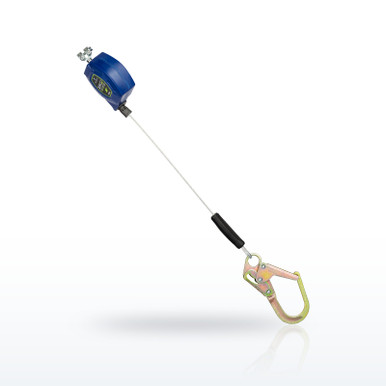 FallTech 82808RP0 Self-Retracting Lifelines, 8 ft FT-X Cable Leading EdgeA Class 2 personal SRL, the fall arrest connector for work where the anchor is at foot level (FallTech data)
Why the order matters more than the equipment. A harness is the answer most people picture, and it is the fourth answer in the rules. A guardrail protects everyone on the deck, all day, without anyone deciding to clip in; a cover over a hole does the same; a restraint line removes the fall entirely. Fall arrest is what is left when those are not feasible, and it only works if the clearance below is enough, the anchor holds, the connector is the right class for where the anchor is, and someone can get the worker down. FallTech’s list of common planning mistakes is a list of the arrest system’s dependencies: the wrong tie-off location, clearance that changes as the job changes, incompatible components, no rescue plan. The control measures below are in the order the rule names them, each with the hazard it answers and the paragraph it comes from.
The hazards, and the control the rule names for each
Construction paragraphs from 1926.501 and Subparts L, X and R; the general industry counterpart from 1910.28 where it differs.
The hierarchy of controls as the fall rules apply it
| Level | What it is | Where the rule puts it | What the worker has to do |
|---|---|---|---|
| 1. Eliminate the exposure | Do the work from the ground or a floor; prefabricate; confirm the surface will hold before anyone is on it | 1926.501(a)(2) surface integrity; the employer’s own planning | Nothing |
| 2. Passive systems | Guardrail systems (42 in ± 3, 200 lb), covers (twice the load, secured, marked), safety nets (within 30 ft, drop-tested) | Named first in every duty paragraph of 1926.501(b) and 1910.28(b); criteria in 1926.502(b), (c), (i) and 1910.29 | Nothing, once installed and maintained |
| 3. Travel restraint | Anchorage, connector, restraint line and harness set so the edge cannot be reached; no free fall | Named in 1910.28(b) and defined in 1910.140(b); accepted in construction where it prevents the exposure | Wear the harness, connect, keep the line set to length |
| 4. Personal fall arrest | Anchorage (5,000 lb), harness, lanyard or SRL limiting force to 1,800 lb and free fall to 6 ft, with clearance below and a rescue plan | 1926.502(d); 1910.140(d) | Wear, inspect, connect to the right anchor with the right class of connector, stay connected; the crew rescues |
| 5. Administrative measures | Warning lines, controlled access zones, safety monitoring systems, designated areas, a written fall protection plan | Only where a paragraph allows them: low-slope roofing, leading edge and precast work, residential construction, overhand bricklaying, general industry roofs beyond 6 and 15 ft (1926.502(f)–(h), (k); 1910.28(b)(13)) | Stay inside the line; obey the monitor; follow the plan |
| Under all of them: training and inspection | Hazard recognition and procedures before exposure; equipment inspected before each use | 1926.503; 1910.30; 1926.502(d)(21); 1910.140(c)(18) | Attend, demonstrate understanding, inspect, report |
The order is the one the rules name the systems in and the one FallTech describes; the employer’s hazard assessment decides which level is feasible for each task.
Source: 29 CFR 1926.501, 1926.502, 1926.503, 1910.28, 1910.29, 1910.140, 1910.30 (e-CFR text as of Nov 5 2026); FallTech, “Active Fall Protection Systems: What They Are and When to Use Them” (falltech.com).
What FallTech states about active systems and the planning mistakes behind most failures
From the FallTech pieces and OSHA’s fall module:
- “Passive systems protect an area once they are installed … Active fall protection systems, on the other hand, depend on the worker using the equipment correctly.” Neither is universally better; whenever passive protection can eliminate the hazard it is generally the preferred solution, and active systems become necessary when workers need mobility or passive controls cannot protect the area.
- The components of an active system have to work as a system: the harness as body support with the dorsal D-ring positioned correctly and the fit checked; a lanyard or SRL as the connecting device, with horizontal or vertical lifelines where the worker has to move; and an anchorage whose location sets free fall, swing fall and clearance. FallTech names compatibility of every component, and connection to the right attachment point, as part of the planning.
- Common planning mistakes FallTech lists: the wrong tie-off location, which increases free fall and arrest distance, reduces clearance or creates a swing fall; failing to account for changing conditions, when stored material or a new platform below eats the clearance the plan assumed; and skipping the pre-use inspection of harness, lanyard, connectors, anchorage connectors and lifelines for damage, contamination, missing labels or signs of deployment.
- Restraint before arrest: FallTech describes fall restraint as fall prevention (the worker cannot reach the hazard, no free fall, no clearance or rescue planning needed) and fall arrest as fall control (a fall is allowed within OSHA’s limits and the system must manage what follows, including rescue), and states that OSHA judges the result, whether the system prevents or controls the exposure, rather than the label.
- Training and a competent person: effective training teaches hazard recognition, inspection, connection and the system’s limitations; a competent person oversees system selection and makes sure workers understand the site-specific procedures before work begins. OSHA’s fall module adds the worker’s own list: know the written plan, attend training, use the equipment when required and make sure it fits, inspect before each use, keep holes covered or railed, get specialized training before scaffolds, lifts or ladders.
- The weather and the body: FallTech’s general contractor and heat pieces add the hazards the rules do not list by name, wind on a deck, wet or icy surfaces, heat illness in a harness, fatigue at height, and treat them as reasons to plan the passive and restraint controls first.
Questions people ask
What are the hazards and control measures involved in working at height?
Hazards: unprotected edges and leading edges, holes and skylights, weak or fragile surfaces, scaffolds, ladders, aerial lifts, steel erection, roofs, and falling objects. Controls, in the rules’ order: confirm the surface, then guardrails, covers and nets, then travel restraint, then personal fall arrest with clearance and rescue, then warning lines, controlled access zones, monitors and plans where allowed, with training and inspection under all of it.
What are the safety measures for employees working above 6 feet?
In construction, at 6 feet the employer must protect each employee at an unprotected edge by a guardrail system, a safety net system or a personal fall arrest system (1926.501(b)(1)), cover or guard holes, protect those below from falling objects, train each exposed employee under 1926.503, and provide for prompt rescue if arrest systems are used.
What is the hierarchy of fall protection?
Eliminate the exposure; passive systems (guardrails, covers, nets); travel restraint; personal fall arrest; administrative controls (warning lines, controlled access zones, safety monitors, designated areas, fall protection plans). The OSHA duty paragraphs name the systems in that order and allow the administrative measures only in named situations.
What is the difference between active and passive fall protection?
Passive systems (guardrails, barriers, covers, nets) protect an area once installed and need nothing from the worker. Active systems (restraint and arrest) depend on the worker wearing the harness, connecting to a suitable anchorage, inspecting the gear and staying tied off. FallTech: passive is generally preferred where it can eliminate the hazard.
What is the most secure type of fall protection?
The rules and FallTech put elimination and passive systems first because they do not depend on the worker; restraint next because no fall can occur; arrest last because it manages a fall that has happened. Which is feasible for a task is the employer’s hazard assessment.
How can falls from height be prevented?
By planning the work so the exposure does not occur (ground-level assembly, confirmed surfaces), installing guardrails and covers before the work starts, using restraint where the geometry allows, and reserving fall arrest, with its clearance check and rescue plan, for what remains; then training before exposure and inspection before each use.
What are the most common fall hazards?
OSHA’s fall module: unprotected roof edges, roof and floor openings, structural steel and leading edges; improperly constructed scaffolds; unsafe portable ladders. Its long-run split of fatal falls is about a third from roofs, 18 percent from scaffolds, 16 percent from ladders and 8 percent from structural steel.
What size hole is considered a fall hazard?
OSHA defines a hole as a gap or void 2 inches (5.1 cm) or more in its least dimension in a floor, roof or other walking/working surface (1926.500(b)). Holes 6 ft or more above a lower level need covers, guardrails or PFAS; every hole needs a cover against stepping into it and against objects falling through.
When is a fall protection plan allowed instead of equipment?
Only for leading edge work, precast concrete erection and residential construction, when the employer can demonstrate that guardrails, nets and PFAS are infeasible or create a greater hazard, and the plan meets 1926.502(k): written, site-specific, prepared by a qualified person, with a controlled access zone and a safety monitor where used. The rule presumes conventional systems are feasible.
What does the worker have to do under each control?
Nothing under elimination and passive systems once they are in place; wear, connect and keep the line to length under restraint; wear, inspect, connect to the right anchor with the right connector and stay connected under arrest; stay inside the line and obey the monitor under administrative measures; and attend training and inspect equipment under all of them.
Related guides
What is the OSHA 4-foot rule?General industry fall protection under 1910.28When is fall protection required?The OSHA height rulesThe four types of fall protectionGuardrails, nets, arrest and restraintWhat are the components of a fall restraint system?Anchorage, connector, body support and the lengthHow to calculate fall clearanceThe numbers behind the 10 feet and the 18 feetWhat is a rescue plan?And does OSHA require oneThe ratings, test results and standards shown here are the manufacturers' published values, reproduced as published. Nothing on this page is a recommendation by Bayshore Safety that any product is suitable for a particular task, hazard or workplace. Selecting safety products and protective equipment is the responsibility of the end user and the employer, based on their own hazard assessment and the regulations that apply to their work. Confirm every value on the manufacturer's own documentation before use.