
What are the components of a fall restraint system? Anchorage, connector, body support, and the length that keeps you from the edge
A fall restraint system, which OSHA’s general industry rule calls a travel restraint system, is “a combination of an anchorage, anchorage connector, lanyard (or other means of connection), and body support that an employer uses to eliminate the possibility of an employee going over the edge of a walking-working surface” (1910.140(b)). Those are the four components people are asking about: the anchorage (the structure, 5,000 lb per employee or engineered to a safety factor of two), the anchorage connector (the strap, clamp or D-ring plate that joins the line to it), the connecting line (a restraint lanyard, fixed or adjustable, which must hold 5,000 lb and has no energy absorber because there is no fall to absorb), and the body support (a full-body harness, or in general industry a body belt). The fifth element is not a part but a dimension: the line has to be short enough, from that anchor, that the worker cannot reach the edge. If the geometry lets the worker get to the edge, the system is not restraint, whatever the label on the lanyard says, and it would then have to meet every fall arrest requirement it was never built for.
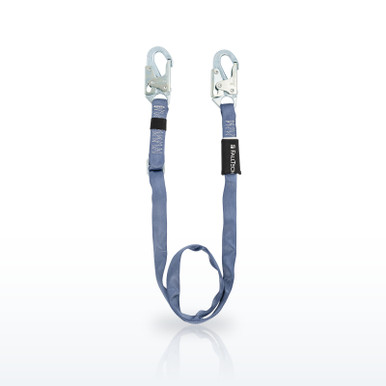 FallTech 8209 Restraint Lanyards, 4-6 ft Adjustable Length, Single-legAn adjustable restraint lanyard listed to ANSI Z359.3: set the length so the edge is out of reach (FallTech data)
Why restraint is its own system. Fall arrest plans for the fall: clearance below, 1,800 lb on the body, a shock absorber, a rescue. Restraint removes the fall, so none of that is needed, which is why the general industry rule lists it as one of the three personal fall protection systems and why FallTech describes it as fall prevention rather than fall control. The catch is that restraint only works if the geometry is right from every anchor the worker will use. A 6-foot restraint lanyard on a roof anchor 8 feet from the edge is restraint; the same lanyard on an anchor 5 feet from the edge is a fall arrest system with no energy absorber and a line that was never tested for it. The components are simple; the length is the engineering.
The four components, as the rule defines them
From 1910.140(b), with the strength figure that goes with each.
Restraint beside arrest and positioning, in the rules’ figures
| Travel restraint | Personal fall arrest | Positioning | |
|---|---|---|---|
| Purpose in the rule | Eliminate the possibility of going over the edge (1910.140(b)) | Arrest an employee in a fall from a working level (1926.500(b)) | Support the employee on an elevated vertical surface with both hands free (1926.500(b)) |
| Free fall allowed | None by design | 6 ft maximum (1926.502(d)(16)(iii)) | 2 ft maximum (1926.502(e)(1)) |
| Anchorage | 5,000 lb per employee or engineered, factor of 2 (1910.140(c)(13)) | 5,000 lb per employee or engineered, factor of 2 (1926.502(d)(15)) | Twice the potential impact load or 3,000 lb, whichever is greater (1926.502(e)(2)) |
| Line | 5,000 lb tensile, no energy absorber (1910.140(c)(14)) | Lanyard 5,000 lb; energy absorber or SRL limits force to 1,800 lb | Connecting assembly 5,000 lb tensile (1926.502(e)(5)) |
| Body support | Harness, or body belt in general industry | Full-body harness only since Jan 1 1998 | Harness or body belt |
| Clearance and rescue planning | Not needed when the geometry holds (FallTech) | Required: clearance below and prompt rescue (1926.502(d)(16), (d)(20)) | Backed by a separate fall arrest system where a fall is possible |
| Manufacturer standard listed | ANSI/ASSP Z359.3 (restraint and positioning lanyards) | ANSI/ASSP Z359.13 lanyards, Z359.14 SRLs, Z359.11 harness | ANSI/ASSP Z359.3 |
Source: 29 CFR 1910.140, 1926.500(b), 1926.502(d) and (e) (e-CFR text as of Nov 5 2026); FallTech, “Fall Restraint vs. Fall Arrest: What is the Difference?” (Apr 2026); the ANSI Standards field on the FallTech lanyard pages.
What a work restraint lanyard is, and what FallTech lists
From the FallTech product pages and guides:
- A work restraint lanyard (restraint lanyard, travel restraint lanyard) is a lanyard with no energy absorber, built for a system in which no fall can occur. FallTech lists its restraint lanyards to ANSI/ASSP Z359.3 with OSHA 1926.502 and 1910.66 in the OSHA field, in fixed lengths (2–8 ft web, 3–6 ft rope or cable, 6 ft coated cable) and adjustable lengths (4–6, 5–8, 6–10, 7–12 and 11–20 ft jacketed web), single and double leg, with steel snap hooks, rebar hooks or a 5K carabiner at the anchor end, and arc flash (Kevlar) and WeldTech versions.
- FallTech’s lanyard guide separates four lanyard types by job: energy-absorbing lanyards for fall arrest, positioning lanyards to hold the worker at the work, restraint lanyards to keep the worker from the fall hazard, and the specialty forms (arc flash, welding, tie-back, leading edge). Its rule for the restraint type is the one in the definition: the lanyard length and anchor location are chosen so the worker cannot reach the edge.
- Examples of restraint systems: a roofer on a low-slope roof with an anchor set back from the edge and an adjustable lanyard shortened so the edge is out of reach; a worker on a flatbed or a mezzanine with an overhead rail and a short line; a mobile elevating work platform where the manufacturer requires the occupant to be tied to the platform anchorage so that the worker cannot be ejected over the rail; a parapet roof with a horizontal lifeline run back from the edge. In each case the line is set so the edge cannot be reached from any point on the line.
- Passive restraint is a different thing: a guardrail or a parapet of guardrail height restrains the whole crew without anyone wearing anything. FallTech calls guardrails and covers passive systems and harness-based systems active systems; a restraint system with a harness is active fall protection.
- Where the general industry rule allows travel restraint by name: unprotected edges, hoist areas, holes, runways with one rail, dangerous equipment, openings, low-slope roofs within 6 and 15 ft of the edge, slaughtering platforms (1910.28(b)). The construction rule does not use the word; OSHA’s construction definitions and FallTech both describe a system that keeps the worker from the edge as acceptable fall protection where it prevents the exposure.
Questions people ask
What are the four main components of a fall restraint system?
An anchorage, an anchorage connector, a lanyard or other means of connection, and a body support, combined so the employee cannot go over the edge. That is OSHA’s definition of a travel restraint system in 1910.140(b).
What are the four components of a fall protection system?
The trade’s ABCD: anchorage, body support, connector and descent or rescue. OSHA’s definitions use the first three (anchorage, body belt or harness, connectors, with lanyard, lifeline or deceleration device as the connecting means) for both arrest and restraint; rescue is a separate duty in 1926.502(d)(20) and 1910.140(c)(21).
What is a work restraint lanyard?
A lanyard without an energy absorber used to keep a worker from reaching a fall hazard. Fixed or adjustable length, rated to 5,000 lb tensile, listed by the manufacturers to ANSI/ASSP Z359.3. It is not for fall arrest.
What is the definition of fall restraint?
OSHA’s general industry term is travel restraint system: a combination of anchorage, anchorage connector, lanyard and body support used to eliminate the possibility of an employee going over the edge of a walking-working surface (1910.140(b)). FallTech: a system that restricts movement so the hazard cannot be reached, with no vertical free fall when set up correctly.
How should fall restraint systems be designed to limit worker movement?
By length and anchor location: from every anchor the worker will use, the line (with its stretch and the worker’s reach) must stop short of every edge. Adjustable lanyards are shortened to the geometry; the restraint line must hold 5,000 lb and the anchorage 5,000 lb per employee or an engineered factor of two.
What are some examples of restraint systems?
A roof anchor set back from the edge with a shortened adjustable lanyard; an overhead rail with a short line on a mezzanine or flatbed; the platform anchorage on an aerial lift; a horizontal lifeline run back from a parapet. A guardrail is passive restraint for the whole crew and is not a personal system.
Can body belts be used for fall restraint systems?
In general industry, yes: 1910.140(b) lists travel restraint among a body belt’s uses, and FallTech lists a 1D restraint belt. Not for fall arrest, in either rulebook, since January 1, 1998.
Can you use a fall arrest lanyard for restraint?
An energy-absorbing lanyard can be used where the geometry keeps the worker from the edge, but it is longer than its label once the absorber is counted and gives no benefit when no fall can occur; the manufacturers list restraint lanyards for that use. The reverse is never allowed: a restraint lanyard has no energy absorber and is not fall arrest.
Can an SRL be used for fall restraint?
An SRL is a fall arrest connector; it pays out line as the worker moves, so it does not limit travel. FallTech lists its SRLs under fall arrest, and its restraint lanyards under restraint. Where the manufacturer states a restraint use for a device, that statement governs.
Does a restraint system need clearance or a rescue plan?
FallTech states that a correctly set up restraint system removes the need for the fall arrest clearance evaluation and the post-fall rescue plan, because a fall cannot happen. If a fall is possible from any position, the system is not restraint and both are required.
Related guides
Fall arrest vs restraint vs positioningThe three systemsTypes of lanyards and maximum lengthEnergy-absorbing, restraint, positioningWhat is an anchor point, and what must it hold?The 5,000-pound ruleTemporary, permanent and engineered anchorsThe types and the strength ruleThe four types of fall protectionGuardrails, nets, arrest and restraintIs a safety harness PPE?Where OSHA places it, and who paysThe ratings, test results and standards shown here are the manufacturers' published values, reproduced as published. Nothing on this page is a recommendation by Bayshore Safety that any product is suitable for a particular task, hazard or workplace. Selecting safety products and protective equipment is the responsibility of the end user and the employer, based on their own hazard assessment and the regulations that apply to their work. Confirm every value on the manufacturer's own documentation before use.