Home › Guides › Fall protection and confined space › Vertical lifelines
Guide · Fall protection · OSHA 1926.502(d) and 1910.140 · ANSI/ASSP Z359.15 · FallTech and Safewaze manuals

Bayshore Safety & Industrial Supplies Guide

What is a vertical lifeline? Rope size and material, the 5,000-pound rule, one worker per lifeline, rope grabs, and how a rope lifeline is rigged, from 1926.502(d) and the manufacturers’ manuals

A vertical lifeline is a rope hung from a single anchor so a worker’s rope grab can travel along it as the worker moves up or down a roof, a ladder, a tank or a scaffold; OSHA defines a lifeline as a flexible line connected to an anchorage at one end so as to hang vertically, or at both ends to stretch horizontally, serving as the means for connecting the rest of the system to the anchor. The rules on it are short: a minimum breaking strength of 5,000 pounds, synthetic fiber rope, protected against cuts and abrasion, and each worker on a separate lifeline. The manufacturers build to that: FallTech’s vertical lifelines are all 5/8-inch synthetic rope rated for one user of 130 to 310 pounds, with a 5,000-pound snap hook in a thimbled eye at the anchor end, and Safewaze’s FS700 PRO lifelines are 5/8-inch polyester rope in 25- to 300-foot lengths. A rope grab (fall arrester) rides the line and locks on it in a fall, usually through a 3-foot energy-absorbing lanyard to the harness; a 5-pound weight on the free end keeps the line taut so the grab travels.
Bayshore Safety. Industrial safety and PPE supplier since 2017. · Current as of November 2026 · 29 CFR 1926.502(d)(7), (9), (10), (11) and (14) and 29 CFR 1910.140(b) definitions and (c)(3) to (6) and (20) (current e-CFR); FallTech Single Anchor Vertical Lifelines and Fall Arresters User Instruction Manual MVLL01 Rev D (May 2021) (description, types, 5/8-inch rope, capacity, one lifeline per anchorage, installation, counterweight, abrasion protection, rope grab installation, restraint use, inspection, Tables 1 to 3); FallTech roofer’s kit sell sheet PN 480-00005 (anti-panic fall arrester); Safewaze FS700 PRO and V-Line vertical lifeline and rope grab product pages and technical data sheets as carried on this site (polyester and kernmantle rope, lengths 25 to 300 ft, hardware)
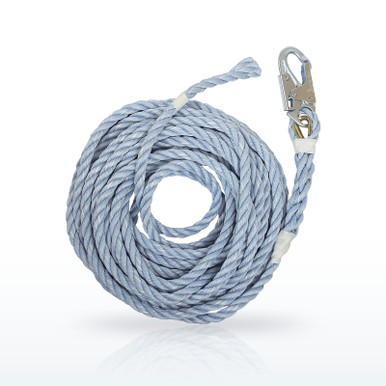
FallTech 8149 Rope Grabs & Lifeline Rope, 50' Construction-grade VerticalFallTech 8149 Rope Grabs & Lifeline Rope, 50' Construction-grade VerticalFallTech 8149 50 ft construction-grade vertical lifeline, 5/8-inch rope, ANSI Z359.15-2014

The horizontal lifeline, the rope grab and the SRL each have their own guide on this site. This page is the vertical rope lifeline itself: what a safety line or life line is in the US rules, what size and kind of rope it is, how much weight it holds, why only one worker rides it, how it differs from a horizontal lifeline and from climbing rope, how the grab works on it, and how it is rigged and inspected. The facts are from the FallTech vertical lifeline manual, the Safewaze lifeline data carried on this site, and the construction and general industry fall protection rules.

Vertical lifelines, question by question

OSHA’s construction criteria are 1926.502(d); the general industry rule, 1910.140, carries the same lifeline provisions in (c). The manufacturer figures are FallTech’s and Safewaze’s own.

What is a vertical lifeline, a safety line, a life line in construction?They are the same thing in the US rules. OSHA defines a lifeline as a component of a personal fall protection system consisting of a flexible line for connection to an anchorage at one end so as to hang vertically (vertical lifeline), or for connection to anchorages at both ends so as to stretch horizontally (horizontal lifeline), which serves as a means for connecting other components of the system to the anchorage (1910.140(b)). “Safety line” and “life line” are the trade’s words for it; “lifeline rope” is the rope before the hardware is spliced on. FallTech describes its vertical lifelines as the vertical rope lifeline portion of a fall arrest or restraint system, available in many configurations, lengths and materials, and designates them as Types by construction, material and end configuration; when a lifeline is combined with a rope grab, a shock-absorbing lanyard and a counterweight it becomes what FallTech calls a fall arrester connector subsystem, and that plus an anchorage and a full body harness is a personal fall arrest system. A vertical lifeline is not a climbing rope: the rope in a climbing or rope-access system is dynamic or low-stretch rope used with descenders under different standards, while a lifeline is a static anchor line for a grab.
29 CFR 1910.140(b) (lifeline definition); FallTech MVLL01 Rev D, Sections 2.0 and 2.1.
What is the standard size of lifeline rope, and what is it made of?5/8 inch, synthetic. FallTech states that all its vertical lifelines are 5/8-inch diameter synthetic rope, and its tables list polyester 3-strand rope at 5,000 lb minimum (Type A, with a braided end and alloy steel snap hook) and 5,600 lb minimum (the types with a carbon steel thimble and alloy snap hook), in 25, 30, 50, 75, 100, 150 and 200-foot lengths; its product data on this site lists 5/8-inch rope on the 8149 construction-grade and premium polyester-blend lifelines. Safewaze’s FS700 PRO lifelines are listed as polyester rope with zinc-plated steel hardware in 25, 50, 75, 100, 150, 200, 250 and 300 feet, its V-Line lifelines as copolymer rope, and its V-Line kernmantle lifelines as a nylon core with a polyester cover. OSHA requires that ropes and straps used in lanyards and lifelines be made from synthetic fibers (1926.502(d)(14)) and that lanyards and vertical lifelines have a minimum breaking strength of 5,000 pounds (1926.502(d)(9); 1910.140(c)(4)); manila and other natural fiber are not allowed. The grab is matched to the rope: FallTech’s labels say to use its fall arresters only with 5/8-inch polyester rope.
FallTech MVLL01 Rev D, Section 2.1 and Tables 1 and 2; Safewaze FS700 and V-Line product data on this site; 29 CFR 1926.502(d)(9) and (14); 1910.140(c)(4).
What is the maximum weight capacity of a lifeline?Two numbers, and they are different things. The rope’s minimum breaking strength is 5,000 pounds by rule, 5,600 pounds on FallTech’s thimbled polyester lifelines; that is what the rope will hold before it breaks. The user capacity is what the system is rated to arrest: FallTech states the fall arresters, connectors, lifelines and lanyards in its manual have a listed single-user capacity, including clothing and tools, of 130 to no more than 310 pounds, the ANSI Z359 limit, and that no more than one lifeline may be connected to one anchorage connector at a time; Safewaze lists the same 130 to 310 lb ANSI capacity on its kits and lifeline assemblies. OSHA’s force limits sit between: the system must limit arresting force to 1,800 pounds and keep free fall to 6 feet, and the anchorage must hold 5,000 pounds per employee attached. FallTech also notes that users above the ANSI limit face higher arrest forces and faster onset of suspension trauma, which is why the capacity is written as a range rather than a maximum alone.
FallTech MVLL01 Rev D, Sections 1.0 and 4.1 and Tables 1 and 2; 29 CFR 1926.502(d)(9), (15), (16); Safewaze product data on this site.
How many workers are allowed on a vertical lifeline?One. When vertical lifelines are used, each employee shall be attached to a separate lifeline (1926.502(d)(10)(i)); the general industry rule says the same (1910.140(c)(3)). The single exception is in construction, during the construction of elevator shafts, where two employees may be attached to the same lifeline in the hoistway provided both are working atop a false car equipped with guardrails, the lifeline’s strength is 10,000 pounds (5,000 per employee) and every other lifeline criterion is met (1926.502(d)(10)(ii)). FallTech’s manual carries the rule into the hardware: one user per lifeline, and no more than one lifeline on one anchorage connector at a time. A horizontal lifeline is different, rated for the number of users its manufacturer states, and the HLL guide linked below covers that.
29 CFR 1926.502(d)(10); 29 CFR 1910.140(c)(3); FallTech MVLL01 Rev D, Section 4.1.
How does a rope grabber work on the lifeline?OSHA defines a rope grab as a deceleration device that travels on a lifeline and automatically, by friction, engages the lifeline and locks so as to arrest the fall of an employee, usually by inertial locking, cam or lever locking, or both (1910.140(b)). FallTech describes its fall arresters as steel mechanisms that allow worker mobility along the lifeline and whose spring-loaded internal cam locks onto the lifeline during a fall event; the 7489 and 8388 add a tension roller and internal spring that keep the device in position and let it move smoothly up and down hands-free (a trailing grab), a hinged body that installs anywhere on the line, an anti-inversion hinge cam that will not let the gate close if the grab is upside down, and an anti-panic feature that still puts pressure on the lifeline if the user grips the lever open while falling. Every FallTech grab carries an UP arrow that must point toward the anchor; the manual warns that a grab installed upside down will not lock. The grab connects to the harness through a 3-foot energy-absorbing lanyard (permanently attached on the 8388 and 8355) so the force on the body is limited; a longer lanyard adds free fall and is not what the manufacturer supplies.
29 CFR 1910.140(b) (rope grab); FallTech MVLL01 Rev D, Sections 2.2 and 5.4.1 to 5.4.5; FallTech roofer’s kit sell sheet PN 480-00005.
How is a vertical lifeline rigged, step by step?From FallTech’s manual: the anchorage and harness are already in place and approved; attach the lifeline’s self-closing, self-locking snap hook (pre-installed in a plated steel thimble) or, on the Type F line, a carabiner, to the anchorage; attach a counterweight of at least 5 pounds to the free end to keep the line taut and let it hang freely (if no weight can be used, the lower end must have a rope stop so the grab cannot travel off the end); provide abrasion protection wherever the rope passes over an edge or any rough or uneven surface; install the grab with the arrow up (open the hinged gate, retract the cam, lay the rope in the channel, close and lock, latch down); connect the lanyard to the grab and the lanyard’s shock-absorbing end to the dorsal or sternal D-ring; and move the grab along the line by the lanyard, never by its body or lever. The rule adds that lifelines must be protected against being cut or abraded (1926.502(d)(11)) and the general industry rule that a competent or qualified person must inspect each knot in a lanyard or vertical lifeline before use (1910.140(c)(6)), which is one reason factory-spliced thimbled ends are the norm. Safewaze’s FS700-GA assemblies come with the snap hook and rope grab already on the rope.
FallTech MVLL01 Rev D, Section 5.4; 29 CFR 1926.502(d)(11); 29 CFR 1910.140(c)(6); Safewaze FS700-GA product data on this site.
What is the difference between horizontal and vertical lifelines, and can a line be both?A vertical lifeline hangs from one anchor and the grab rides it; a horizontal lifeline is stretched between two end anchorages and the worker’s lanyard or SRL travels along it. OSHA treats them differently: a horizontal lifeline must be designed, installed and used under the supervision of a qualified person as part of a complete system with a safety factor of at least two (1926.502(d)(8); 1910.140(c)(11)), because the tension in a horizontal line multiplies the load at its ends, while a vertical lifeline is governed by the 5,000-pound rope rule and one worker per line. A line can become both: on suspended scaffolds or similar platforms with horizontal lifelines which may become vertical lifelines, the device used to connect must be capable of locking in both directions on the lifeline (1926.502(d)(7); 1910.140(c)(11)(i)). The purpose of each is the same, to connect the worker to the anchor while allowing movement, in one direction or the other; the HLL guide linked below covers spans, users and tensioners.
29 CFR 1926.502(d)(7) and (8); 29 CFR 1910.140(c)(11).
Can a vertical lifeline be used for restraint, rescue or climbing?Restraint yes, with the right grab; rescue and climbing no. FallTech states that the vertical lifeline, when used with a non-trailing (manual) fall arrester and designed and installed by a competent person, may be configured as a restraint system to prevent the user from reaching a fall hazard, with no free fall permitted and in line with OSHA and ANSI; the manual also states that the lifeline is not suited for rescue, positioning, riding or climbing applications, and points to ANSI Z359.4 for rescue. Life safety rope for rescue and rope access is a different product built to NFPA 1983 or the rope-access standards and used with descenders and ascenders; utility rope has no life safety rating at all and is never a lifeline. The climbing systems the bank asks about on fixed ladders are their own category, ladder safety systems with a carrier and a sleeve, covered on the fixed ladder guide linked below.
FallTech MVLL01 Rev D, Sections 3.3 and 3.4.
What is not true for a vertical lifeline: the common mistakesThe manuals and the rule between them list them. Not true: that two workers can share one line (one per line, except the elevator-shaft case); that a lifeline can be tied off with a knot to anything handy (the anchorage must hold 5,000 pounds and knots must be inspected by a competent or qualified person; factory eyes are the norm); that the grab can go on either way up (it will not lock inverted); that any rope will do (synthetic, 5,000 pounds, the diameter the grab is built for); that the line can run bare over an edge (abrasion protection is required); that a longer lanyard on the grab is fine (free fall must stay under 6 feet and the manufacturer supplies a 3-foot lanyard); that the line can be used to hoist materials (harnesses and components are for employee protection only, 1926.502(d)(18)); and that a line that has caught a fall can go back to work (it is removed from service until a competent person clears it, and FallTech says a system that has taken a fall arrest load is removed until inspected).
29 CFR 1926.502(d)(10), (11), (15), (16), (18), (19); FallTech MVLL01 Rev D, Sections 4.1, 5.4.1, 6.4 and 7.3.
How is a vertical lifeline inspected, and when is it retired?Before each use the user inspects the system for damage and wear and confirms the grab works properly on the rope; a competent person other than the user inspects it at least once a year. FallTech’s checklist: labels present and legible; all metal components (snap hooks or carabiners, thimble eyes, fall arresters, D-rings, ferrules) free of cracks, corrosion, deformities, missing parts or defects; the rope free of frayed strands, cuts, abrasions, burn marks and discoloration indicating UV damage, with particular attention to the areas the fall arrester teeth contact, thimble eyes firmly in place, and no build-up of paint, dirt, rust, concrete or cement; minor fuzziness is acceptable as long as the inner core is not damaged. Cleaning is with a water and detergent solution, blown out with compressed air and dried with a clean cloth, no solvents or caustic chemicals; storage is in a clean, dry environment. Anything that has been subjected to fall arrest forces or fails inspection is removed from service, and the arrester is not to be repaired.
FallTech MVLL01 Rev D, Sections 6.1, 6.2, 6.4, 7.1, 7.2 and 7.3.

Vertical lifelines in plain words

  • A vertical lifeline is a rope hung from one anchor; a rope grab rides it and locks in a fall. “Safety line” and “life line” mean the same thing.
  • Rope: 5/8 inch, synthetic (polyester, copolymer or kernmantle), 5,000 lb minimum breaking strength (FallTech’s thimbled lines 5,600 lb). No manila, no utility rope.
  • One worker per lifeline, one lifeline per anchor. The anchor holds 5,000 lb. The only exception is two workers on a 10,000 lb line atop a guarded false car in an elevator shaft.
  • User capacity 130 to 310 lb with clothing and tools (ANSI). Free fall 6 feet or less; 1,800 lb maximum on the body.
  • Rigging: snap hook to the anchor, 5 lb weight on the free end, abrasion protection over any edge, grab on with the arrow pointing up, 3 ft energy-absorbing lanyard to the back D-ring, move the grab by the lanyard.
  • Trailing grab follows you hands-free; manual grab stays where you set it and can rig the line as restraint. An upside-down grab will not lock.
  • A horizontal lifeline is a different system (two anchors, qualified person, safety factor of two). A line that can become vertical needs a grab that locks both ways.
  • Inspect before each use and yearly by a competent person: labels, metal parts, rope (fraying, cuts, burns, UV fading, paint or cement). After a fall, out of service.
29 CFR 1926.502(d); 29 CFR 1910.140(b) and (c); FallTech MVLL01 Rev D; Safewaze FS700 and V-Line data.
Vertical lifeline rules and the manufacturers’ figures
ItemOSHA ruleFallTech statesSafewaze states
Rope materialSynthetic fiber (1926.502(d)(14))5/8-inch synthetic rope on every VLL; polyester 3-strand in the tablesPolyester (FS700 PRO); copolymer (V-Line); nylon core, polyester cover kernmantle (V-Line kernmantle)
Rope diameterNot specified5/8 inch; fall arresters labeled for 5/8-inch polyester rope only5/8 inch on the FS700 and FS33200 rope assemblies
Breaking strength5,000 lb minimum (1926.502(d)(9); 1910.140(c)(4))5,000 lb (Type A, braided end); 5,600 lb (thimbled types)Published per data sheet
Users per lineOne; elevator-shaft exception at 10,000 lb (1926.502(d)(10))One user, 130 to 310 lb; one VLL per anchorage connectorANSI 130 to 310 lb on kits and assemblies
Lengths—25, 30, 50, 75, 100, 150, 200 ft25, 50, 75, 100, 150, 200, 250, 300 ft (FS700); 30 and 60 ft kernmantle
Anchor endAnchorage 5,000 lb per worker (1926.502(d)(15))Self-closing, self-locking alloy snap hook (3,600 lb gate) in a plated steel thimble; Type F for a carabinerSnap hook on the GA assemblies
Free end—At least 5 lb counterweight or a rope stop5 lb rope counterweight sold separately
Edge protectionProtected against cuts and abrasion (1926.502(d)(11); 1910.140(c)(20))Abrasion protection wherever the rope crosses an edge18 and 36-inch rope protectors
Grab lanyardFree fall 6 ft or less; 1,800 lb (1926.502(d)(16))3 ft shock-absorbing lanyard (permanent on 8388, 8355)FS560 lanyard in the roof kits

Source: FallTech MVLL01 Rev D (Sections 2.1, 4.1, 5.4, Tables 1 to 3); Safewaze FS700, V-Line and accessory product data on this site; 29 CFR 1926.502(d); 29 CFR 1910.140(c).

Questions people ask

What is a vertical lifeline?

A rope connected to an anchorage at one end so as to hang vertically, serving as the means to connect the rest of a personal fall protection system to the anchor (OSHA 1910.140(b)). A rope grab travels on it and locks in a fall.

What is a safety line, and what is a life line in construction?

Trade names for a lifeline: the rope (vertical) or cable (horizontal) the worker’s grab or lanyard connects to. The US rules say “lifeline”.

What is the standard size of lifeline rope?

5/8 inch. FallTech states all its vertical lifelines are 5/8-inch synthetic rope and its grabs are for 5/8-inch polyester rope; Safewaze’s FS700 lifelines are 5/8-inch polyester.

What is the maximum weight capacity of a lifeline?

The rope breaks at no less than 5,000 lb (5,600 lb on FallTech’s thimbled lines); the system is rated for one user of 130 to 310 lb with clothing and tools (ANSI), and must limit arrest force to 1,800 lb.

How many workers are allowed on a vertical lifeline?

One (1926.502(d)(10); 1910.140(c)(3)). Only in elevator-shaft construction may two share a 10,000 lb line while both are on a guarded false car.

What are the two types of lifelines?

Vertical (one anchor, hangs down, a rope grab rides it) and horizontal (two end anchorages, the lanyard or SRL travels along it, qualified-person design with a safety factor of two).

What is the difference between horizontal and vertical lifelines?

Direction and rules: a vertical line is governed by the 5,000 lb rope rule and one worker per line; a horizontal line by qualified-person design and a safety factor of two because tension multiplies the end loads.

How does a rope grabber work?

A spring-loaded cam rides the rope and locks on it when the line runs fast in a fall (OSHA: engages by friction and locks, by inertia, cam or lever). Trailing grabs follow the worker hands-free; the UP arrow must point at the anchor or the grab will not lock.

What is the purpose of a lifeline?

To connect the worker to the anchor while letting the worker move: down a roof slope, up a tank or scaffold, along a beam (horizontal). It is the connecting component of a PFAS or restraint system.

What is a life line on a roof?

A vertical lifeline clipped to a ridge or field roof anchor, weighted at the free end, with a rope grab and 3-foot lanyard to the harness. The roof tie-off guide covers the rigging.

What is the difference between life safety rope and utility rope?

Life safety rope is built and labeled to a standard for supporting people (NFPA 1983 for rescue; lifelines to ANSI Z359.15 and the 5,000 lb OSHA rule); utility rope has no such rating and is never used as a lifeline.

Which type of rope is used for life safety ropes?

Synthetic rope: polyester, copolymer or nylon-core kernmantle, as the manufacturers list them. OSHA requires synthetic fiber for lanyards and lifelines (1926.502(d)(14)).

How safe are climbing ropes, and what is the safety rope in climbing called?

Climbing ropes are dynamic ropes built to mountaineering standards and are not fall protection lifelines; in work at height the rope the grab rides is the lifeline, and rope access uses separate working and safety (backup) lines under its own standards.

What is not true for a vertical lifeline?

That two workers can share it, that any rope or knot will do, that the grab can go on upside down, that it can run bare over an edge, that a long lanyard is fine, that it can hoist materials, or that it can go back to work after catching a fall.

What is the purpose of a horizontal lifeline?

To let a worker travel along a span (a beam, a roof edge, a deck) while connected, where a single anchor would mean swing fall or re-rigging. It needs a qualified person and a safety factor of two (1926.502(d)(8)).

How does a rope descender work, and is it a lifeline device?

A descender is a friction device for controlled lowering in rescue and rope access, used on life safety rope under those standards; FallTech states its vertical lifelines are not for rescue, positioning, riding or climbing. The rescue guide linked below covers descent devices.

The ratings, test results and standards shown here are the manufacturers' published values, reproduced as published. Nothing on this page is a recommendation by Bayshore Safety that any product is suitable for a particular task, hazard or workplace. Selecting safety products and protective equipment is the responsibility of the end user and the employer, based on their own hazard assessment and the regulations that apply to their work. Confirm every value on the manufacturer's own documentation before use.

Need fall protection matched to the work?Call (925) 215-7337 or email us the trade, the anchor you have and the drop, and we will quote by the crew with the manufacturer’s figures. We sell nationwide.
Fall protection selector

© 2026 Bayshore Safety & Industrial Supplies, Inc. All rights reserved. This guide may not be copied or republished without written permission.

How to buyCard, purchase order or invoice terms; quotes on request; agencies and institutions welcome.
Live Service & SupportReal people who know the products, Monday to Friday 7:30am to 4pm Pacific. 925-215-7337
We DeliverWe ship nationwide. Parcel and LTL freight to job sites and businesses across the U.S.